
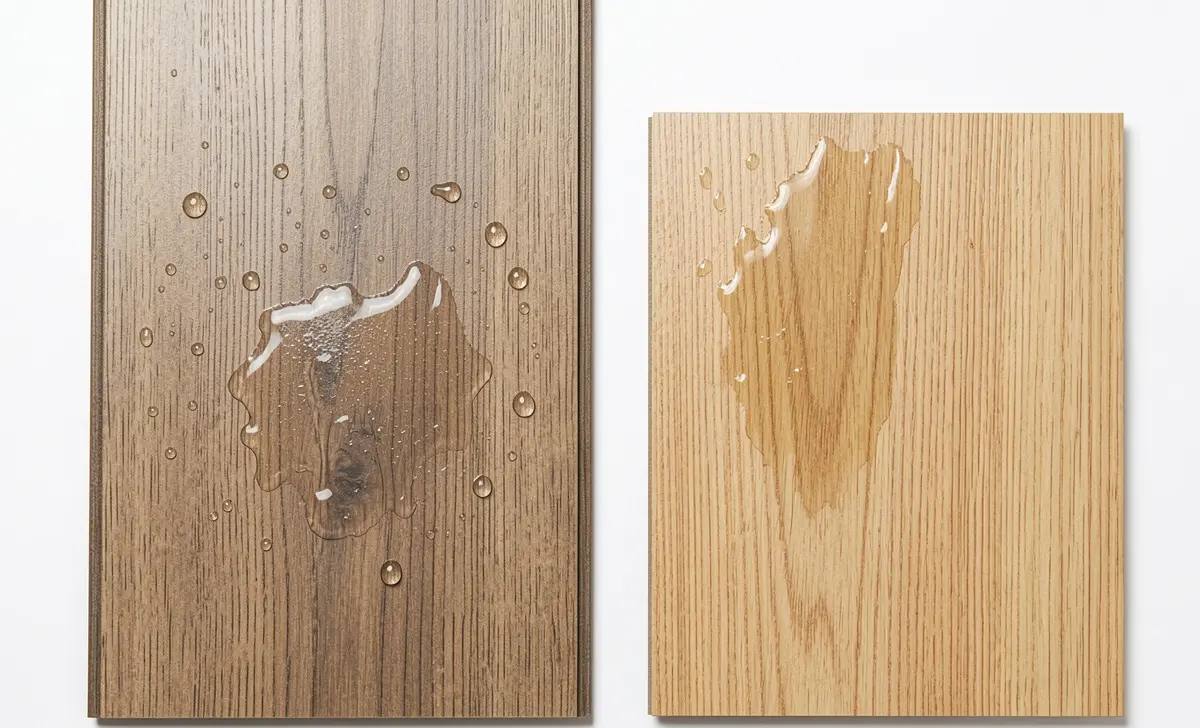
A homeowner in Ohio installed laminate flooring in her bathroom. Within eight months, the planks buckled, the subfloor warped, and she faced a $3,000 repair bill — all because the flooring was labeled “water-resistant,” not waterproof. She assumed both terms meant the same thing. They do not.
Understanding the difference between waterproof and water-resistant flooring is one of the most practical decisions you can make before a renovation. Kitchens, bathrooms, and basements all have different moisture profiles, and the wrong choice leads to structural damage that no surface cleaner can fix. Before you measure a room for flooring, you need to know exactly what you’re putting down.
In this guide, you’ll learn everything about waterproof vs water-resistant flooring — the exact difference, how each performs under moisture, and which one is right for your home.
What Is Waterproof vs Water-Resistant Flooring? (Quick Comparison Table)
| Feature | Water-Resistant | Waterproof |
|---|---|---|
| Definition | Repels moisture for a limited time | Blocks water penetration completely |
| Water Exposure Tolerance | Withstands brief spills (30–60 minutes) | Handles standing water for 24–72+ hours |
| Ideal Use Areas | Living rooms, dining rooms, low-traffic kitchens | Bathrooms, laundry rooms, basements |
| Lifespan Under Moisture | Degrades with repeated exposure | Maintains integrity long-term |
| Price Range | $1–$4 per sq ft (material only) | $2–$7 per sq ft (material only) |
What Does Water-Resistant Flooring Mean?
Water-resistant flooring is built to handle incidental moisture — not sustained exposure. It slows water absorption but does not stop it entirely.
How It Handles Spills and Moisture
Most water-resistant floors can handle a spilled glass of water if wiped within 30 minutes. After that window, moisture begins penetrating the seams and reaching the core material or subfloor beneath.
Key limitation: The surface layer resists water, but the joints and edges do not. Water that sits in seams will eventually reach the core.
Common Types of Water-Resistant Flooring
- Hardwood (treated) — Surface-sealed but vulnerable at joints; not recommended for wet zones
- Laminate (standard) — HDF core absorbs water; rated for light spills only
- Cork — Naturally repels moisture but swells with prolonged exposure
- Engineered wood (standard grade) — Performs better than solid hardwood, but still not waterproof
What Is Waterproof Flooring?
Waterproof flooring is built from materials that do not absorb water at all — either through the surface or the core. Even if water sits on it for hours, the floor itself won’t warp, swell, or buckle.
How It Handles Standing Water
Luxury Vinyl Plank (LVP) and tile are 100% plastic-based. Water cannot penetrate the core. According to manufacturer specs from Shaw Floors and LifeProof, LVP can handle standing water for 24–72 hours without damage.
Ceramic and porcelain tile have a water absorption rate below 0.5%, making them essentially impermeable. Porcelain specifically is rated Class V — the highest moisture resistance classification.
Note: Even waterproof flooring can allow water to reach the subfloor through grout lines or loose seams. Proper installation and sealing matter.
Common Types of Waterproof Flooring
- Luxury Vinyl Plank (LVP) — 100% waterproof core; most popular waterproof option
- Luxury Vinyl Tile (LVT) — Same core as LVP; mimics stone or ceramic
- Porcelain tile — Industry standard for wet areas; extremely durable
- Ceramic tile — Water absorption under 3%; suitable for most wet rooms
- WPC vinyl (Wood Plastic Composite) — Waterproof core with added cushion layer
Waterproof vs Water-Resistant Flooring: Key Differences
| Factor | Water-Resistant | Waterproof |
|---|---|---|
| Spill Resistance | Up to 30–60 minutes | 24–72+ hours |
| Humidity Performance | Can warp in high humidity | Unaffected by humidity |
| Standing Water Durability | Fails within hours | Holds up indefinitely |
| Installation Areas | Dry to low-moisture rooms | Any room, including bathrooms, basements |
| Maintenance | More sensitive to cleaning products | Easy to clean; tolerates wet mopping |
Most homeowners confuse ‘waterproof’ with ‘spill-proof,’ but subfloor damage can still occur if water finds gaps at the perimeter or transitions. Waterproof refers to the flooring material itself — not the installation system.
Which Flooring Is Best for Each Room?
Bathrooms and Laundry Rooms
These rooms have the highest moisture exposure — steam, standing water, and daily humidity fluctuations. Waterproof flooring is the only responsible choice here.
Porcelain tile and LVP are the top recommendations. Porcelain has a 20–30 year lifespan in wet applications. LVP is softer underfoot and easier to install as a DIY project.
If you’re already dealing with bathroom ceiling mold, installing the wrong flooring will only accelerate moisture damage from below.
Recommended: Porcelain tile, LVP, LVT
Kitchens and Living Areas
Kitchens see spills, but dry out between incidents. Living areas rarely encounter standing water. Both waterproof and high-quality water-resistant options can work here, depending on budget.
Recommended: LVP (waterproof), engineered hardwood with WPC core (water-resistant), ceramic tile
Basements and High-Humidity Spaces
Basements are the most demanding environment. Ground moisture, flooding risk, and persistent humidity make water-resistant flooring a liability. Only fully waterproof materials belong below grade.
LVP is the most common basement choice — it handles moisture from both above and below, installs over uneven concrete, and costs less than tile. If you have a leaking ceiling or mold issue adjacent to the space, resolve that before installing any flooring.
Recommended: LVP, LVT, epoxy-coated concrete, porcelain tile
Pros and Cons of Waterproof Flooring
Pros:
- Handles standing water without damage
- Works in all rooms, including basements and bathrooms
- Resistant to mold and mildew growth
- Low long-term maintenance cost
- Suitable for homes with pets or young children
Cons:
- Higher upfront cost than basic water-resistant options
- Vinyl and tile can feel harder underfoot than wood
- Cheaper LVP options can look less realistic than engineered hardwood
- Tile requires grout maintenance to stay fully sealed
Pros and Cons of Water-Resistant Flooring
Pros:
- Lower material cost ($1–$4 per sq ft)
- More natural appearance (hardwood, engineered wood, cork)
- More comfortable underfoot than tile or vinyl
- Good performance in dry living areas
Cons:
- Fails with prolonged moisture exposure
- Seams and edges absorb water even when the surface is treated
- Not suitable for bathrooms, laundry rooms, or basements
- Swelling and warping are often irreversible
Cost Comparison: Waterproof vs Water-Resistant Flooring
Installation Costs
| Material | Material Cost (per sq ft) | Installation Cost (per sq ft) | Total Estimate |
|---|---|---|---|
| Standard laminate (water-resistant) | $1–$3 | $2–$4 | $3–$7 |
| Engineered hardwood (water-resistant) | $3–$7 | $3–$5 | $6–$12 |
| LVP — waterproof | $2–$5 | $1.50–$3 | $3.50–$8 |
| Porcelain tile — waterproof | $2–$7 | $4–$8 | $6–$15 |
LVP typically has lower installation costs than tile because it floats over existing floors without adhesive or mortar.
Long-Term Value
Water-resistant flooring in high-moisture rooms often needs replacement within 5–10 years. Waterproof flooring in the same areas lasts 15–25 years. The upfront savings on water-resistant options are frequently erased by early replacement and subfloor repair costs.
[EXPERT PERSPECTIVE]: “I’ve pulled out laminate flooring from bathrooms that were less than two years old — destroyed by subfloor moisture. The homeowner saved $300 on materials and spent $2,500 fixing the damage. In wet rooms, always go waterproof. There’s no real argument for anything else.” — Licensed flooring contractor, 18 years experience
How to Choose the Right Flooring for Your Home
Use this checklist before purchasing:
- Is the room a wet zone? (bathroom, laundry, basement) → Choose waterproof only
- Does the room have humidity fluctuations? (kitchen, mudroom) → Choose waterproof or WPC-core vinyl
- Is the room above grade with low moisture? (living room, bedroom) → Water-resistant options are acceptable
- Do you have pets or children? → Waterproof protects against repeated accidents
- What is your budget? → LVP offers the best waterproof value at $2–$5/sq ft
- Do you want a wood look? → LVP or WPC vinyl mimics hardwood without the vulnerability
- Are you finishing a basement? → Use only waterproof; consider floating installation over concrete
Before finalizing your material choice, consult your subfloor condition. If you’re removing old paint from walls or prepping the space, address wall and surface issues before the floor goes down.
Key Takeaways — Waterproof vs Water-Resistant Flooring
- Water-resistant flooring repels brief spills; waterproof flooring blocks moisture entirely
- Water-resistant floors fail in bathrooms, laundry rooms, and basements — these rooms require waterproof materials
- LVP is the most practical waterproof option: $2–$5/sq ft, DIY-friendly, and handles 24–72 hours of standing water
- Porcelain tile is the most durable waterproof option with a 20–30 year lifespan in wet areas
- Higher upfront cost on waterproof flooring prevents far more expensive subfloor repairs later
Conclusion
Choosing the right flooring material is not just a style decision — it is a structural one. Water damage to subfloors, joists, and walls compounds over time and costs significantly more to fix than the original flooring ever did.
The wrong flooring does not fail immediately — it fails when water stays. A floor that looks fine after the first spill can be silently rotting from below for months before the damage becomes visible. Waterproof materials eliminate that risk.