
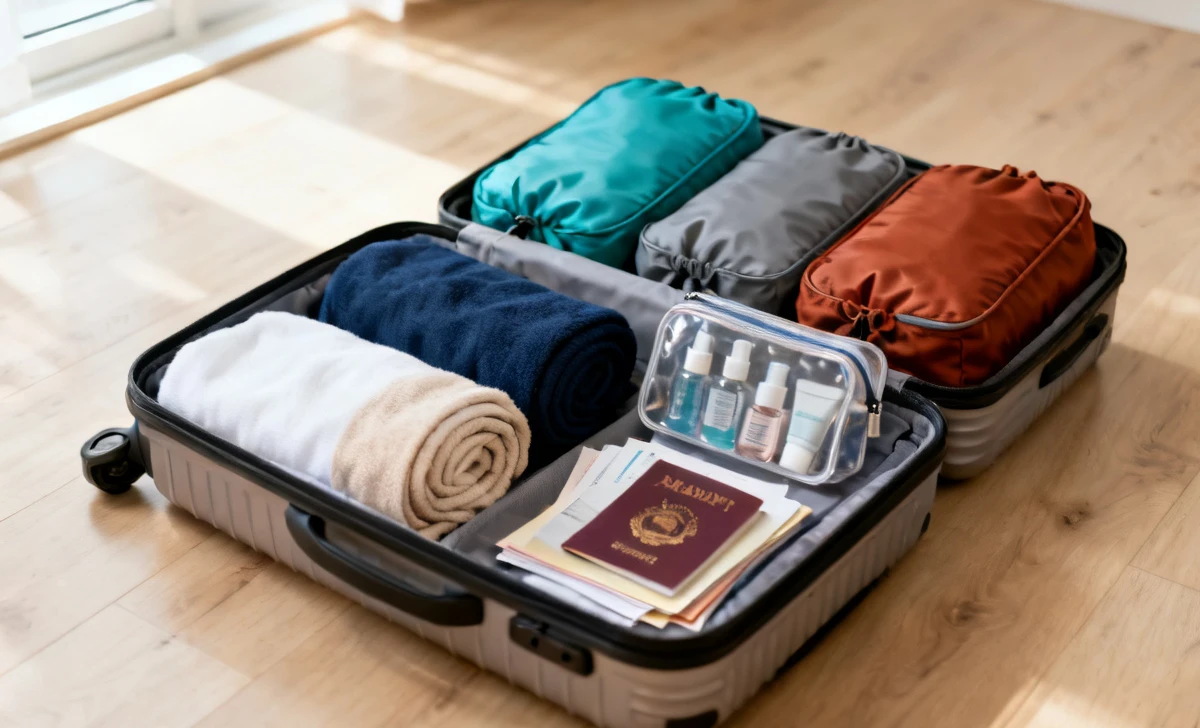
Most travelers overpack by 30–50% — yet studies show that a well-planned carry-on can handle up to two weeks of travel without a single checked bag. Airlines worldwide mishandle or lose over 26 million bags per year, meaning your luggage has a real chance of never arriving with you.
Travelers increasingly want to skip baggage fees that now average $35–$70 per checked bag per flight, avoid carousel delays, and eliminate the stress of lost luggage. A carry-on-only approach solves all three problems at once.
In this guide, you will learn how to pack a carry-on bag for a two-week trip using smart strategies, space-saving techniques, and a complete checklist — everything in one place.
Why Pack a Carry-On for a Two-Week Trip?
Traveling carry-on only saves you money, time, and stress. The benefits compound across every part of your journey — from check-in to arrival.
- Cost savings: Avoid checked baggage fees of $35–$140 round-trip on most major airlines.
- Speed: Skip the check-in line and baggage claim — you can walk off the plane and out of the airport in minutes.
- Security: Your bag never leaves your sight, eliminating theft and loss risk.
- Flexibility: Hop between cities, take last-minute trains, and navigate tight spaces without hauling a heavy checked bag.
According to SITA’s 2023 Baggage IT Insights report, the global rate of mishandled bags is 6.9 per 1,000 passengers — a risk eliminated when you go carry-on only.
What Size Carry-On Bag Do You Need? (Airline Rules Explained)
Before buying a bag, know the rules. Most major airlines follow similar carry-on size limits, but exact dimensions vary.
- Standard US carry-on dimensions: 22 x 14 x 9 inches (56 x 36 x 23 cm) — this fits most overhead bins on major carriers like Delta, United, and American Airlines.
- Budget airlines (Spirit, Ryanair, EasyJet): May enforce stricter limits — always check the airline’s website before packing.
- Weight limits: Most US carriers have no carry-on weight limit. International and budget airlines may cap it at 7–10 kg (15–22 lbs).
Pro tip: Choose a soft-sided bag over a hard shell — it can be compressed to fit tight overhead bins and has more flexibility if you overpack slightly.
The Ultimate Carry-On Packing List for 14 Days
Clothing Essentials
The goal is 7 days of outfits that mix and match — then repeat or do a quick laundry mid-trip.
- 5–6 tops (neutral colors that pair easily)
- 3 bottoms (2 pants/jeans + 1 shorts or skirt)
- 1 lightweight jacket or cardigan
- 7 pairs of underwear
- 5–6 pairs of socks
- 1 outfit for sleeping/lounging
- 2–3 pairs of shoes maximum (wear the bulkiest on the plane)
Toiletries and Personal Care
Stick to the TSA 3-1-1 rule: liquids in containers of 3.4 oz (100ml) or less, all fitting in one quart-sized clear bag.
- Travel-size shampoo, conditioner, body wash
- Toothbrush, toothpaste, floss
- Deodorant (solid preferred — no liquid limit)
- Skincare essentials (moisturizer, SPF)
- Razor, nail clippers, tweezers
- Any prescription medications (keep in original packaging)
Travel Documents and Tech
- Passport, ID, printed itinerary
- Travel insurance documents
- Credit/debit cards + small local cash
- Phone + charger + universal adapter
- Power bank (carry-on only — not allowed in checked bags)
- Noise-canceling earbuds or headphones
- Laptop or tablet (if needed)
Optional Items (Weather/Activities)
- Lightweight packable rain jacket (doubles as a windbreaker)
- Compact umbrella
- Swimwear (1 piece — quick-dry fabric)
- Foldable tote bag (for day trips, groceries, or overflow)
- Small first-aid kit (bandages, pain reliever, antacids)
How to Fit 14 Days of Clothes in a Carry-On
Rolling vs Folding (What Works Best)
Rolling beats folding for most items. It reduces wrinkles on casual clothes and can save up to 20–30% more space compared to flat folding. Roll T-shirts, jeans, casual pants, and underwear tightly. Fold only structured items like blazers or dress shirts to avoid creases.
Packing Cubes Strategy
Packing cubes are the single most effective carry-on tool — travel expert Rick Steves has recommended them for decades. Use a 3-cube system: one for tops, one for bottoms, one for underwear and socks. Compression packing cubes can reduce clothing volume by up to 60%.
Outfit Planning Method (Mix & Match)
Plan outfits before you pack — not after. Lay out every clothing item and build 10–12 outfits from 6–8 pieces. Every item must pair with at least two others. This is called the capsule wardrobe method, and it’s the core reason carry-on travel works for two weeks.
Step-by-Step Carry-On Packing System
Step 1: Choose your outfits. Plan every outfit for the trip. Lay them out physically — remove anything that doesn’t mix and match with at least two other pieces.
Step 2: Layer heavy items at the bottom. Place shoes, toiletry bag, and heaviest items at the bottom (near the wheels). This keeps your bag balanced and upright.
Step 3: Use packing cubes for clothing. Roll all clothes tightly, load into packing cubes, and compress. Stand cubes vertically inside the bag for maximum visibility and access.
Step 4: Fill dead space. Stuff socks inside shoes. Tuck small items (chargers, belts, accessories) into corners, gaps, and around cubes. Use every cubic inch.
Step 5: Final compression. Close the bag — if it’s tight, don’t force it. Remove one item. A bag that closes easily is a bag you can carry comfortably for two weeks.
Smart Packing Tips Most Travelers Miss
- Wear your bulkiest items on the plane. Heavy boots, a thick jacket, and bulky jeans worn during transit free up significant bag space.
- Limit shoes to 2–3 pairs max. One walking shoe, one casual/dressy shoe, and sandals (if needed) cover almost every scenario.
- Use solid toiletries. Solid shampoo bars, conditioner bars, and solid sunscreen bypass TSA liquid rules entirely — a lesser-known hack that frees up your entire liquids bag.
- Plan a mid-trip laundry day. One hotel sink wash or quick laundromat visit on day 7 means you only need one week of clothes for a two-week trip. Merino wool and quick-dry fabrics are ideal for this strategy.
- Pack a foldable tote. An empty foldable bag weighs almost nothing and solves overflow issues — use it for day trips, beach outings, or souvenirs.
Common Carry-On Packing Mistakes to Avoid
- Overpacking “just in case.” Every “just in case” item is a guaranteed waste of space. If you haven’t worn it in the last month, you won’t wear it on a trip either.
- Ignoring the TSA 3-1-1 liquid rule. Full-size bottles will be confiscated at security. Decant everything into 100ml or smaller containers before you travel.
- Not planning outfits. Packing random clothes without a plan leads to over-packing and under-dressing. Plan first, pack second — always.
- Forgetting airline-specific rules. Low-cost carriers often have smaller size limits or charge for carry-on bags above a personal item. Check every airline’s policy before you arrive at the gate.
What to Do If You Run Out of Space
If your bag won’t close, don’t panic — work through this process systematically.
- Remove duplicates first. Do you have two similar tops? Three pairs of socks more than needed? Duplicate items are the #1 cause of overpacking.
- Repack using compression. Unpack everything and re-roll clothes tighter. Reload packing cubes and use compression straps. A chaotic repack often reveals 20–30% more space.
- Buy it at your destination. Toothpaste, shampoo, sunscreen — these are available everywhere. Skip packing full-sized toiletries and buy locally. This alone can free up significant baggage space.
- Wear more on the plane. Put on your heaviest outfit and carry your thickest jacket. You can take it all off once you board.
Key Takeaways — Pack Smart, Travel Light
- Pack 7 days of mix-and-match clothes and plan a mid-trip laundry — that’s all you need for 14 days.
- Choose a bag that meets the 22 x 14 x 9 inch standard limit and always verify with your specific airline.
- Use rolling + packing cubes + the capsule wardrobe method — these three habits solve 90% of packing problems.
- Wear bulky items on the plane, use solid toiletries, and pack a foldable tote to maximize space.
- Always plan outfits before packing — never after.
Conclusion
Smart carry-on packing is a skill that reflects how modern travelers think — efficiency over excess, experiences over stuff. Minimalist packing isn’t about sacrifice; it’s about freedom from the friction that slows most trips down.
As the saying goes: “The less you pack, the more freedom you carry.” A lighter bag means faster movement, lower costs, and more headspace for the trip itself.
What’s your go-to carry-on packing hack? Share it in the comments — the best tips always come from travelers who’ve figured it out the hard way.