
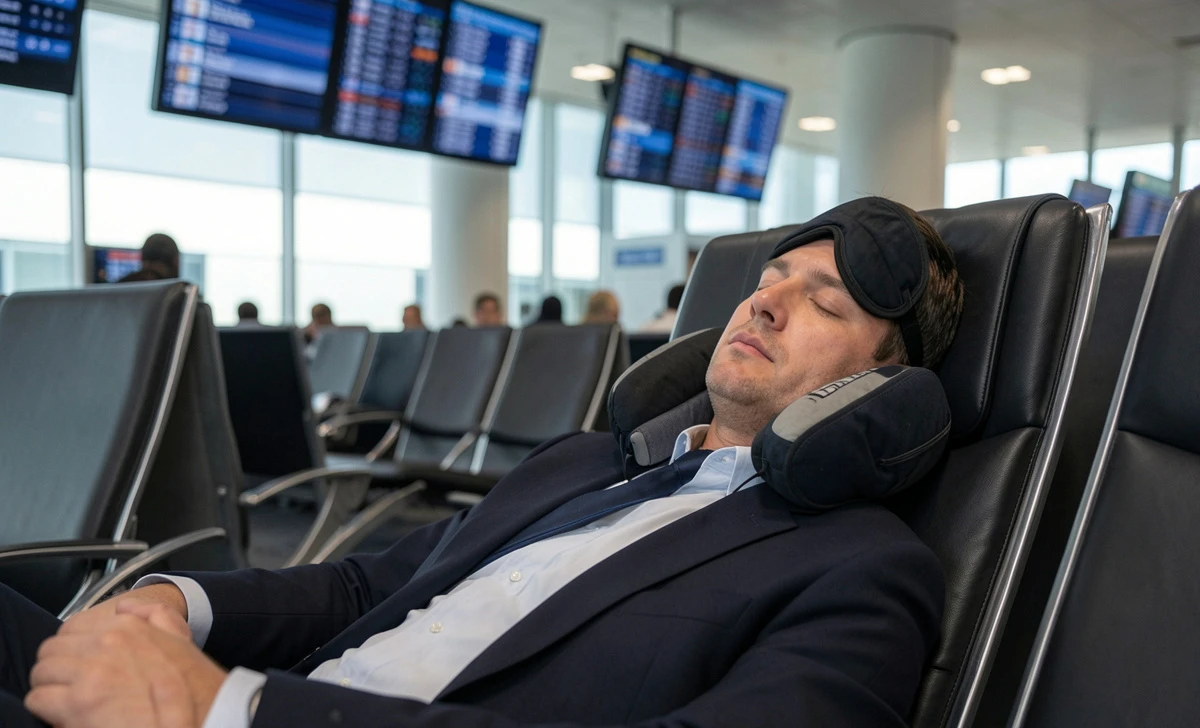
Most travelers assume that reclining in a premium airport lounge guarantees recovery between flights. But here’s what the science actually shows: fragmented lounge sleep can leave your body in a worse hormonal state than no sleep at all. Bright overhead lighting, constant PA announcements, and recliner posture actively suppress the deep sleep stages your brain needs to reset.
Airport lounges were designed for comfort and carry-on convenience — not sleep recovery. Despite plush seating and quiet corners, most lounges fail to deliver the environment your body requires during a long layover. The result is airport lounge sleep fatigue — a cycle of disrupted rest that deepens exhaustion instead of relieving it.
In this guide, you’ll learn why airport lounge sleep can backfire, what causes travel fatigue during layovers, and smarter alternatives for recovering between flights.
What Is Airport Lounge Sleep Fatigue?
Airport lounge sleep fatigue refers to the exhaustion and cognitive impairment that follows low-quality sleep taken in airport lounge environments. It is not simply tiredness — it is the physiological result of sleep that fails to progress through the full sleep cycle.
Restorative sleep requires uninterrupted cycles of NREM stages 1–3 and REM sleep, each lasting roughly 90 minutes. A lounge nap broken by noise, light, or discomfort rarely completes even a single full cycle. The body enters light sleep, begins descending toward deep sleep, and then gets pulled back to wakefulness. This incomplete cycle increases sleep debt rather than clearing it.
Why Do Travelers Sleep in Airport Lounges?
Long Layovers and Delayed Flights
Layovers exceeding four hours, combined with overnight delays, push travelers toward any available rest surface. A 2023 survey by the Global Business Travel Association found that 61% of frequent flyers attempt to sleep during layovers longer than five hours. With limited hotel options near terminals and high short-stay rates, the lounge becomes the default choice.
Lounges Feel Safer and More Comfortable
Compared to gate seating or terminal floors, lounges offer perceived safety, controlled access, and softer furniture. Travelers with lost luggage concerns or unfamiliar transit airports particularly gravitate toward lounge spaces as a secure holding zone. The psychological comfort is real, but the sleep quality rarely matches the expectation.
Why Sleeping in Airport Lounges Can Worsen Travel Fatigue
Recliner Sleep Disrupts Natural Sleep Cycles
Airport lounge chairs are engineered for alert relaxation, not deep sleep. Even fully reclined seats maintain a slight incline that increases muscle micro-tension in the neck, lower back, and hips. This residual tension triggers micro-awakenings — brief, often unremembered arousals that fragment sleep architecture. A 2022 study in the Journal of Sleep Research confirmed that sleeping in non-flat positions increases arousal frequency by up to 40% compared to horizontal sleep.
Noise and Lighting Interrupt Deep Sleep
Repeated sound interruptions above 45 decibels reduce deep sleep quality by nearly 30%, according to a 2024 sleep environment study. Most international airport lounges operate at ambient noise levels between 55 and 70 decibels — well above the threshold for sleep disruption. Simultaneously, the blue-enriched white lighting used in modern lounges actively delays melatonin production. Blue-wavelength light (450–490 nm) suppresses melatonin secretion for up to 90 minutes after exposure, making it physiologically difficult to enter deep sleep stages even when the body is exhausted.
Constant Announcements Increase Stress Hormones
Gate announcements, boarding calls, and lounge service updates broadcast at irregular intervals — precisely the pattern most damaging to sleep. Unpredictable noise spikes activate the amygdala’s threat-detection system, triggering brief cortisol surges. Over a two-hour rest period, repeated activations accumulate into measurable cortisol elevation, leaving travelers more physiologically stressed after the nap than before it.
Interrupted Sleep Makes Jet Lag Worse
Incomplete sleep cycles fail to consolidate circadian rhythm anchoring — the process by which sleep reinforces your body clock. When travelers land after a disrupted lounge nap, their circadian system receives contradictory signals: partial sleep pressure relief combined with unresolved sleep debt. Dr. Matthew Walker, sleep neuroscientist and author of Why We Sleep, has noted that fragmented sleep is neurologically inferior to consolidated short sleep, as it prevents the synaptic pruning and memory consolidation that occur during uninterrupted REM.
What Happens to Your Body During Poor Layover Sleep?
Reduced REM Sleep
REM sleep — the stage responsible for emotional regulation, memory processing, and cognitive recovery — requires prior deep sleep to activate. Lounge interruptions almost always abort the sleep cycle before REM is reached. Travelers denied REM report impaired decision-making, heightened irritability, and reduced reaction speed — all dangerous states for onward travel and navigation.
Increased Cortisol Levels
Cortisol, the primary stress hormone, follows a natural diurnal curve — lowest during night sleep, peaking in early morning. Disrupted lounge sleep decouples this rhythm, producing abnormally elevated nighttime or mid-layover cortisol. Elevated cortisol increases heart rate, suppresses immune function, and amplifies the perception of fatigue.
Brain Fog and Dehydration
Airport cabin air runs at humidity levels between 10–20% — far below the 40–60% optimal for respiratory comfort. During lounge sleep, mouth breathing accelerates moisture loss. Combined with reduced water intake during rest periods, this produces mild dehydration that manifests as brain fog, headache, and difficulty concentrating upon waking — symptoms frequently misattributed to jet lag alone.
Are Airport Sleep Pods Better Than Lounges?
Privacy and Noise Control
Sleep pods — available at airports including Helsinki Vantaa, Munich, and Dubai International — provide enclosed, darkened, near-horizontal sleep surfaces with acoustic insulation. Unlike open lounge chairs, pods eliminate visual stimulation and reduce ambient noise to below 40 decibels in most units. This environment is physiologically compatible with light restorative sleep cycles.
Cost vs Recovery Value
Pod rentals typically range from $15–$40 per hour, compared to lounge day passes averaging $50–$80 for unlimited access. For a targeted 90-minute recovery nap, a pod offers superior physiological value per dollar. Travelers prioritizing cognitive recovery over lounge amenities should consider pods a medical-grade investment rather than a luxury upgrade.
Best Alternatives to Sleeping in Airport Lounges
Airport Hotels
Transit hotels within terminals — such as the Yotel at Amsterdam Schiphol or the Aerotel at London Heathrow — offer horizontal beds, blackout curtains, and full noise isolation. For layovers exceeding six hours, a four-hour hotel room often costs less than the combined productivity loss from poor lounge sleep. Similarly, travelers researching cheap vs. expensive hotel options at their destination should apply the same value analysis to transit accommodation.
Sleep Pods and Nap Rooms
As noted above, pods offer the best lounge-adjacent recovery option. Several airlines, including Finnair and Lufthansa, have begun integrating nap room partnerships into their premium lounge offerings as part of 2025–2026 passenger wellness initiatives.
Strategic Walking and Light Exposure
Fifteen to twenty minutes of brisk walking through terminal concourses elevates core body temperature and promotes adenosine clearance — the neurochemical responsible for sleep pressure. Following walking with controlled exposure to natural daylight (or broad-spectrum lighting) helps re-anchor circadian rhythms disrupted by transmeridian travel.
Proper Hydration and Meal Timing
Drinking 500ml of water per hour of layover counteracts the dehydrating effects of low-humidity terminal air. Avoiding heavy meals within two hours of intended sleep prevents digestive activity from raising core body temperature and delaying sleep onset.
Long Layover Sleep Tips That Actually Work
- Set a 90-minute sleep alarm — aligning rest with one complete sleep cycle avoids waking mid-deep-sleep (sleep inertia)
- Use a sleep mask and earplugs or noise-cancelling headphones — reduces lounge stimulus below the disruption threshold
- Recline fully and elevate feet if possible — reduces lower-body venous pooling and decreases micro-tension
- Avoid caffeine within six hours of intended sleep — caffeine’s half-life of 5–6 hours significantly delays sleep onset
- Choose a lounge corner position facing away from foot traffic — reduces visual startle responses during light sleep
- Apply melatonin (0.5–1mg) 30 minutes before rest — particularly effective for overnight layovers across multiple time zones
What Frequent Travelers Say About Airport Lounge Sleep
Veteran business travelers increasingly report choosing 90-minute pod rentals over full lounge access when cognitive performance on arrival is a priority. Aviation wellness consultant Cristina Roca, who advises airlines on passenger recovery design, noted in a 2025 industry brief that “most premium lounge environments were designed around 1990s concepts of comfort — not the sleep science we now understand governs recovery.”
Airline lounge design in 2025–2026 is shifting accordingly. Singapore Airlines’ Changi Terminal 3 SilverKris Lounge now features a dedicated quiet sleep zone with adjustable ambient lighting and horizontal day beds — a direct response to traveler feedback on lounge sleep inadequacy. Several Gulf carriers are piloting biometric sleep quality trackers in premium lounges to gather recovery data.
One lesser-known insight most travel blogs miss: lounge chair armrests physically prevent the lateral sleep position — the posture most conducive to glymphatic brain waste clearance during sleep. This architectural constraint alone significantly limits the neurological recovery value of even the most comfortable lounge chair.
Key Takeaways — Should You Sleep in an Airport Lounge?
Airport lounges offer comfort and security — but not restorative sleep. For layovers under three hours, controlled rest with sleep accessories in a lounge is acceptable. For layovers exceeding four hours where cognitive performance matters, sleep pods, transit hotels, or structured rest protocols deliver measurably better recovery outcomes.
The science is clear: incomplete sleep cycles increase cortisol, suppress REM, and worsen jet lag. Choosing recovery quality over lounge convenience is not a luxury — it is a physiological strategy for arriving functionally.
Final Thoughts
Airport lounge sleep fatigue reveals a fundamental tension in modern travel culture: the assumption that premium comfort equals genuine recovery. As flight networks expand and open-jaw flight itineraries create increasingly complex layover patterns, the quality of inter-flight rest will define how well travelers actually arrive — not just how far they’ve flown.
The most expensive lounge chair in the world cannot replace 90 uninterrupted minutes of horizontal sleep.