
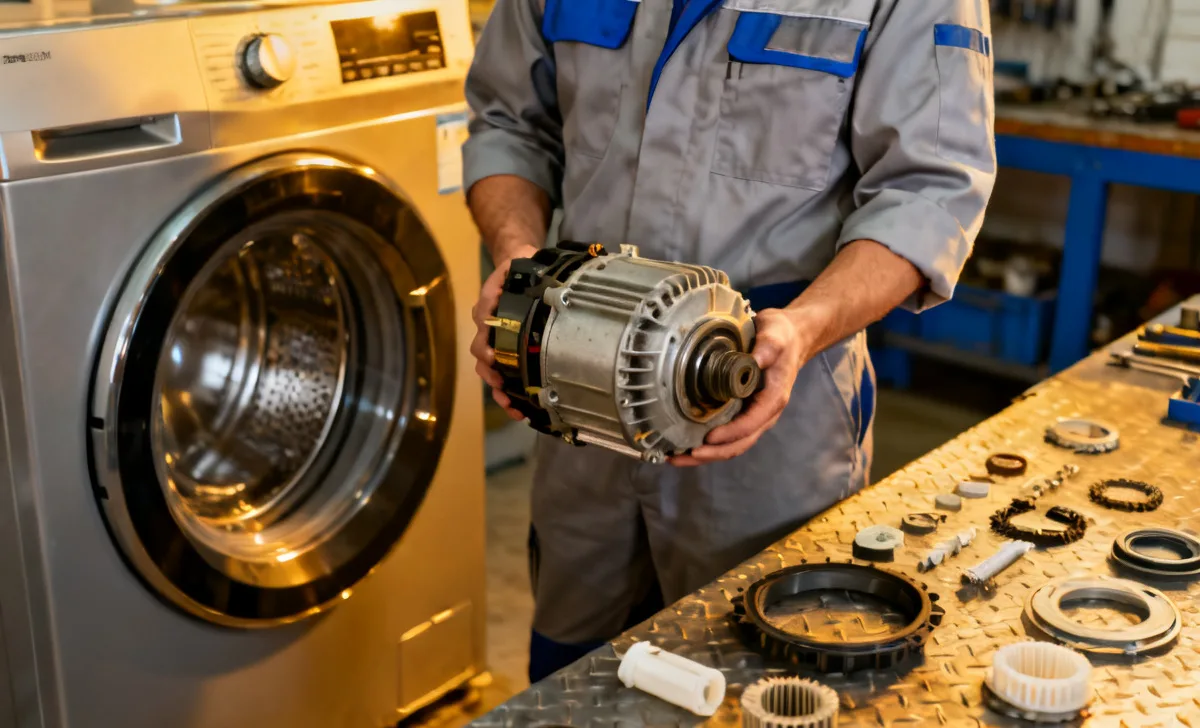
Imagine your washing machine stops working on a Sunday night with a full load of laundry inside. You call a technician, and they tell you the part needed is no longer made — or it will take three weeks to arrive from overseas. So you end up buying a brand-new machine, not because the old one was beyond saving, but because the system made repair impossible. That frustration is something millions of homeowners deal with every year.
For decades, getting a home appliance repaired has been harder than it should be. The core problem is simple: appliance brands manufacture parts that only work with their own products. A motor built for a Whirlpool washing machine will not fit an LG. A pump designed for a Bosch dishwasher cannot be swapped into a Samsung. This lock-in strategy has kept repair costs high, parts hard to find, and consumers with little choice but to replace appliances that still had years of usable life. Over 60% of appliances are replaced instead of repaired, not because they cannot be fixed, but because the parts are unavailable or too expensive to source.
That is starting to change. In this article, you will find a complete breakdown of the new standardized appliance spare parts agreement, which brands are on board, which appliances benefit first, what the real cost impact looks like, and what you should do right now if an appliance breaks before full rollout arrives.
What Are Standardized Spare Parts for Appliances?
A growing number of major appliance manufacturers have agreed to standardize key components — motors, filters, pumps, and electronic control boards — so the same part can work across multiple brands.
This is a direct response to the global Right to Repair movement, which pushes companies to design products that can actually be fixed by independent technicians, not just brand-authorized service centers. The logic is straightforward: if a pump that fails in 40% of dishwashers is built to the same spec across brands, it can be mass-produced cheaply, stocked locally, and installed by any competent technician in hours rather than weeks.
The shift does not mean every component in every appliance becomes universal overnight. The first phase targets high-failure parts — the components most likely to break and most often responsible for appliances being scrapped prematurely.
Why Repairs Have Been So Difficult Until Now
The repair problem has three layers.
Parts get discontinued too fast. Most manufacturers stop producing spare parts for a model within 5 to 7 years of its release. For an appliance that should reasonably last 12 to 15 years, that is a problem. The appliance still works fine except for one failing component, but that component no longer exists in the supply chain.
Brand exclusivity inflates prices. When only one manufacturer produces a specific part, they set the price with no competition. A control board that might cost $15 to produce can retail for $120 or more because there is no alternative.
Technicians cannot stock what does not exist. Independent repair shops thrive on keeping common parts in inventory. When parts are brand-specific and hard to source, local technicians cannot do same-day repairs. This drives consumers toward brand service centers with long wait times and higher labor charges.
If your home has other repair challenges — like bathroom ceiling mold removal — you already know how the cost of specialized work adds up fast. Appliance repair has followed the same pattern.
Which Brands Have Signed On?
Several major global manufacturers are actively participating in the standardization effort:
- Whirlpool
- LG
- Samsung
- Bosch
- Electrolux
These companies are working with international manufacturing bodies to align component specifications. The EU is moving fastest, pushed by strict repair legislation that requires manufacturers to keep parts available for minimum periods and provide repair documentation to independent technicians.
Not every brand has fully committed, and full standardization across all product lines is still years away. But the participation of these five alone covers a large share of the appliances currently in homes across North America, Europe, and Asia.
When Will Standardized Parts Actually Arrive?
The rollout follows a staged timeline:
2025: Initial agreements finalized, pilot programs launched in select markets.
2026: Early adoption in washing machines and refrigerators. Some standard parts begin appearing in independent repair supply chains.
2027–2028: Wider rollout across dishwashers and kitchen appliances. Repair costs begin dropping noticeably in markets with strong independent technician networks.
The EU is ahead of this curve. Repair legislation passed in recent years already requires manufacturers in member states to supply spare parts for 7 to 10 years after a product’s release and to make repair manuals available to non-authorized technicians.
Which Appliances Benefit First?
Standardization is rolling out by category based on repair demand and the availability of common failure points.
First wave (2026):
- Washing machines
- Refrigerators
- Dishwashers
Later phases (2027 and beyond):
- Air conditioners
- Microwaves
- Smart kitchen appliances
Washing machines are the priority because they have the highest repair request volume and the most clearly identifiable common failure parts — pumps, door seals, control boards, and bearings.
Will Repairs Get Cheaper?
Yes, and the savings are expected to be substantial.
| Factor | Before Standardization | After Standardization |
|---|---|---|
| Spare Part Cost | High, brand-specific markup | Lower, competitive supply |
| Wait Time | Days to weeks | Same day or 1–2 days |
| Technician Access | Often limited to brand centers | Any independent technician |
Industry estimates put the cost reduction at 20% to 40% by 2027 for categories covered by the first wave. The savings come from three places: competitive part pricing, faster repairs requiring less labor time, and the ability to use local independent technicians rather than expensive brand service networks.
For a washing machine repair that currently costs $300 to $400 at a brand service center, that could mean paying $180 to $240 once standardized parts are widely available, for the same fix.
What to Do If Your Appliance Breaks Right Now
Full standardization is still rolling out. If something breaks today, here is a practical approach:
Check your warranty first. If the appliance is under manufacturer or extended warranty, you may get the repair covered at no cost, regardless of the parts situation.
Ask about compatible third-party parts. Many technicians already use aftermarket components for common repairs. These are not always inferior — for motors, pumps, and filters, third-party parts often match or exceed OEM quality.
Compare the repair cost to the replacement cost honestly. A rough rule: if repair costs more than 50% of the replacement price and the appliance is over 8 years old, replacement may make more sense. Under 8 years, almost always repair.
Buy repair-friendly brands going forward. When purchasing new appliances, ask the retailer or manufacturer directly: “Are spare parts available for at least 10 years after purchase?” Brands committed to the standardization effort are more likely to say yes.
Key Takeaways
- Major brands, including Whirlpool, LG, Samsung, Bosch, and Electrolux, are standardizing key spare parts
- The first wave covers washing machines, refrigerators, and dishwashers by 2026
- Repair costs are projected to fall 20–40% by 2027
- Independent technicians will be able to handle more repairs without brand authorization
- Full rollout across all appliance categories will take until 2028 or beyond
- The EU is ahead of other regions due to existing repair legislation
Conclusion
The appliance industry is moving — slowly but clearly — away from a replace-first model. Standardized parts will not fix everything overnight, but for homeowners who have watched perfectly repairable machines get scrapped because a $30 pump was unavailable, this is a real and meaningful shift. Fix more, replace less.