
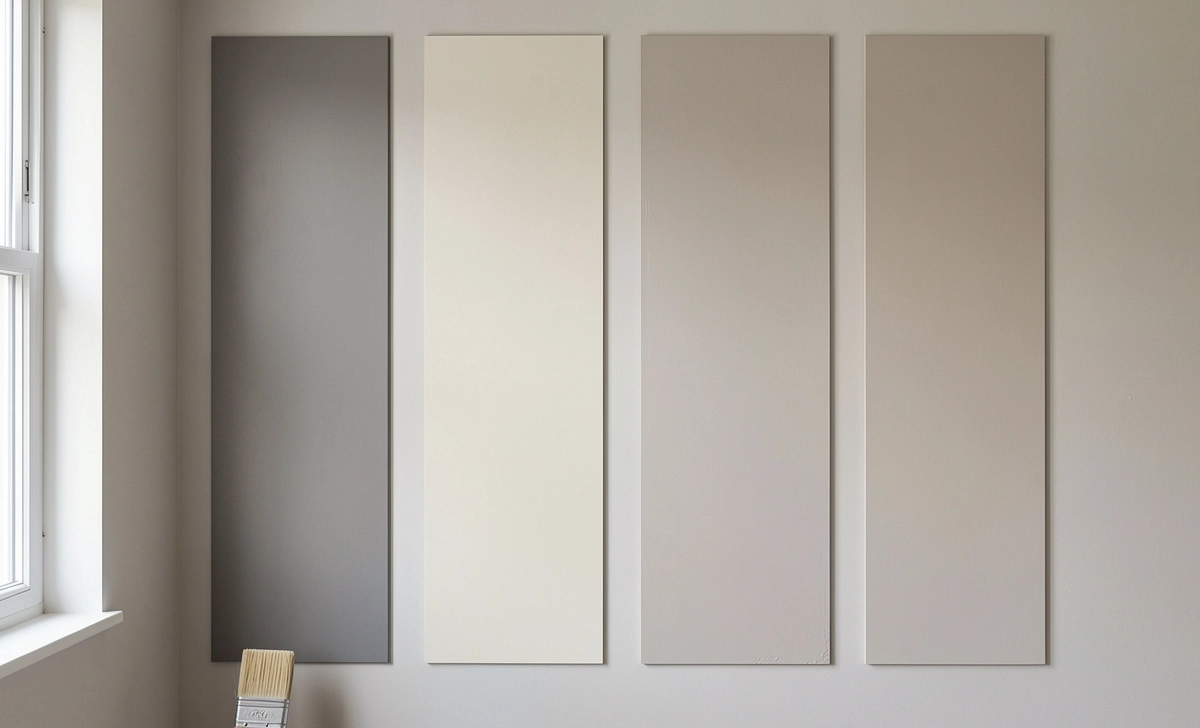
Most people pick a paint color first, but the finish is what decides how your walls actually look after a month.
Many homeowners feel confused when choosing the right paint finish for rooms throughout their home — flat, eggshell, satin, and semi-gloss all look similar on a paint chip, but perform very differently on your walls. The wrong choice leads to visible stains, difficult cleaning, and walls that show every scuff and mark. Before you even open a color swatch, understanding paint finish is the decision that protects your investment.
In this guide, you will learn how to choose the right paint finish for every room, with durability comparisons, real use cases, and recommendations backed by professional painters.
What Are Paint Finishes?
A paint finish refers to the level of sheen or shine that a dried coat of paint reflects. Two walls painted the same color will look and perform very differently depending on the finish applied.
Here is a quick comparison to orient you before going deeper:
| Finish Type | Shine Level | Durability | Best For |
|---|---|---|---|
| Flat/Matte | No shine | Low | Ceilings, low-traffic rooms |
| Eggshell | Low sheen | Medium | Living rooms, bedrooms |
| Satin | Soft shine | High | Kitchens, hallways |
| Semi-Gloss | Noticeable shine | Very high | Bathrooms, trims |
| Gloss | High shine | Maximum | Doors, cabinets |
Each finish is a deliberate tradeoff between appearance and function. None of them is universally “best” — the right one depends entirely on where and how you use the space.
Why Does Paint Finish Matter in Every Room?
Paint finish affects three things directly:
Durability — How well the surface resists scuffs, stains, and repeated contact. Higher sheen finishes form a harder surface film that holds up to impact and moisture far better than flat paints.
Cleanability — How easily you can wipe dirt, grease, or crayon marks off a wall without damaging the paint beneath. A flat finish absorbs liquid rather than repelling it, which makes scrubbing nearly impossible without leaving a dull patch.
Light reflection — How bright or textured your walls appear. Satin and semi-gloss finishes reflect more ambient light, which makes a room feel larger and airier. The tradeoff is that sheen also amplifies every dent, crack, or patch on the wall surface.
According to Sherwin-Williams, higher sheen paints last up to 40% longer in high-traffic areas compared to flat finishes. That difference compounds over the years, particularly in hallways and kitchens.
One area where surface preparation becomes especially important is removing old paint from walls before applying a new finish — a rough or flaking substrate will ruin even the best paint job, regardless of the finish chosen.
What Are the Different Types of Paint Finishes?
Flat / Matte Finish
Flat paint has zero shine. It scatters light in all directions, which makes imperfections on a wall surface nearly invisible. This is why most professional painters use it on ceilings and on older walls that have been patched or repaired.
Best for: Ceilings, low-traffic bedrooms, formal dining rooms, and feature accent walls.
The downside: Flat paint has almost no resistance to moisture or abrasion. Attempts to scrub it typically strip the paint film, leaving a lighter spot. Use it only where the walls receive minimal contact.
Eggshell Finish
Eggshell has a very slight sheen — roughly the visual texture of the surface of an egg, hence the name. It is noticeably more durable than flat paint and tolerates light cleaning without damage.
Best for: Living rooms, adult bedrooms, dining areas.
It sits in a practical middle ground between appearance and performance. The low sheen does not amplify wall imperfections the way satin or gloss does, but it offers enough surface hardness to survive everyday life.
Satin Finish
Satin is one of the most widely used finishes in residential painting. It has a smooth, soft shine that reads as clean and fresh without looking plastic or clinical. More practically, it resists moisture and repels stains far better than flat or eggshell finishes.
Best for: Hallways, kids’ rooms, kitchens, laundry rooms.
According to Behr Paint, satin finishes are 30% easier to clean than eggshell. That matters enormously in spaces like children’s bedrooms or mudrooms, where walls take a daily hit.
Semi-Gloss Finish
Semi-gloss reflects light strongly and forms a hard, moisture-resistant surface. It is the standard choice for any surface that gets wet regularly or requires frequent wiping.
Best for: Bathrooms, kitchen cabinets, trim, window frames, doors.
The higher shine level means wall flaws are more visible under direct light. This makes surface preparation more important when using semi-gloss on large wall areas. On trim and doors, that is rarely a concern because the surfaces are typically smooth from the factory.
Gloss Finish
Gloss paint is the most reflective and hardest finish available. It forms an almost glass-like surface that holds up to repeated contact, moisture, and cleaning.
Best for: Furniture, cabinetry, decorative architectural elements, exterior doors.
It highlights every imperfection on a surface, so application quality matters significantly. On furniture and cabinets, where surfaces are machine-sanded smooth, this is not usually an issue.
How to Choose the Right Paint Finish for Every Room
A single rule covers most decisions: more traffic means higher sheen.
Ask yourself these three questions before selecting a finish:
- Will this wall get dirty or be touched frequently?
- Is there moisture in this room — steam, condensation, or splashing?
- Are the walls smooth, or do they have patches, cracks, and imperfections?
If the answer to questions one or two is yes, move up the sheen scale. If the answer to question three is yes, move down the scale.
Quick decision guide:
- Low traffic → Flat or Eggshell
- Medium traffic → Eggshell or Satin
- High traffic → Satin or Semi-Gloss
- High moisture → Semi-Gloss or Gloss
Room-by-Room Paint Finish Guide
Living Room — Eggshell
Living rooms are used regularly but do not face the same abuse as kitchens or bathrooms. Eggshell provides a soft, refined look and enough durability to handle occasional cleaning. It does not reflect light aggressively, which keeps the space feeling warm rather than sterile.
Bedroom — Flat or Eggshell
Adult bedrooms are low-traffic by nature. Flat paint works well here because walls rarely need cleaning, and the non-reflective surface creates a calm, restful atmosphere. For children’s bedrooms, move up to satin — fingerprints and scuffs are a certainty.
Kitchen — Satin or Semi-Gloss
Kitchens generate grease, steam, and splatter every time you cook. Flat and eggshell finishes absorb grease rather than repelling it, making them almost impossible to clean without removing the paint itself. Satin handles everyday cooking well. Semi-gloss is the better call for kitchens that see heavy use.
Bathroom — Semi-Gloss
Bathrooms are the most moisture-intensive rooms in the house. Hot showers drive condensation onto every surface, and standing moisture promotes mold growth. Semi-gloss repels water effectively and tolerates repeated cleaning without breaking down. For a full approach to moisture-related wall problems, the process of leaking ceiling mold repair shares useful context on what happens when moisture goes unchecked inside walls.
Hallways and Corridors — Satin
Hallways take constant contact — shoulders brushing walls, hands touching surfaces at the light switch, luggage scraping the baseboards. Satin is the correct choice. It stands up to daily abrasion and wipes clean without streaking or patching.
Ceilings — Flat
Ceilings are almost universally painted flat. They rarely get touched, so durability is not a concern. More importantly, a flat ceiling finish hides the minor texture variations and patch marks that are nearly impossible to eliminate. Using a sheen finish on a ceiling creates glare under lighting and makes every surface imperfection visible from below.
Doors and Trim — Semi-Gloss or Gloss
Trim, door frames, and baseboards are in constant contact. They also need to contrast with the walls visually to give the room definition. Semi-gloss or gloss finishes hold up to repeated cleaning, resist chipping better than flat paint on hard edges, and provide a crisp visual contrast against eggshell or satin walls.
Common Mistakes to Avoid When Choosing Paint Finish
Using flat paint in high-traffic areas. This is the most common error. Flat paint in a kitchen, hallway, or child’s room will stain permanently and resist every attempt to clean it.
Applying gloss on uneven walls. High sheen amplifies surface imperfections. If your walls have patches, skim coat them smooth first, or select a lower sheen finish that hides the variation.
Ignoring lighting conditions. A north-facing room with little natural light will look dark and flat with a matte finish. A south-facing room with strong sunlight will look harsh and washed out with semi-gloss on every wall. Adjust your finish choice based on how much light the room actually receives.
Using the same finish throughout the entire house. Different rooms have different demands. A single finish throughout feels like a shortcut and performs poorly in at least some of the rooms. Treat each space as a separate decision.
Skipping surface preparation. No finish performs well on a damaged surface. Cracks, loose paint, and gaps around fixtures all affect how the final coat looks and how long it lasts. Addressing window gaps and sealing before painting is one example of the kind of preparation that prevents problems from showing through a fresh coat.
What Paint Finish Do Professionals Recommend?
Professional painters follow a consistent pattern across most residential projects:
- Eggshell for the majority of interior walls
- Satin for kitchens, hallways, kids’ rooms, and any high-use area
- Semi-gloss for bathrooms, trim, and doors
- Flat for ceilings exclusively
According to Benjamin Moore’s painting experts, satin and eggshell finishes offer the best balance of appearance and durability for most homes. They avoid recommending gloss for large wall areas in typical residential settings because surface preparation requirements are difficult to meet consistently across wide surfaces.
The professionals also note that primer matters as much as finish. Applying a quality primer before the topcoat improves adhesion, coverage, and how uniformly the finish sheen appears once dry.
Key Takeaways
- Flat paint hides imperfections but stains permanently and cannot be scrubbed.
- Eggshell balances a clean appearance with enough durability for most living spaces.
- Satin is the right call for busy rooms — it resists moisture and cleans without damage.
- Semi-gloss handles moisture, cleaning, and heavy contact — use it in bathrooms, on trim, and on doors.
- Gloss is maximum durability and sheen — best reserved for cabinets, furniture, and accent elements.
- The right finish depends on how you use the room, not on the color you want to paint it.
Choosing the right paint finish is not about trends. It is a practical decision that determines how your walls perform for years. A good finish in the right room saves hours of cleaning, extends repainting cycles, and makes the space easier to live in.
If you are planning a broader refresh of a room, it is also worth measuring the room accurately for flooring at the same stage — tackling both paint and flooring together reduces disruption and lets you plan materials with the full picture in mind.