
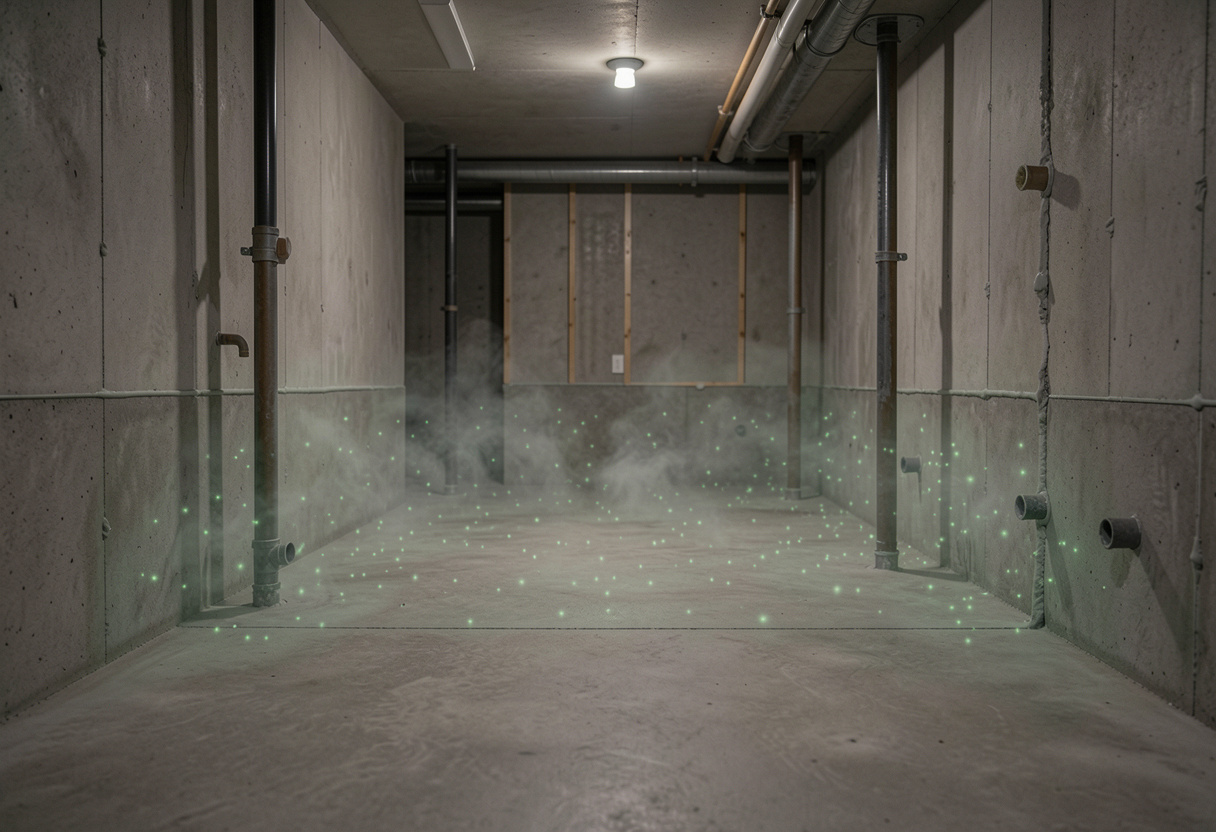
Most homeowners seal gaps and caulk cracks to cut energy bills — but home sealing radon gas buildup is a real and largely ignored consequence of this trend. Radon is a colorless, odorless radioactive gas that seeps up from soil beneath your home. When you reduce natural air exchange by tightly sealing your house, radon has fewer exit routes and concentrates indoors.
The EPA links it to roughly 21,000 lung cancer deaths every year in the United States — and a sealed home can push your exposure levels 2–3 times higher than a drafty older structure.
This guide covers how the buildup happens, how to test for it, and how to weatherproof your home without putting your family at risk.
What Is Radon Gas and Why Is It Dangerous?
Radon is a naturally occurring radioactive gas produced by the decay of uranium in soil, rock, and water. It’s invisible and odorless — making it impossible to detect without testing.
Where Radon Comes From
Radon enters homes through cracks in foundations, gaps around pipes, construction joints, and crawl spaces. The EPA reports that nearly 1 in 15 U.S. homes has elevated radon levels at or above the action level of 4 picocuries per liter (pCi/L).
Once radon enters your home, it can accumulate to dangerous concentrations — especially in lower levels like basements and crawl spaces where air circulation is limited.
Health Risks Linked to Radon Exposure
“Radon is a radioactive gas that can cause lung cancer,” according to the U.S. Environmental Protection Agency. It is the second-leading cause of lung cancer in the United States after smoking.
Long-term exposure to elevated radon levels significantly increases lung cancer risk. The American Lung Association warns that smokers exposed to radon face an even higher combined risk, making early detection and mitigation essential for every household.
Can Sealing Too Many Gaps in a Home Increase Radon Levels?
Yes — and this is one of the most overlooked risks in modern energy-efficient home improvement. Tightly sealed homes create conditions that trap soil gases indoors.
How Air Pressure Changes Inside a Tightly Sealed House
When you heavily seal a home, you reduce natural air infiltration. This creates negative indoor air pressure — the house essentially becomes a vacuum that pulls soil gases, including radon, upward from the ground.
Building scientists explain this as the “stack effect”: warm interior air rises and escapes through upper gaps, drawing in replacement air (and radon) from below. A tightly sealed home with no planned ventilation intensifies this process.
Why Radon Gets Trapped Indoors
In older, drafty homes, radon dilutes quickly because fresh air constantly enters through unintentional gaps. Sealed modern homes can concentrate radon at levels 2–3 times higher than comparable older structures.
Without a proper ventilation strategy, every caulk gun you use to block a gap could be reducing radon’s only exit route.
What Happens When You Over-Caulk a Home?
Over-caulking is a common DIY mistake. Homeowners focused on energy savings often seal far more than necessary — and in doing so, compromise indoor air quality.
Common Home Weatherproofing Mistakes
- Sealing all basement wall cracks without installing a radon mitigation system first
- Caulking around utility pipe penetrations without checking radon entry points
- Blocking soffit vents or attic ventilation in the name of energy efficiency
- Sealing crawl spaces without proper mechanical ventilation
Leaking ceilings and mold are commonly addressed with aggressive sealing — but the same approach applied to radon entry points can significantly worsen indoor air quality.
Areas Homeowners Often Seal Incorrectly
| Area | Common Mistake | Safer Approach |
|---|---|---|
| Basement walls | Sealing all cracks | Test for radon first; install sub-slab depressurization |
| Crawl spaces | Complete encapsulation without vents | Use mechanical ventilation with encapsulation |
| Foundation slab | Caulking pipe gaps | Install radon-resistant pipe sleeves |
| Window frames | Over-sealing all gaps | Leave planned ventilation intact |
Signs Your Home May Have High Radon Levels
Because radon is invisible and odorless, there are no physical warning signs you can see, smell, or feel until damage is already done.
Symptoms and Warning Signs
There are no immediate symptoms of radon exposure. The CDC confirms that health effects — primarily lung cancer — only appear after years of prolonged exposure. This is what makes radon especially dangerous compared to other indoor air pollutants.
Risk factors that suggest your home may have elevated levels include:
- Living in a high-radon geographic zone (EPA Zone 1 areas)
- Having a basement or crawl space below living areas
- Recently weatherproofed or heavily insulated your home
- Never having tested for radon
Why Radon Often Goes Undetected
Only about 17% of U.S. homes have ever been tested for radon, according to the National Radon Program Services. Most homeowners assume the risk is low because they feel no symptoms — a dangerous assumption given radon’s silent nature.
How to Test for Radon Gas in Your Home
Testing is the only way to know whether your home has a radon problem. The process is simple, inexpensive, and highly recommended by the EPA.
DIY Radon Test Kits
Short-term kits (2–7 days) and long-term kits (90+ days) are available at most hardware stores for $15–$30. Long-term tests provide more accurate results because radon levels fluctuate daily.
Steps for DIY testing:
- Place the test kit in the lowest livable area of your home
- Keep windows and doors closed during the test period
- Mail the kit to the lab, included in the package
- Results arrive within 1–2 weeks
Professional Radon Inspections
If DIY results show levels at or above 4 pCi/L, the EPA recommends hiring a certified radon measurement professional. Certified inspectors follow standardized protocols and provide legally defensible results for real estate transactions.
The National Radon Program Services maintains a database of state-certified radon professionals searchable by zip code.
How to Reduce Radon Indoors Safely
The good news: radon can be reduced effectively through proven mitigation strategies. The EPA states that mitigation systems can reduce indoor radon levels by up to 99%.
Radon Ventilation Systems
Sub-slab depressurization (SSD) is the most effective mitigation method. A pipe is inserted through the floor slab into the soil, and a fan draws radon-laden air out before it enters the living space. Costs typically range from $800 to $2,500, depending on home size and construction.
Attic insulation choices by climate affect whole-home air exchange — coordinate insulation upgrades with a radon mitigation plan to avoid creating new pressure imbalances.
Smart Weatherproofing Without Blocking Ventilation
You don’t have to choose between energy efficiency and radon safety. Follow these principles:
- Seal air leaks above the foundation (walls, windows, attic) — these don’t affect radon entry
- Avoid sealing foundation cracks without installing mitigation first
- Install energy recovery ventilators (ERVs) or heat recovery ventilators (HRVs) to bring in fresh air without sacrificing efficiency
- Test radon before and after any major weatherproofing project
Should You Stop Caulking Your Home?
No — but you should caulk strategically. The goal is not to avoid sealing your home; it’s to seal the right areas while maintaining controlled ventilation.
The Right Balance Between Efficiency and Ventilation
Building scientists recommend what’s called a “sealed and mechanical” approach: tighten the building envelope as much as desired, but compensate with planned mechanical ventilation to maintain healthy air exchange rates.
The ASHRAE 62.2 standard recommends a minimum of 0.35 air changes per hour in residential buildings to maintain indoor air quality — a standard that tightly sealed homes may not meet without mechanical ventilation.
Expert Recommendations for Safer Sealing
Building scientists warn that weatherproofing projects should always include planned ventilation strategies. Sealing without ventilating creates pressure differentials that actively draw radon and other soil gases into living spaces.
Key guidelines from building science professionals:
- Always test for radon before starting a major sealing project
- Prioritize sealing the upper building envelope (attic, roof line) over the below-grade areas
- Install an HRV or ERV when achieving high levels of air tightness
- Re-test for radon 24 months after any major renovation
Common Myths About Radon and Home Sealing
Myth 1: “Older homes don’t have radon problems.” False. Radon affects homes of all ages. In fact, newer energy-efficient construction can trap higher radon concentrations than older drafty homes.
Myth 2: “Sealing basement cracks will reduce radon.” Partially false. While sealing can reduce entry points slightly, the EPA emphasizes that sealing alone is not sufficient as a primary radon mitigation strategy.
Myth 3: “Radon is only a problem in certain states.” False. The EPA has documented elevated radon levels in all 50 states. Every home should be tested regardless of location.
Myth 4: “If my neighbor tested negative, my home is fine.” False. Radon levels can vary dramatically between adjacent properties due to differences in soil, construction, and ventilation.
What Homeowners Should Do Next in 2026
In 2026, radon awareness is growing alongside the boom in energy-efficient home upgrades. With more homeowners investing in tight building envelopes, heat pumps, and insulation, the intersection of home sealing and indoor air quality has never been more important.
If you haven’t tested your home for radon — especially after recent weatherproofing work — the EPA recommends doing so immediately. Test kits are available online and at home improvement stores for under $30.
Priority action steps for homeowners in 2026:
- Test your home using a long-term radon kit (90+ days for accuracy)
- Review your sealing history — identify any below-grade gaps you’ve recently caulked
- Consult a certified radon professional if results exceed 4 pCi/L
- Plan ventilation before starting any new weatherproofing project
- Re-test annually or after major renovations
Key Takeaways — How to Weatherproof Without Trapping Radon
Modern homes are being sealed tighter than ever in pursuit of energy efficiency — and this trend is quietly raising indoor radon levels across the country. The solution is not to stop sealing your home, but to do it with a comprehensive indoor air quality strategy in place.
Tightly sealed homes with interior mold issues often share the same root cause: insufficient ventilation. The same principle applies to radon — what keeps moisture and mold in, keeps radon in too.
Conclusion
- Radon is the second-leading cause of lung cancer in the U.S., responsible for ~21,000 deaths annually
- Tightly sealed homes concentrate radon by reducing natural air dilution
- Sealing foundation-level gaps without mitigation can worsen radon levels
- The EPA recommends action at 4 pCi/L or above
- Sub-slab depressurization systems reduce radon by up to 99%
- Always test before and after major weatherproofing projects
- Mechanical ventilation (HRV/ERV) is the safe solution for tight homes
Protecting your home from drafts and protecting your family from radon are not opposing goals — they simply require a thoughtful, science-based approach to how air moves through your house.