

In this article
- Why Accurate Flooring Measurement Matters
- What Tools Do You Need to Measure a Room for Flooring?
- How to Measure a Room for Flooring Step-by-Step
- How to Calculate Flooring Material Needed
- Common Flooring Measurement Mistakes to Avoid
- Pro Tips for Measuring Irregular Rooms Accurately
- Final Flooring Estimation Checklist Before Buying Material
- Key Takeaways — What Makes Accurate Measurement Important?
Many homeowners buy flooring material without measuring twice — and pay for it. A 2024 National Floor Covering Association report found that over 30% of flooring returns happen because buyers ordered the wrong quantity. Some over-order by 20% or more. Others run short mid-installation and face discontinued tile lots that no longer match.
Accurate room measurement saves money, cuts waste, and prevents installation delays that push renovation timelines back by weeks.
In this guide, you will learn how to measure a room flooring accurately, including step-by-step methods, the tools you need, and tips for irregular spaces and renovation challenges.
Why Accurate Flooring Measurement Matters
Cost Savings and Waste Reduction
Flooring materials are priced per square foot or square meter. A measurement error of just 5% in a 300 sq ft room means you buy or lose 15 sq ft of material. At $8–$15 per sq ft for mid-range hardwood, that is $120–$225 in avoidable cost.
Ordering too little means a second delivery, a possible price increase, and a batch mismatch. Ordering too much means wasted budget and leftover material you may never use.
Common Mistakes Homeowners Make
- Measuring only the center of the room and ignoring closets
- Forgetting to add a waste factor for cuts and pattern alignment
- Recording measurements in mixed units (feet and inches together)
- Not re-measuring after walls are found to be out of square
What Tools Do You Need to Measure a Room for Flooring?
Basic Measuring Tools
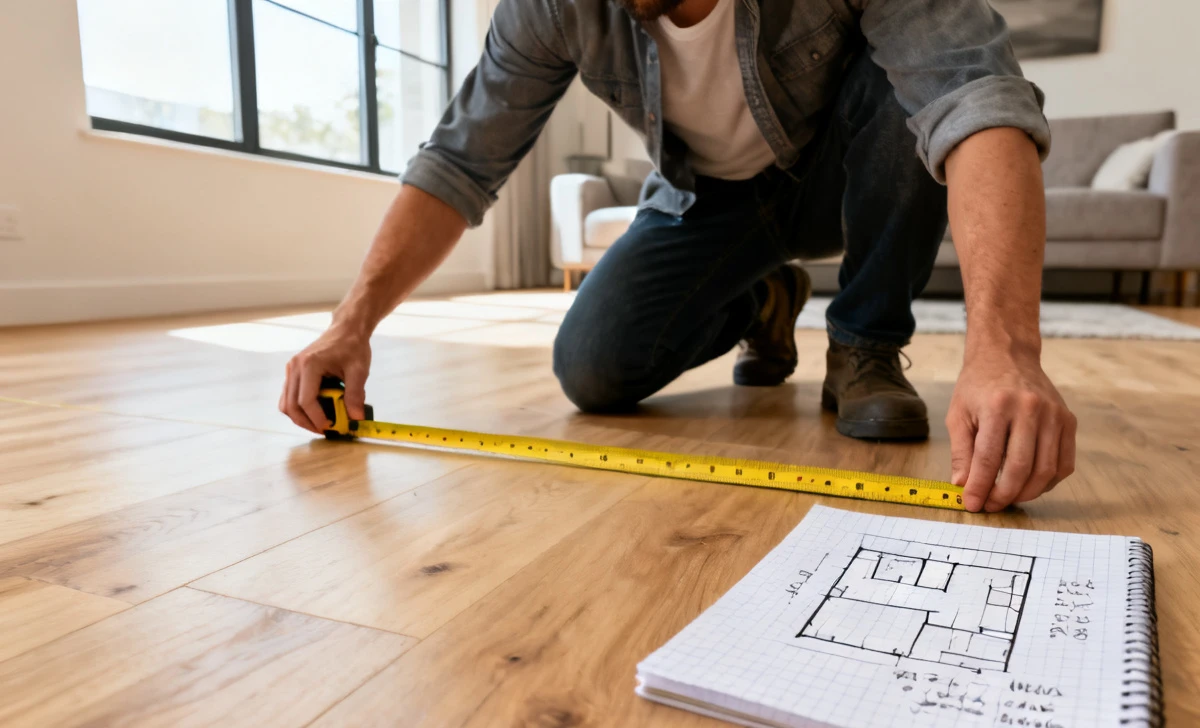
- Steel tape measure (25 ft minimum) — essential for all room shapes
- Graph paper or notepad — sketch the room layout with dimensions
- Calculator — convert and multiply measurements accurately
- Pencil and painter’s tape — mark reference points on the floor
Digital Tools and Apps in 2026
Several apps now use your smartphone camera and LiDAR sensors to generate room measurements automatically.
- MagicPlan — scans walls and outputs floor plans with sq ft calculations
- RoomScan Pro — uses iPhone LiDAR for point-to-point accuracy under 1% margin of error
- Planner 5D — visualises layout and calculates material quantities
- Leica DISTO laser distance tools — professional-grade handheld laser measures up to 330 ft with ±1/16 inch accuracy
Laser tools have become the contractor standard in 2026 for rooms larger than 200 sq ft, where tape sag and human error become significant factors.
How to Measure a Room for Flooring Step-by-Step
Measuring Rectangular Rooms
Rectangular rooms are the simplest case. Follow these steps:
- Measure the length of the room at its longest point (wall to wall)
- Measure the width at its widest point
- Multiply length × width to get total square footage
- Example: A 12 ft × 10 ft room = 120 sq ft
Always measure at floor level, not at baseboard height. Walls bow slightly inward in older homes.
Measuring L-Shaped or Irregular Rooms
L-shaped rooms require dividing the space into two or more rectangles.
- Divide the L-shape into Rectangle A and Rectangle B
- Measure each rectangle separately (length × width)
- Add both areas together
Example:
- Rectangle A: 10 ft × 8 ft = 80 sq ft
- Rectangle B: 6 ft × 5 ft = 30 sq ft
- Total: 110 sq ft
For rooms with bay windows, alcoves, or angled walls, measure the full bounding rectangle first, then subtract any areas that will not be floored.
Converting Measurements Into Square Feet/Meters
| Unit | Conversion |
|---|---|
| Inches to feet | Divide by 12 |
| Feet to meters | Multiply by 0.0929 |
| Meters to sq ft | Multiply by 10.764 |
Always convert everything into one unit before calculating. Mixed units cause the most common calculation errors.
How to Calculate Flooring Material Needed
Adding Waste Factor (5%–15%)
Raw square footage is never the final number you order. Add a waste factor based on installation complexity.
| Room Type | Recommended Waste Factor |
|---|---|
| Simple rectangular room | 5% |
| L-shaped or irregular | 10% |
| Diagonal or herringbone pattern | 15% |
| Rooms with many cuts (stairs, corners) | 15% |
Formula: Total sq ft × (1 + waste factor) = Material to order
Example: 120 sq ft room with 10% waste = 120 × 1.10 = 132 sq ft to order
Adjusting for Tile, Wood, or Vinyl Flooring
Different flooring types have different calculation rules:
- Ceramic or porcelain tile: Add 10–15% for cuts, especially diagonal layouts. Buy an extra box for future repairs.
- Hardwood planks: Add 7–10%. Planks are sold by the box; round up to the nearest full box.
- Luxury vinyl plank (LVP): Add 5–8%. LVP cuts cleanly and wastes less than wood.
- Carpet: Sold in rolls, usually 12 ft wide. Calculate based on roll width to minimise seam placement.
Common Flooring Measurement Mistakes to Avoid
Ignoring Closets and Corners
Closets add floor area. A standard reach-in closet (2 ft × 5 ft) adds 10 sq ft. Many homeowners forget this completely. Walk the entire room perimeter and include every recessed area.
Wrong Unit Conversion Errors
Recording a wall as “10 feet 6 inches” and entering it as 10.6 feet instead of 10.5 feet creates a 1.4% error. Across a full room, this compound. Always convert inches to decimal feet: 6 inches = 0.5 feet, not 0.6.
Not Accounting for Pattern Alignment
Patterned tile or wood with a repeat design requires extra material to align the pattern at walls and doorways. A 12-inch tile with a 4-inch pattern repeat can waste an entire row if not accounted for. Always note the pattern repeat length on the product spec sheet before calculating.
Pro Tips for Measuring Irregular Rooms Accurately
Breaking the Room Into Shapes
Any room — regardless of how complex — can be broken into rectangles and triangles. Sketch the layout on graph paper first. Label every section with its own measurement. Add all sections together at the end.
Expert Tip: Flooring contractors recommend measuring every room at three points along each wall — near each end and in the middle. If the numbers differ by more than half an inch, the wall is out of square and will affect how planks or tiles lay. This is one of the most-overlooked steps in DIY flooring projects.
To address issues like this in older homes where walls have settled or moisture has caused structural shifts, it helps to first address any surface preparation issues. Problems like leaking ceiling, damage, or mold should be resolved before the flooring goes down.
Using Laser Measuring Tools
Laser distance measurers eliminate the tape sag problem in large rooms. In a room longer than 20 feet, a sagging tape can show a reading 0.5–1 inch short of the actual distance. At scale, this causes under-ordering.
Entry-level laser tools from Bosch (GLM 50 CX) and Leica (DISTO D2) are priced at $50–$120 and accurate to ±1/16 inch. They also store multiple measurements and calculate the area automatically.
Double-Checking Measurements
Measure every wall twice. If the two readings differ, measure a third time and take the middle value. Never trust a single measurement when buying materials. A two-minute re-check prevents a $200 mistake.
Final Flooring Estimation Checklist Before Buying Material
Use this checklist before placing any order:
- Measured all walls at floor level (not at baseboard height)
- Included closets, alcoves, and recessed areas
- Converted all measurements to the same unit
- Calculated total sq ft using the correct formula
- Added the appropriate waste factor (5%–15%)
- Checked the product’s pattern repeat length (if applicable)
- Rounded up to the nearest full box or roll
- Verified room is square by measuring both diagonals (equal diagonals = square room)
- Cross-checked with a second measurement pass
Before installation, also check that your subfloor is free from existing damage. Addressing issues like gaps around windows and walls before laying new flooring prevents air infiltration and moisture problems underneath.
Key Takeaways — What Makes Accurate Measurement Important?
Accurate flooring measurement sits at the center of every successful home improvement decision. It determines your budget, your material order, your installation timeline, and your waste output. Skipping this step — or doing it carelessly — turns a manageable project into an expensive correction.
Accurate measurement is the difference between a smooth renovation and a costly mistake.
What part of measuring your room for flooring do you find most challenging? Drop your question below — whether it is an L-shaped room, a bathroom with angled walls, or a pattern tile layout, the right measurement method exists for every situation.