
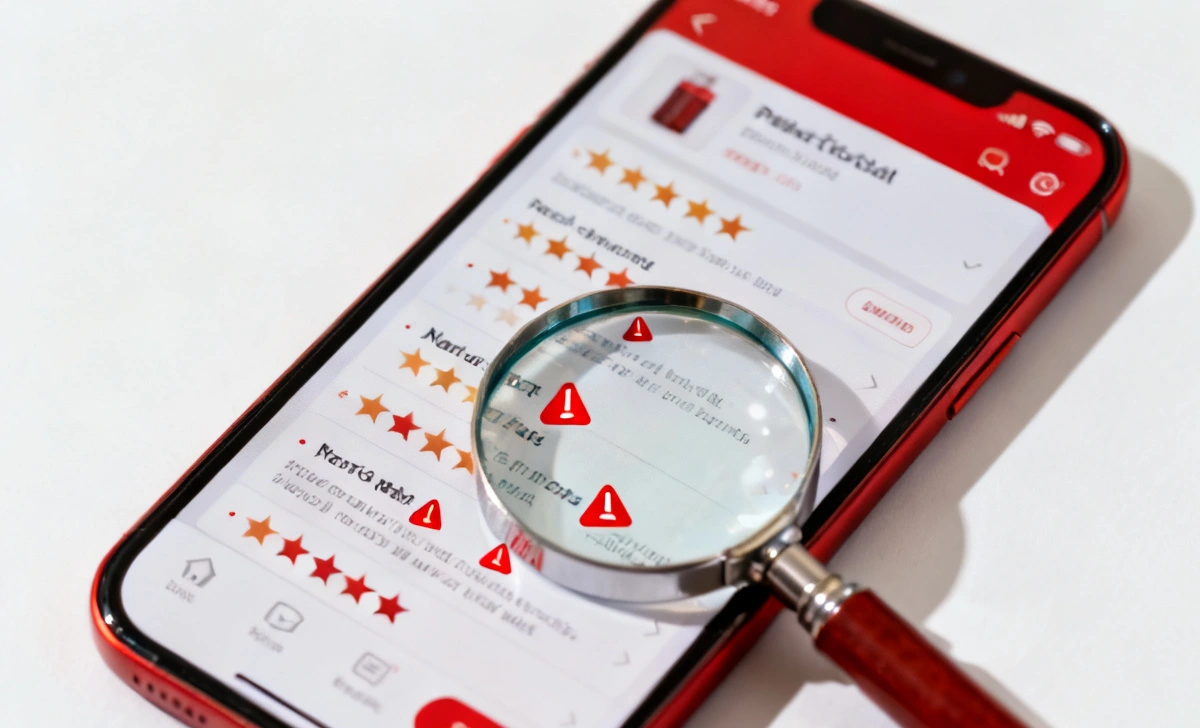
A 2026 report by Fakespot found that over 30% of online reviews may be unreliable. That means roughly one in three products you browse could be propped up by manufactured praise. For everyday shoppers who want to spot fake online reviews before spending money, that is not a small risk — it translates directly into wasted money, disappointing purchases, and eroded trust in platforms you rely on daily.
The problem has grown more complicated in 2026. AI writing tools have made it cheaper and faster than ever to generate hundreds of convincing fake reviews in minutes. The language sounds natural, the details seem specific, and the profiles look real. Old detection methods are no longer enough on their own.
This guide walks you through the specific warning signs, the tools that help, and the habits that will protect you — whether you are buying electronics, booking a hotel, or downloading an app. Much like learning to identify deepfake video on a phone, spotting fake reviews is a skill that gets sharper with practice.
What Are Fake Online Reviews?
Fake reviews are fabricated or purchased feedback designed to push a product’s rating in one direction — usually upward for the seller’s own listing, or downward for a competitor’s.
In 2026, they are produced through several means:
- AI-generated reviews — sellers now use large language models to produce hundreds of varied, convincing reviews at almost no cost, making volume-based detection harder
- Paid reviewer networks — sellers hire individuals through underground marketplaces to post positive reviews, often in exchange for free products or cash
- Automated bots — scripts that generate large volumes of reviews in a short time, using slight variations to avoid pattern detection
- Incentivized customers — buyers who receive a discount or rebate in exchange for a positive review, even if the platform technically prohibits this
- Competitor attacks — coordinated waves of one-star reviews targeting a rival brand’s listing
Platforms like Amazon, Google, and Trustpilot invest heavily in detection, but fake reviews still slip through at scale. Even a small fraction of undetected fakes can meaningfully distort a product’s visible reputation.
Why This Matters More Than You Think
According to a 2025 study by BrightLocal, 87% of consumers read online reviews before making a purchase, and 49% trust those reviews as much as a personal recommendation from someone they know.
That level of trust makes reviews one of the most powerful — and most abused — tools in online commerce. When the feedback is manufactured, you are not reading other people’s honest experiences. You are reading content designed to move money in one direction.
The financial scale is significant. A 2026 estimate from consumer research firm Juniper Research put the global cost of fake review fraud at over $152 billion in influenced consumer spending annually. For individual buyers, the consequences are direct: money spent on products that underperform, services that do not show up as promised, or apps riddled with problems that five-star ratings somehow failed to mention.
7 Clear Signs of Fake Online Reviews
1. Repetitive or Identical Phrasing
One of the oldest patterns to spot is repeated language across multiple reviews. Phrases like “Amazing product, highly recommend!” appearing word-for-word across dozens of entries are a clear signal that the reviews share a source — whether a template or a bot cycling through slight variations.
In 2026, AI-generated reviews are harder to catch this way because the phrasing varies. Look instead for reviews that all emphasize the same two or three product features while ignoring everything else.
2. Extreme Ratings With No Middle Ground
Legitimate products attract a spread of opinions. Some buyers love them, some are lukewarm, some are disappointed. If a product has hundreds of five-star reviews and almost nothing in between, that distribution is statistically unusual.
The same applies in reverse — a sudden cluster of one-star reviews on an otherwise well-regarded product often signals a competitor attack rather than genuine customer dissatisfaction.
3. Generic or Anonymous Reviewer Profiles
Check who is leaving the reviews. Accounts with names like “User4821” or “JohnM123,” no profile photo, no review history, and a join date that coincides with the product’s launch are not reassuring signs.
Real buyers usually have a visible history: a mix of products reviewed over time in categories that reflect actual purchasing behavior. A profile that exists solely to leave glowing reviews for one product category is worth questioning.
4. Sudden Spikes in Review Volume
Watch the review timeline. A product that collects 300 reviews in 48 hours and then goes quiet for weeks did not earn those reviews through normal sales. That pattern reflects a coordinated push — often timed to a product launch or to recover from a rating drop.
Many review-analysis tools display this timeline visually, making spikes easy to identify at a glance.
5. Vague Language With No Specific Details
Genuine reviews mention specifics: how long the product held up, whether it fits true to size, how customer service handled a return, and what the packaging looked like. Fake reviews — even AI-generated ones — tend to stay general because there is no real experience behind them.
Phrases like “Great quality!” or “Very satisfied with this purchase” say nothing useful. If a review does not tell you anything you could not have guessed without using the product, treat it with skepticism.
6. Missing “Verified Purchase” Tags
On platforms like Amazon, the “Verified Purchase” label confirms that the reviewer bought the product through the platform. Its absence does not automatically mean a review is fake, but a high proportion of unverified reviews on an already-suspicious product adds weight to the concern.
Verified purchase status is one of the simpler things to check and one of the more meaningful filters available without any tools.
7. AI-Sounding Fluency With Zero Personality
This is the 2026 addition to the list. Real customers write with personality. They go off-topic. They mention their cat knocked over the package, or that they bought it as a gift, and the recipient loved it.
Reviews that are grammatically perfect, logically structured, and completely on-message — with no tangents, no humor, no frustration — increasingly suggest AI generation rather than a real person. The writing is too clean to be human.
Tools That Can Help in 2026
You do not have to analyze reviews manually every time. Several tools have updated their detection methods to account for AI-generated content.
Fakespot grades a product’s reviews on a scale from A to F. Its 2025 update added AI-content detection alongside its existing checks for review timing, language clustering, and reviewer behavior. It works as a browser extension and supports Amazon, Walmart, and several other major platforms.
ReviewMeta filters out reviews it considers suspicious and shows you an adjusted star rating. It also breaks down which reviews it removed and why — useful for understanding the reasoning rather than just accepting a score.
Trustpilot is more useful as a platform than a tool. It publishes reviews for businesses rather than individual products, flags suspicious activity publicly, and requires companies to respond to negative reviews — giving you a sense of how a brand handles real problems.
None of these tools is perfect. Use them as one input among several, not as a final verdict.
How to Read Reviews Like a Skeptic
Star ratings are a starting point, not a conclusion. Here is a more reliable process:
Start with three-star reviews. Buyers who give three stars are usually trying to be fair. Those reviews tend to be the most informative because fake positive campaigns rarely bother with middling ratings.
Check the reviewer’s profile history. A history of varied purchases across different categories suggests a real person. A profile with only five-star reviews for products in the same niche is a concern.
Search for the product outside the platform. Look for reviews on YouTube, Reddit, and independent blogs. Video reviews are harder to fake because they require actual footage. Reddit discussions are more likely to surface honest experiences because the community pushes back on promotional content.
Cross-check across platforms. A product with 4.8 stars on Amazon but 2.9 stars on Trustpilot and complaint threads on Reddit is giving you important information. No single platform has the complete picture.
Just as you would check your phone’s settings before trusting an unfamiliar app — for instance, by doing an app location access check — cross-checking reviews is a basic step worth building into your buying routine.
What Platforms Are Doing About It in 2026
Major platforms have stepped up enforcement, but the problem has not been solved.
Amazon now uses a combination of machine learning and human review teams to flag suspicious activity, and has partnered with regulators in the EU and UK to pursue legal action against review brokers. Google expanded its spam review detection across Maps and Shopping in late 2025, with a particular focus on local businesses in high-fraud categories like restaurants and home services.
The EU’s Digital Services Act, which came into full effect for large platforms in 2024, requires companies to publish transparency reports on fake review removal rates and the methods they use. This has created more accountability than existed before, though enforcement varies by country.
In the United States, the Federal Trade Commission finalized its rule against fake reviews and testimonials in 2025, making it illegal to buy, sell, or suppress reviews, with civil penalties for violations. Several companies faced fines under this rule in early 2026.
Understanding how to spot fake tech support scam warning signs follows the same logic: the tactics are designed to appear legitimate, and the defense is knowing what legitimate actually looks like.
Key Takeaways
Fake reviews are more common and more convincing than most buyers assume. The core habits that protect you are straightforward:
- Trust patterns over individual reviews
- Read three-star and negative reviews before five-star ones
- Watch for AI-sounding fluency with no personal detail — a new 2026 red flag
- Check reviewer profiles and purchase history
- Use tools like Fakespot and ReviewMeta as a quick filter
- Cross-check across platforms and off-platform sources like Reddit and YouTube
- Be alert to sudden review spikes and products with zero negative feedback
Online commerce depends on trust, and fake reviews exploit that trust directly. Once you know what to look for, the signals become easier to read — and your purchases become more reliably what you expected them to be.
The same critical thinking that protects you from a fake tech support scam or helps you securely wipe an old smartphone before selling applies here. Awareness is the practical first step. The rest follows from that.
Conclusion
Fake reviews in 2026 are more sophisticated than they were even two years ago. AI generation has made volume easier, language harder to flag, and detection tools slower to catch up. But the underlying patterns still exist — no fake review campaign, however well-organized, can fully replicate the texture of genuine human experience across thousands of real buyers.
The most reliable protection remains your own judgment, applied consistently. Read the reviews that fall in the middle. Check who wrote them. Look for specific details and personality. Cross-check on platforms where sellers have less control. Use a tool like Fakespot for purchases that matter.