Marvel labels things “reboots” that are technically sequels. Disney calls live-action adaptations “remakes” when they share almost nothing with the originals. Studios use these words to market films — not always to describe them accurately.
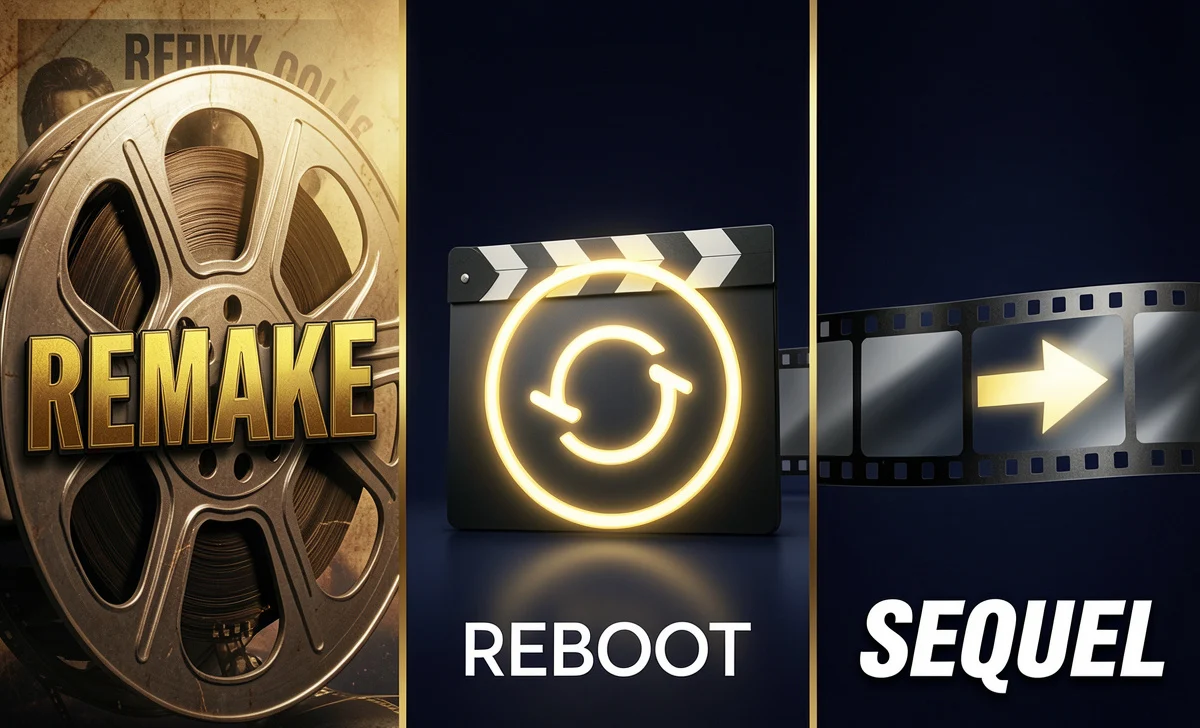
These three terms define how Hollywood continues stories, reimagines old films, or builds new timelines from existing IPs. Understanding remake reboot sequel differences helps you know what a studio is actually promising before you buy a ticket.
In this guide, you will learn the clear difference between remakes, reboots, and sequels, with simple examples from popular films and franchises — everything explained in one place.
What Is the Difference Between a Remake, Reboot, and Sequel? (Quick Comparison Table)
| Remake | Reboot | Sequel | |
|---|---|---|---|
| Definition | A new version of an existing film | A fresh start for an existing franchise | A continuation of an existing story |
| Purpose | Retell the same story for a new audience | Reset the timeline, tone, or characters | Extend the narrative forward |
| Story Continuity | Same story, updated presentation | Ignores or replaces prior continuity | Directly follows previous events |
| Example Films | The Lion King (2019), Scarface (2024) | The Batman (2022), Casino Royale (2006) | Avengers: Endgame (2019), Top Gun: Maverick (2022) |
What Is a Remake in Movies?
A remake is a new film that tells the same story as an older one. The plot, characters, and major beats stay largely the same. Only the production, cast, visuals, and technology get updated.
How Remakes Work
Studios produce remakes to introduce a proven story to audiences who have never seen the original. They keep the core narrative intact but update the setting, tone, or style. The original film still exists in its own separate space — the remake does not erase it.
Famous Remake Examples
- The Lion King (2019) — Almost a shot-for-shot recreation of the 1994 animated film using photorealistic CGI.
- A Star Is Born (2018) — The fourth version of the same story, previously made in 1937, 1954, and 1976.
- It (2017) — A remake of the 1990 TV miniseries, based on the same Stephen King novel.
If you want help finding movies and shows you’ll like based on your taste, that resource covers discovery tools and methods that go beyond guessing from trailers.
What Is a Reboot in Movies?
A reboot wipes the slate clean. It takes an existing IP — characters, universe, brand name — and starts a new story from scratch. Previous films are treated as if they do not exist.
How Reboots Work
Reboots let studios keep valuable brand names while discarding continuity problems, aging storylines, or underperforming characters. The characters may have the same names but different origins, personalities, and relationships. A reboot is not a sequel to anything — it builds its own timeline.
[EXPERT INSIGHT: In the modern streaming era, studios prefer reboots over sequels because reboots allow complete creative freedom without the burden of decades of lore. Streaming platforms like Netflix and Disney+ need content that works for first-time viewers globally — a reboot has no prerequisite viewing list.]
Famous Reboot Examples
- Casino Royale (2006) — Rebooted the entire James Bond franchise with Daniel Craig, ignoring all previous Bond films.
- The Batman (2022) — A completely separate take on Bruce Wayne, unconnected to the Ben Affleck DC films.
- Spider-Man: Homecoming (2017) — The third reboot of Spider-Man in 15 years, this time integrated into the Marvel Cinematic Universe.
What Is a Sequel in Movies?
A sequel continues the story of a film that came before it. Events from the original film directly affect the sequel’s plot. Characters remember what happened. Continuity is preserved.
How Sequels Continue Stories
Sequels pick up where the previous film left off — sometimes immediately, sometimes years later. The audience is expected to know what happened before. A sequel cannot be understood fully without the original.
Famous Sequel Examples
- Top Gun: Maverick (2022) — Set 36 years after the original Top Gun, with Pete Mitchell still flying and dealing with the legacy of Goose’s death.
- Avengers: Endgame (2019) — Directly follows Infinity War and resolves the five-year time jump storyline.
- The Dark Knight (2008) — Continues Bruce Wayne’s story from Batman Begins, with the Joker emerging as Gotham’s new threat.
Remake vs Reboot vs Sequel: Key Differences Explained
Story Continuity Differences
A sequel has direct continuity — what happened in the last film matters here. A remake has mirrored continuity — it tells the same story again with no connection to the original’s timeline. A reboot has zero continuity — it starts over with the same characters in a new universe.
This is the clearest way to separate them:
- Sequel = Story continues forward
- Remake = Story told again
- Reboot = Story starts over
Audience Expectations Differences
Sequel audiences expect payoff. They have followed the story and want a resolution. Remake audiences expect familiarity — the same beats they know, updated visually. Reboot audiences expect something new, wearing a familiar name. Each delivers a different promise, which is why studios choosing the wrong label creates confusion.
Why Do Studios Use Remakes, Reboots, and Sequels?
Business and Franchise Strategy
Original films carry financial risk. A known IP — even an old one — comes with built-in audience awareness. Studios can spend less on marketing when audiences already recognize the characters. Sequels, remakes, and reboots all reduce that risk by building on something people already know. This is why the top-grossing films every year are almost always franchise entries, not originals.
Audience Demand and Nostalgia Factor
Nostalgia is a reliable box office driver. A remake of a beloved 1990s film targets both the original audience and their children. A reboot targets younger viewers who find the original outdated. A sequel rewards loyal fans who have stayed with a franchise for years. Each approach targets a different emotional trigger.
Real Examples From Hollywood and Streaming Platforms (2026 Update)
Disney Live-Action Remakes
Disney has produced more than a dozen live-action remakes of its animated classics. The Little Mermaid (2023) told the same story as the 1989 original with live actors and updated songs. Mulan (2020) kept the character but changed the story significantly — making it closer to a reboot than a true remake. Disney uses the word “remake” loosely across both.
Marvel and DC Reboots and Sequels
The MCU runs almost entirely on sequels — each film connects to the last. DC has leaned toward reboots, resetting Superman, Batman, and the Justice League multiple times since 2013. The Flash (2023) literally rebooted the DC timeline within its own plot. Marvel’s multiverse saga introduced alternate timelines, blurring the line between sequel and reboot within single films. For viewers trying to follow complex TV and film series week by week, these overlapping timelines can be genuinely difficult to track.
Netflix and Streaming Reboots
Netflix rebooted Lost in Space (2018), Cowboy Bebop (2021), and One Piece (2023) — all original properties adapted into new formats. These streaming reboots often shift from animation to live-action or change tone significantly. The goal is to reach global audiences who were not around for the original run.
Which One Is Better: Remake, Reboot, or Sequel?
There is no objectively better format. Each works under specific conditions.
When Remakes Work Best
Remakes succeed when the original story is strong, but the original film is technically outdated or culturally inaccessible. The Jungle Book (2016) worked because the 1967 version had aged visually. The story itself was timeless.
When Reboots Succeed
Reboots succeed when a franchise has become overcomplicated or when the original audience has aged out. Casino Royale worked because the Bond franchise had become self-parody by the late 1990s. Starting fresh gave it credibility again.
When Sequels Fail
Sequels fail when studios produce them past the point of creative necessity. Indiana Jones and the Dial of Destiny (2023) and Shrek 5 (2023) both faced audience fatigue from overextended franchises. A sequel made for financial reasons rather than story reasons almost always underperforms critically.
Common Mistakes People Make About These Terms
Calling every continuation a “remake.” If the characters remember the events of the previous film, it is a sequel, not a remake.
Thinking reboots are always inferior. Batman Begins (2005) and Casino Royale (2006) are among the best films in their respective franchises.
Assuming a remake must be live-action. The Little Mermaid (2023) is live-action. Cinderella (1997) was a TV remake. Format does not define the term.
Confusing a spin-off with a sequel. Rogue One (2016) is a Star Wars spin-off — it does not continue the Skywalker story, even though it exists in the same universe.
Final Takeaways: How to Easily Remember the Difference
Modern entertainment runs on familiar stories. Studios have learned that audiences return more reliably to known characters and worlds than to entirely new ones. This is not a creative failure — it is a reflection of how people engage with storytelling. Franchises build emotional investment over time, and remakes, reboots, and sequels all serve that long-term relationship differently.
Understanding these three terms turns you from a passive viewer into an informed one. When a studio announces a reboot, you know to expect something new. When they announce a sequel, you know your prior investment in the story matters. And when they announce a remake, you know what the experience will feel like before you ever sit down to watch.