
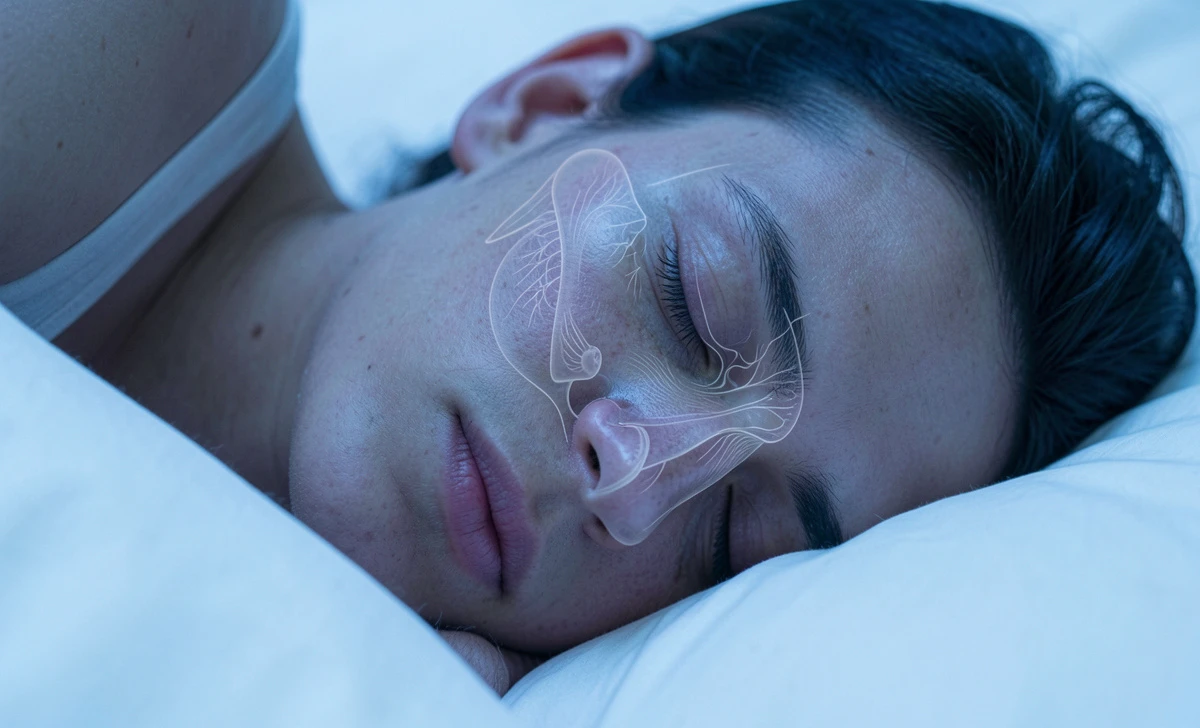
Many people blame stress or allergies for poor sleep, but the way nose shape affects breathing at night is often the real culprit. A narrow nasal passage, a deviated septum, or a collapsed nasal valve may reduce oxygen flow and increase snoring or mouth breathing during sleep. Understanding nasal anatomy can help identify problems earlier and improve both sleep quality and long-term health.
In this article, you will learn how nose shape affects nighttime breathing, which nasal structures matter most, common warning signs, treatment options, and when to seek medical help.
Why Does Nose Shape Affect Breathing at Night?
How Nasal Airflow Works
The nose is the body’s primary airway. It filters, humidifies, and warms incoming air before it reaches the lungs. Inside the nose, air passes through two narrow passages separated by the septum, flowing past turbinates — small shelf-like bones covered in soft tissue.
“The nose accounts for nearly half of total airway resistance,” said Dr. Maurice Ohayon of Stanford Sleep Medicine research.
Any structural abnormality along this path — a bend in the septum, swollen turbinates, or a weak nasal valve — reduces the volume of air that can pass through freely. This reduction in airflow creates turbulence, increases breathing effort, and can trigger a chain of problems during sleep.
Why Breathing Problems Get Worse During Sleep
During the day, gravity helps keep nasal tissues in position and promotes natural drainage. At night, lying flat changes everything. Blood flow redistributes, and nasal tissues tend to swell. Muscle tone in the airway also decreases during sleep, which means structural weaknesses have a greater impact.
Many people breathe normally during the day but struggle at night because lying flat increases swelling inside the nasal tissues — a lesser-known fact that explains why symptoms often appear only after waking. This positional shift is why even mild nasal structural issues can lead to disrupted REM vs deep sleep cycles and poor overnight recovery.
Which Nose Shapes and Structures Commonly Cause Breathing Issues?
Deviated Septum
The nasal septum is the wall of cartilage and bone dividing the two nostrils. Ideally, it sits perfectly centered. In reality, research suggests that up to 80% of people have some degree of septal deviation, most of which go undiagnosed.
A significant deviation narrows one or both passages, forcing the body to work harder to pull air through. This extra effort can disturb sleep architecture and reduce oxygen efficiency.
Common signs of a deviated septum include:
- Persistent one-sided nasal blockage
- Frequent nosebleeds on one side
- Noisy breathing during sleep
- Preference for sleeping on a specific side
Narrow Nasal Passages
Some people are born with naturally narrower nasal anatomy. This can be related to facial bone structure, ethnicity, or developmental factors. Narrow passages increase resistance to airflow, especially at higher breathing rates — such as during deeper sleep stages.
Enlarged Turbinates
Turbinates help condition incoming air, but they can become chronically enlarged due to allergies, infections, or hormonal changes. When swollen, they significantly reduce the usable space inside the nasal cavity. Chronic turbinate hypertrophy is one of the most common causes of nasal obstruction in adults.
Collapsed Nasal Valve
The nasal valve is the narrowest point of the nasal airway, located just inside the nostril. When the cartilage supporting this area is weak or damaged — often after rhinoplasty or due to natural anatomy — the valve collapses inward during inhalation, cutting off airflow abruptly.
| Nasal Structure | Problem | Impact on Breathing |
|---|---|---|
| Nasal Septum | Deviated or crooked | Uneven or restricted airflow |
| Turbinates | Swollen or enlarged | Reduced nasal passage space |
| Nasal Valve | Collapsed or weak | Airflow cuts off on inhalation |
| Nasal Passages | Narrow by anatomy | Higher airflow resistance overall |
What Are the Signs Your Nose Shape May Affect Sleep?
Snoring and Mouth Breathing
When nasal airflow is restricted, the body compensates by opening the mouth. Mouth breathing bypasses the nose entirely, reducing air filtration and humidification. It also changes the position of the tongue and soft palate in ways that promote snoring.
Snoring is not just a nuisance — it is a sign that airflow is being disrupted. Chronic mouth breathing can also dry out the mouth and throat, leading to dental issues and inflammation.
Waking Up Tired or Congested
Key symptoms that suggest nasal anatomy may be affecting sleep:
- Waking with a dry mouth or sore throat
- Feeling unrested despite a full night’s sleep
- Morning headaches
- Nasal congestion that clears slowly after waking
- Facial pressure or sinus discomfort
These symptoms are frequently mistaken for poor sleep hygiene or stress. The early signs of burnout and sleep-related breathing issues can overlap significantly, making correct identification important before symptoms worsen.
Sleep Apnea Symptoms
Nasal obstruction can contribute to obstructive sleep apnea (OSA), a condition in which breathing repeatedly stops and starts during sleep. According to the American Academy of Sleep Medicine, OSA affects an estimated 26% of adults between the ages of 30 and 70.
Warning signs of possible sleep apnea include:
- Loud, chronic snoring
- Gasping or choking sounds during sleep (reported by a partner)
- Waking frequently during the night
- Excessive daytime sleepiness
- Difficulty concentrating during the day
How Doctors Diagnose Nasal Breathing Problems
Physical Examination
An ENT (ear, nose, and throat) specialist performs a detailed examination of the nasal passages using a nasal speculum or an endoscope. They assess the septum position, turbinate size, nasal valve integrity, and any structural narrowing. A simple Cottle maneuver — gently pressing a finger against the cheek to open the nasal valve — can quickly identify valve collapse as a source of obstruction.
Sleep Studies and Imaging Tests
If sleep apnea is suspected, a polysomnography (sleep study) is ordered. This overnight test records brain activity, oxygen levels, heart rate, breathing patterns, and body movements.
For structural evaluation, a CT scan of the sinuses provides detailed imaging of the nasal anatomy, including the degree of septal deviation and turbinate size. These findings guide surgical decisions.
Can Nose Shape Increase the Risk of Sleep Apnea?
Connection Between Airflow and Oxygen Levels
Research published in the Journal of Clinical Sleep Medicine found that nasal obstruction significantly increases the likelihood of sleep-disordered breathing. When nasal resistance increases, the negative pressure generated to pull air past the obstruction can cause the soft palate and throat walls to collapse — the mechanism behind obstructive sleep apnea.
A study in JAMA Otolaryngology reported that patients with chronic nasal obstruction had measurably lower oxygen saturation during sleep compared to those with unobstructed airways.
When Nasal Problems Become Serious
Nasal obstruction rarely acts in isolation. When combined with excess weight, a naturally narrow throat, or poor sleep positioning, even moderate nasal structural issues can tip a person toward clinically significant sleep apnea. Untreated OSA is associated with increased risk of hypertension, cardiovascular disease, metabolic disorders, and cognitive decline.
[EXPERT PERSPECTIVE] ENT specialists often explain that nasal obstruction rarely acts alone. Weight, sleeping position, allergies, and throat anatomy all contribute to breathing quality during sleep. Treating the nasal issue is often the first and most accessible step, but a comprehensive approach yields better long-term results.
Treatments That Can Improve Nighttime Breathing
Non-Surgical Treatments
Many patients see meaningful improvement without surgery.
Non-surgical options include:
- Nasal dilator strips — External adhesive strips that physically open the nasal valve during sleep. Studies show they reduce snoring in mild-to-moderate nasal obstruction.
- Nasal corticosteroid sprays — Reduce turbinate swelling caused by allergies or chronic inflammation. These are first-line treatments recommended by ENT guidelines.
- Saline irrigation — Clears mucus, reduces congestion, and improves nasal passage patency.
- Allergy management — Identifying and treating allergens reduces chronic turbinate hypertrophy.
- CPAP therapy — For those with diagnosed sleep apnea, CPAP delivers continuous pressurized air that keeps the airway open regardless of nasal anatomy.
- Positional therapy — Sleeping on the side rather than the back reduces airway collapse in many patients.
Adequate protein before bed and proper hydration also support airway tissue health and general sleep quality, complementing these interventions.
Surgical Options
When structural problems cause a significant, persistent obstruction, surgery may be recommended.
Common surgical procedures:
- Septoplasty — Straightens a deviated septum by reshaping or removing portions of cartilage and bone. Studies report symptom improvement in 70–80% of patients.
- Turbinate reduction — Reduces the size of enlarged turbinates using radiofrequency ablation, microdebrider, or surgical removal of a portion of the turbinate.
- Nasal valve repair — Reinforces collapsed nasal valves using cartilage grafts (spreader grafts) or implantable supports such as the LATERA absorbable implant.
- Functional rhinoplasty — Addresses both aesthetic and functional nasal concerns, particularly when the external nasal framework contributes to valve collapse.
Surgery is generally considered after conservative treatments have failed and when diagnostic imaging confirms structural abnormalities significant enough to justify intervention.
What Are Experts Saying About Nasal Breathing and Sleep?
Research and Medical Findings
The relationship between nasal anatomy and sleep quality has been increasingly studied over the past two decades. A 2019 review in Sleep Medicine Reviews concluded that nasal obstruction is a significant, underappreciated contributor to sleep-disordered breathing — and that treating nasal obstruction can reduce snoring severity and improve CPAP compliance in apnea patients who struggle with mask pressure.
The American Academy of Otolaryngology recommends a structured evaluation of nasal airway function as part of any sleep-disordered breathing workup, particularly before escalating to more invasive airway treatments.
Expert Perspective
Research consistently shows that correcting nasal obstruction improves sleep quality scores, reduces snoring frequency, and enhances daytime alertness. For patients with mild-to-moderate sleep apnea, nasal interventions can sometimes reduce apnea severity enough to eliminate the need for CPAP.
Key Takeaways — Why Nasal Anatomy Matters for Better Sleep
- The nose provides roughly half of the total upper airway resistance — structural problems here have a direct impact on breathing during sleep.
- Common culprits include deviated septum, enlarged turbinates, narrow nasal passages, and collapsed nasal valves.
- Symptoms like snoring, mouth breathing, morning congestion, and daytime fatigue may point to nasal anatomy as a root cause.
- Lying flat at night worsens nasal congestion and reduces muscle tone, amplifying the effect of structural issues.
- Treatment ranges from nasal strips and corticosteroid sprays to surgical correction, depending on severity.
- Nasal obstruction can increase the risk of obstructive sleep apnea and contribute to long-term cardiovascular and metabolic health risks.
Final Thoughts
Poor sleep is not always caused by stress or bad habits. Sometimes the structure of the nose quietly limits airflow every night — and no amount of good sleep hygiene will fully compensate for a narrowed or obstructed nasal passage.
If you wake up tired, snore regularly, or breathe through your mouth at night, a nasal anatomy evaluation with an ENT specialist is a logical first step. Understanding nasal anatomy helps identify problems earlier, choose the right treatment approach, and protect both sleep quality and long-term health. The path to better nights may begin with a closer look at the nose.