
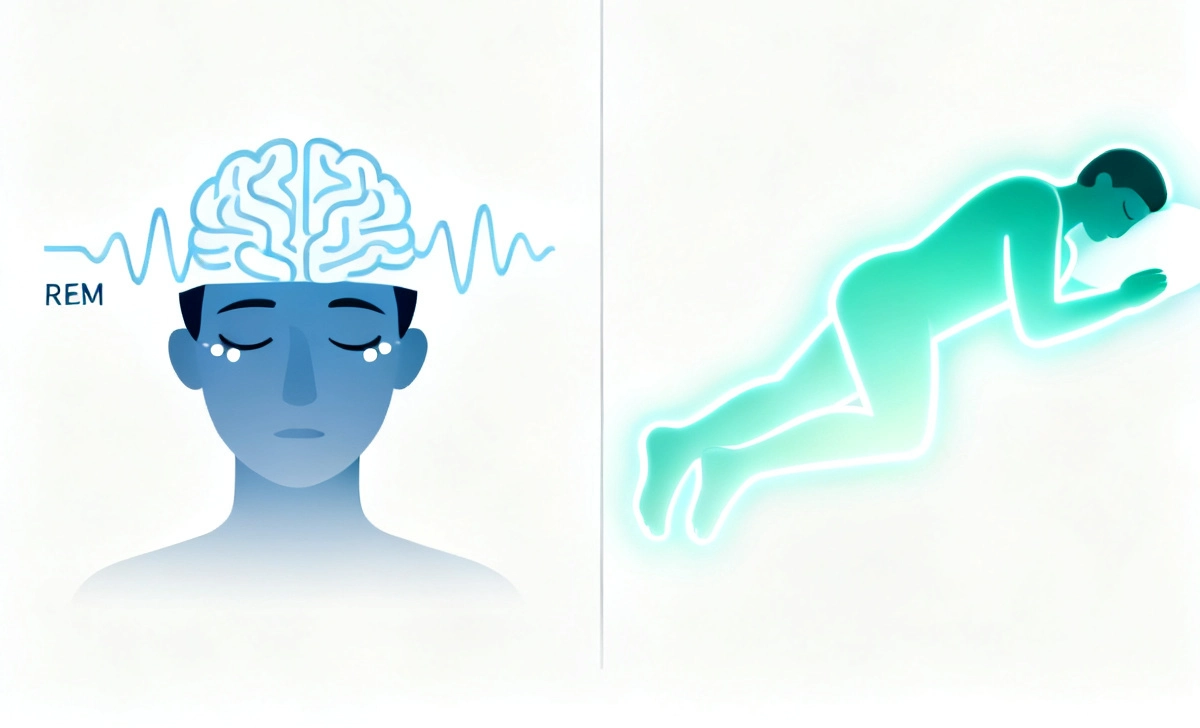
You can sleep 8 hours and still wake up exhausted — because the number of hours you sleep tells only half the story. Most people do not realize that REM vs deep sleep serve completely different functions inside the body.
REM (Rapid Eye Movement) sleep handles brain processing, memory consolidation, and emotional balance. Deep sleep focuses on physical repair and recovery. Skip either one, and you will feel it — whether in your body, your mood, or your ability to think clearly.
This guide covers the exact difference between REM and deep sleep, why you need both, and what you can do to get more of each.
What Is REM Sleep?
REM sleep stands for Rapid Eye Movement sleep. It is the stage where brain activity climbs to levels close to being fully awake.
During this phase, your eyes move rapidly beneath your eyelids, your breathing becomes irregular, and vivid dreams occur. Your brain is essentially running at full speed while your body stays still.
Key Functions of REM Sleep
- Processes and stores new memories
- Supports emotional regulation and mood stability
- Strengthens creative thinking and problem-solving ability
- Helps the brain recover from the mental demands of the day
According to the Sleep Foundation, REM sleep accounts for roughly 20 to 25 percent of total sleep in healthy adults. Most of it happens in the second half of the night, which is why cutting sleep short by even an hour or two can significantly reduce how much REM you get.
What Happens During REM Sleep
- Brain activity mirrors the waking state
- Body muscles become temporarily paralyzed to prevent acting out dreams
- Dreams become intense, detailed, and emotionally charged
- Heart rate and breathing become less regular
What Is Deep Sleep?
Deep sleep, also called slow-wave sleep (SWS), is the most physically restorative stage of the sleep cycle. This is when your body does its most serious repair work.
Growth hormone is released, tissues are rebuilt, and the immune system strengthens. Deep sleep is what makes you feel physically refreshed in the morning — not just rested, but recovered.
Key Functions of Deep Sleep
- Repairs muscles and body tissues
- Strengthens the immune system
- Releases growth hormone critical for cell repair
- Consolidates factual and procedural memory
- Clears metabolic waste from the brain
Research from the National Sleep Foundation shows deep sleep makes up approximately 13 to 23 percent of total sleep in adults. It is most concentrated in the first half of the night, which is why going to bed late consistently tends to reduce how much deep sleep you accumulate.
What Happens During Deep Sleep
- Heart rate slows significantly
- Breathing becomes slow and steady
- Brain waves shift to long, slow delta waves
- It becomes very difficult to wake someone from this stage
- The body temperature drops slightly
REM Sleep vs Deep Sleep: Key Differences
| Feature | REM Sleep | Deep Sleep |
|---|---|---|
| Primary Role | Brain recovery | Physical recovery |
| Brain Activity | High | Very low |
| Dreams | Vivid and frequent | Rare |
| Muscle Activity | Temporarily paralyzed | Relaxed but movable |
| When It Occurs | Later in the night | Earlier in the night |
| Main Benefit | Memory and emotions | Healing and growth |
Why You Need Both
Your body runs two separate repair systems during sleep, and neither can fully replace the other.
Deep sleep fixes the body. REM sleep fixes the mind. Lose one, and you will notice the gap — even if you cannot immediately identify why you feel off.
When deep sleep is lacking:
- Physical fatigue persists regardless of how long you slept
- Muscles recover slowly after exercise or physical activity
- The immune system becomes less effective
- Energy stays low throughout the day
When REM sleep is lacking:
- Memory formation weakens noticeably
- Mood becomes unstable, with increased anxiety or irritability
- Concentration and focus deteriorate
- Learning new skills takes considerably longer
A 2022 study from Harvard Medical School found that insufficient REM sleep can reduce the ability to learn and retain new information by up to 40 percent. That is not a small margin — it means the quality of your sleep directly affects your cognitive performance the next day.
How Much REM and Deep Sleep Do You Need?
A healthy adult sleeping between 7 and 9 hours per night should be getting approximately:
- REM Sleep: 90 to 120 minutes per night
- Deep Sleep: 60 to 110 minutes per night
Sleep cycles repeat roughly every 90 minutes throughout the night, rotating through light sleep, deep sleep, and REM sleep. The proportion of each stage shifts as the night progresses — deep sleep dominates early cycles, and REM sleep becomes longer in later cycles.
Hydration and Sleep Quality: A Connection Worth Knowing
Sleep quality depends on more than just your bedtime routine. What you put into your body during the day matters too. Proper hydration supports the physical processes that happen during deep sleep — muscle repair, hormone release, and cellular recovery all require adequate fluid and mineral balance.
Most people worry about drinking too little water, but overhydration is dangerous too — and its effects can spill into your sleep quality. Electrolyte imbalance from overhydration can disrupt the body’s natural recovery processes during sleep, affecting both deep sleep quality and how effectively your body repairs itself overnight.
What Happens If You Do Not Get Enough
Effects of Too Little Deep Sleep
- Weakened immune response — you get sick more easily
- Persistent muscle fatigue even after rest
- Low energy that does not improve with caffeine
- Slower recovery from physical exertion or illness
Effects of Too Little REM Sleep
- Difficulty retaining new information
- Increased anxiety, mood swings, or emotional reactivity
- Reduced ability to concentrate for extended periods
- Poorer performance on tasks that require creative thinking
Over time, a chronic imbalance in sleep stages raises the risk of serious conditions, including heart disease, obesity, and clinical depression. The connection between poor sleep quality and long-term health outcomes is well-established in research.
How to Improve REM and Deep Sleep
To Get More Deep Sleep
Exercise regularly. Thirty minutes of moderate physical activity during the day — particularly in the morning or early afternoon — meaningfully increases the amount of deep sleep you get at night. Avoid intense exercise within three hours of bedtime.
Keep your bedroom cool. A room temperature between 18 and 20 degrees Celsius creates the conditions your body needs to enter and sustain deep sleep. The body’s core temperature naturally drops during this stage, and a cooler environment supports that process.
Cut off caffeine by 2 PM. Caffeine has a half-life of roughly five to six hours. Consuming it in the afternoon keeps enough of it in your system at bedtime to interfere with deep sleep cycles, even if you fall asleep without trouble.
Limit alcohol. Alcohol may help you fall asleep faster, but it fragments sleep architecture — reducing both deep sleep and REM sleep quality across the night.
To Get More REM Sleep
Stick to a fixed sleep schedule. Going to bed and waking up at the same time every day — including weekends — trains your body’s internal clock. A consistent schedule allows REM sleep to occur reliably in the later cycles of the night.
Reduce screen time before bed. Blue light from phones, tablets, and televisions suppresses melatonin production. Melatonin is the hormone that signals the brain to begin the sleep process, including transitioning into REM stages. Turning screens off an hour before bed makes a measurable difference.
Manage stress actively. Elevated cortisol — the stress hormone — disrupts REM sleep. Practices like slow breathing, light stretching, journaling, or brief meditation before bed help lower cortisol and allow the brain to settle into deeper sleep stages.
Avoid heavy meals at night. Eating large or heavily spiced meals close to bedtime forces the digestive system to stay active during hours when the body should be shifting focus toward sleep and recovery. A lighter meal two or more hours before bed is better for sleep quality.
What Sleep Trackers Actually Measure
Wearable devices like smartwatches estimate sleep stages using:
- Heart rate patterns
- Body movement
- Breathing rate
They are useful for spotting general trends over time, but they are not clinically accurate. They work best as a rough guide rather than a precise diagnostic tool. Clinical sleep studies use EEG machines that directly measure brain wave activity — the only reliable way to precisely identify each sleep stage.
If you consistently feel unrefreshed despite adequate sleep hours, a sleep study ordered by a doctor provides far more useful data than any consumer tracker.
Key Takeaways
- REM sleep is essential for memory, learning, and emotional stability
- Deep sleep is essential for physical repair, immune function, and growth hormone release
- Both are required to feel genuinely rested — hours alone are not enough
- The first half of the night is richer in deep sleep; the second half delivers more REM
- Daily habits around exercise, caffeine, screens, and stress directly shape your sleep quality
Final Thought
Sleep quality matters more than sleep duration. Sleeping nine hours but missing adequate deep sleep or REM sleep leaves you worse off than sleeping a solid seven hours with both stages intact.
If you could change one thing starting tonight, make it consistency — a fixed sleep and wake time is the single most effective adjustment most people can make without buying anything or following a complicated routine.