
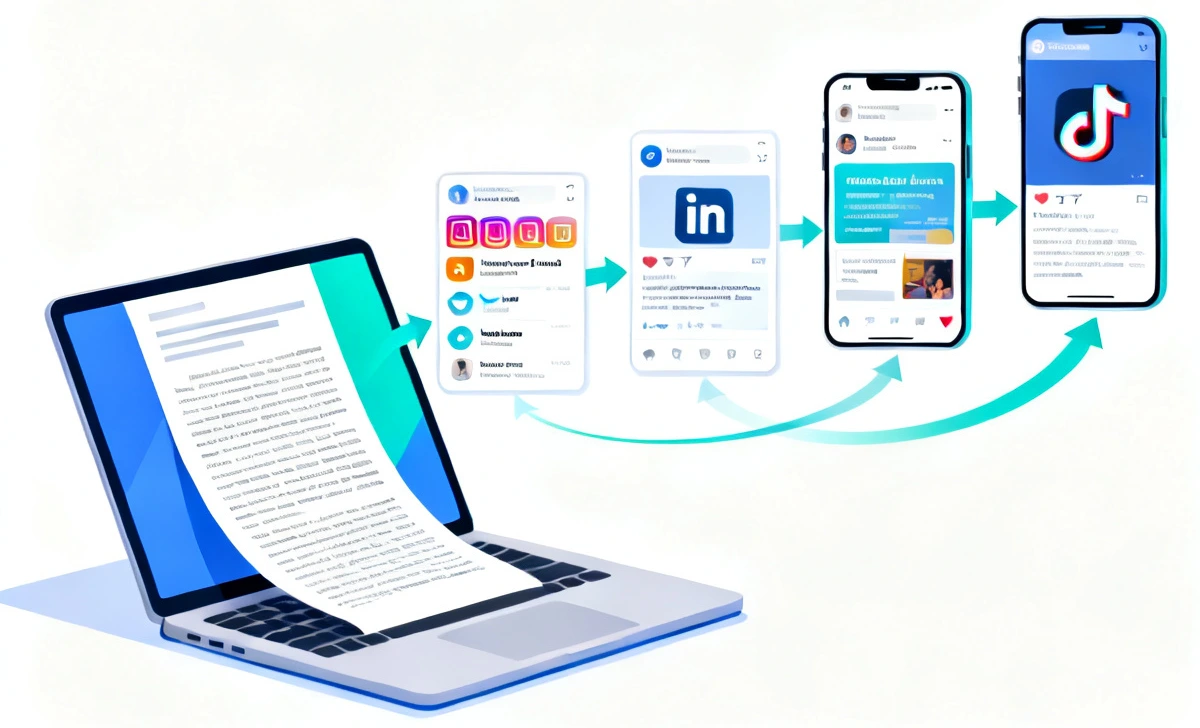
You are working hard every day to create content — but most of it disappears after 24 hours. One blog post, written with so much effort, gets a few reads and then fades away forever. That feels frustrating, right? The good news is that you don’t need to create new content every single day. The smartest move is to repurpose article into social posts — and that is exactly what this guide will teach you. You just need to use what you already have in a smarter way.
Most content creators make one big mistake. They write a great article, post it once, and move on. They never think about how that same content can reach thousands of people on Instagram, Twitter, LinkedIn, or TikTok. The problem is not a lack of ideas — the problem is a lack of strategy. Without a system, you keep starting from zero every single time.
In this article, you will find the complete step-by-step guide to turning one long-form article into 5 different social media posts. We will cover how to pick the right ideas, match them to the right platform, write hooks that stop the scroll, and schedule your content like a pro. By the end, you will have a simple system that saves you hours every week.
What Does Repurposing Content Mean?
Content repurposing means taking one piece of content and turning it into multiple formats for different platforms.
For example, one 1,500-word blog post can become 5 social media posts, 1 email newsletter, and 1 short video. Instead of creating new content every single day, you reuse what already works and push it to more audiences.
Think of it like cooking a big meal on Sunday and eating it throughout the week. The effort is the same, but the output is much bigger.
Why Repurposing Content Saves Time (and Increases Reach)
Most marketers struggle with consistency. Creating new content daily takes hours of effort and mental energy. Repurposing solves this problem without cutting corners on quality.
According to HubSpot (2024), marketers who repurpose content are 60% more likely to stay consistent with their posting schedule. Repurposed content also generates up to 2x more engagement compared to content that is only published once.
Here is why repurposing works so well:
- Different audiences prefer different platforms
- One idea can reach 5x more people with a small rewrite
- You reduce content creation time by up to 70%
- You reinforce your message through repetition across channels
If you want to understand how blog post ranking factors affect your content visibility, repurposing is directly connected — more distribution means more signals, more backlinks, and more authority for your original article.
Step-by-Step: Turn One Blog Post Into 5 Social Posts
Let us walk through a real example. Say you have a blog post called “How to Save Money Fast.” Here is exactly how to break it down into 5 platform-ready posts.
Step 1: Identify 5 Key Ideas
Scan your article and extract the most valuable pieces. Look for main tips, surprising statistics, useful quotes, and real-life examples.
From “How to Save Money Fast,” you might pull:
- Tip 1: Track your expenses daily
- Tip 2: Cut unused subscriptions
- Tip 3: Automate your savings every month
- Stat: 65% of people overspend without realizing it
- Quote: “Small habits create big financial changes.”
Each of these becomes the core idea for one social media post.
Step 2: Match Each Idea to a Platform
Every platform has a different style and audience. You cannot post the same thing everywhere and expect results.
| Platform | Content Type |
|---|---|
| Carousel (swipe post) | |
| Twitter / X | Thread |
| Story-style post | |
| Short value post | |
| TikTok / Reels | Short video script |
Match your strongest ideas to the platforms where your audience is most active.
Step 3: Rewrite — Don’t Copy
Never paste your blog text directly into a social media post. It will feel too long, too formal, and out of place.
Instead, shorten your sentences, add a strong hook at the top, and match the tone of each platform. Instagram wants bold and visual. LinkedIn wants professional and personal. Twitter wants short, punchy, and direct.
Step 4: Add a Hook and a Call to Action
Every social post needs two things: a hook that grabs attention in the first line, and a call to action (CTA) at the end.
Strong hooks look like this:
- “Most people waste money without knowing it.”
- “Stop scrolling — this tip will save you $300 a month.”
- “Here is why your savings account is still empty.”
Strong CTAs look like this:
- “Save this post for later.”
- “Read the full guide (link in bio).”
- “Comment ‘SAVE,’ and I’ll send you the guide.”
Without a hook, people scroll past. Without a CTA, people read and move on without taking any action.
Step 5: Schedule Your Content
Do not post everything at once. Spread your 5 posts across 5 to 7 days so your audience sees consistent content without being overwhelmed.
Use scheduling tools like Buffer, Hootsuite, or Later to plan posts. This takes about 30 minutes once a week.
Platform-Specific Content Formats (With Examples)
1. Instagram Carousel
A carousel is a series of swipeable slides. Slide 1 is your hook. Slides 2 through 5 are your tips. The last slide has your CTA.
Example: Slide 1 — “Stop wasting money” | Slides 2–5 — One tip per slide | Last Slide — “Read the full guide (link in bio)”
2. Twitter / X Thread
A thread breaks your content into connected tweets. Tweet 1 is your hook. Tweets 2 through 6 explain each tip. The last tweet links to your full article.
Example: “Most people waste money daily without realizing it. Here’s how to fix it in 5 steps,” — then one tweet per tip.
3. LinkedIn Post
LinkedIn works best with a short personal story that leads into your tips. Start with a real experience, share your lesson, then add bullet points for easy reading.
Example: “I realized I was wasting $300 a month on subscriptions I forgot I had. Here is what I did to fix it…”
4. Facebook Post
Keep it simple and direct. Facebook readers want quick value without too much scrolling.
Example: “Want to save money fast? Start with these 3 steps: Track your expenses. Cut unused subscriptions. Automate your savings. Full guide: [link].”
5. Short Video (Reels / TikTok)
Write a simple 30-second script. The first 3 seconds are your hook. The middle covers 3 quick tips. The last 3 seconds are your CTA.
Example: Hook — “Most people are losing money daily!” | Tips — 3 fast points | CTA — “Follow for more money-saving tips”
Tools to Speed Up Content Repurposing
You do not need to do this manually every time. These tools help you move faster:
- ChatGPT — Rewrite blog content into platform-specific formats quickly
- Canva — Create Instagram carousels and branded graphics
- CapCut — Edit short-form videos for Reels and TikTok
- Notion — Organize all your content ideas in one place
- Buffer — Schedule posts across all platforms at once
Even using just two or three of these tools will cut your content creation time in half.
Common Mistakes to Avoid
Many beginners start repurposing but make mistakes that kill their results. Here are the most common ones:
Copy-pasting content. Each platform has a different tone, format, and audience. What works on LinkedIn sounds stiff on TikTok. Always rewrite.
Skipping the hook. The first line decides everything. If it is boring, people scroll. Spend extra time writing a hook that creates curiosity or promises value.
No call to action. If you do not tell people what to do next, they will do nothing. Always end your post with a clear next step.
Posting everything at once. If you publish all 5 posts in one day, you waste your own content. Space them out over the week.
What High-Performing Marketers Do Differently
Top content creators do not just repurpose randomly. They follow a clear system and treat every article like a content machine.
They turn 1 blog post into 10 or more pieces of content. They focus on one idea per post instead of cramming everything in. And they regularly revisit their best-performing posts to repurpose them again months later.
Content strategist Justin Welsh has said that most creators do not need more content — they need more distribution. That one shift in thinking changes everything.
Final Thoughts
Repurposing content is not about working harder. It is about working smarter and getting more value from every piece of content you create.
One strong article can fuel your entire week of social media posts. The system is simple: find 5 ideas, match them to 5 platforms, add hooks and CTAs, and schedule consistently.
The real advantage does not come from being the most creative person online. It comes from having a system and showing up every single day. Start with your best article today and try turning it into just one social post. Then build from there.