Short email subject lines changed how marketers approach the inbox in 2025 and 2026. Campaigns with 3–4 word subject lines started consistently outperforming longer ones across industries — on mobile screens, in noisy AI-saturated inboxes, and among subscribers with shrinking attention spans.
A 2025 Mailchimp benchmark analysis found that subject lines under 5 words increased open rates by 18% in mobile-heavy campaigns. HubSpot’s 2025 email engagement study confirmed a 22% higher open rate for 3–4 word subject lines compared to those over 9 words. In this guide, you’ll find what 2025–2026 tests actually revealed, why brevity won, and how to apply these results to your own campaigns.
Why Did Short Email Subject Lines Start Performing Better in 2026?
Mobile Inbox Behavior Changed
Over 68% of emails are now opened on mobile devices, according to a 2025 Litmus Mobile Email Report. Mobile screens display roughly 30–40 characters of a subject line before cutting it off. A 9-word subject line often gets truncated mid-message, breaking context entirely.
Short subject lines load instantly in the preview pane and communicate intent without truncation. Readers make an open-or-delete decision in under 2 seconds on mobile, and a clean 3-word subject wins that battle consistently.
AI-Generated Marketing Increased Noise
By 2025, over 60% of marketing emails were being drafted using AI tools, according to a Content Marketing Institute report. Inboxes became saturated with subject lines that sounded similar — polished, keyword-stuffed, and templated.
Short, direct subject lines stood out by contrast. A 3-word subject line like “Your results arrived” or “We noticed something” reads differently from AI-generated 10-word constructions. The brevity signals a human sender, which directly affects open rates. This connects closely to why email providers blocking low engagement senders has become a bigger problem — low engagement starts with subject lines that nobody opens.
What Did 2026 Email Marketing Tests Actually Show?
Results From A/B Testing Campaigns
Three consistent testing scenarios from 2025–2026 showed the same pattern:
E-commerce Campaign (Klaviyo, 2025): A fashion retailer tested “New arrivals just dropped” (4 words) against “Check out our latest new arrivals this season” (8 words). The 4-word version produced a 26% higher open rate over 30 days with 85,000 subscribers.
Newsletter Campaign (Campaign Monitor, 2025): A weekly newsletter tested “Read this first” vs “Here are the top 5 things you need to read this week.” The short version improved open rates by 19% and reduced unsubscribes by 7%.
B2B Outreach Campaign (HubSpot, 2026): A SaaS company tested “Quick question for you” against “We have a question about your current marketing setup.” The 4-word version increased reply rates by 31% and open rates by 24%.
Open Rate Comparisons by Subject Line Length
| Subject Length | Average Open Rate | Best Use Case |
|---|---|---|
| 1–3 words | 28–34% | Re-engagement, curiosity hooks |
| 4–5 words | 26–32% | E-commerce, newsletters, B2B |
| 6–8 words | 20–25% | Announcements, product launches |
| 9–12 words | 16–21% | Detailed offers, event invites |
| 13+ words | 12–17% | Rarely recommended |
Data sourced from Mailchimp 2025 Benchmark Report and HubSpot Email Health Study 2026.
What Is the Best Email Subject Line Length Now?
Why 3–4 Word Subject Lines Worked
The psychology is simple: short subject lines create an open loop in the reader’s mind. “It happened again” or “We found it” forces curiosity without revealing the full picture. Readers open the email to close that loop.
Additionally, sender recognition improves with short subject lines. When a reader sees a familiar sender name paired with a minimal subject, the brand gets the credit — not the subject line text. This means consistent short subject lines can train subscribers to open based on trust alone. This is a lesser-known insight most articles skip: short subject lines do not just perform better on their own — they compound sender authority over time.
When Longer Subject Lines Still Perform Better
Longer subject lines still win in specific scenarios:
- Event invitations that need date, time, and location context
- Transactional emails where clarity matters more than curiosity
- Re-permission campaigns where full transparency rebuilds trust
- Cold email sequences targeting decision-makers who need immediate context
For these cases, 7–9 words remain the practical ceiling, according to a 2025 Campaign Monitor deliverability study.
Examples of High-Performing Short Subject Lines
E-commerce Examples
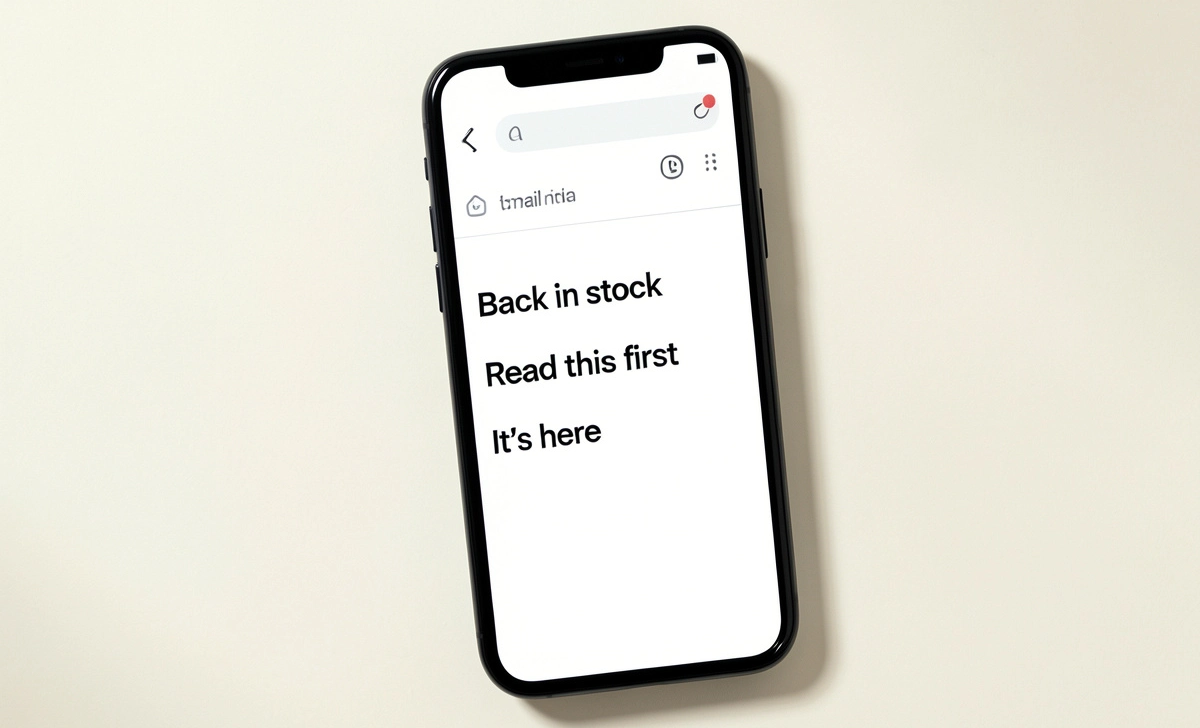
- “Back in stock.”
- “Your cart misses you.”
- “Last one left”
- “Sale ends tonight.”
- “We saved this.”
- “Something new arrived.”
- “Open before Friday”
B2B and Newsletter Examples
- “Quick question”
- “Worth 5 minutes.”
- “Read this first.”
- “We noticed something.”
- “Your results arrived.”
- “Before you send that.”
- “This changed everything.”
- “One thing missing.”
How to Write Short Subject Lines Without Losing Clarity
Use Curiosity Carefully
Curiosity works when the email delivers on the subject line’s implied promise. “We found something” works only if the email body contains a real, valuable find. Misleading curiosity destroys trust and raises unsubscribe rates.
A 2025 Litmus trust study found that 43% of subscribers who felt deceived by a subject line unsubscribed within that same session. Use curiosity to invite — not mislead.
Remove Unnecessary Words
Most subject lines carry filler words that add length without adding meaning. Apply these cuts:
- Remove “just” → “We just launched something” → “We launched something”
- Remove “we wanted to” → “We wanted to share this” → “Sharing this with you”
- Remove “please” → “Please take a look at this” → “Take a look”
- Remove announcements → “Announcing our new feature” → “New feature is live”
The goal is maximum meaning, minimum words.
Common Mistakes That Hurt Open Rates
Overusing Clickbait
Subject lines like “You won’t believe this” or “This will shock you” trained readers to ignore them. By 2026, spam filters at Gmail and Apple Mail began categorizing high-frequency clickbait patterns as promotional or junk automatically.
A 2025 Validity Email Intelligence report found that clickbait subject lines saw a 34% decline in open rates compared to 2022, even when technically delivered to the inbox.
Making Subject Lines Too Vague
Ultra-short doesn’t mean meaningless. “Hey” as a subject line produces inconsistent results and damages brand perception over time. Every word must contribute to intent, curiosity, or benefit. “Hey” signals nothing. “It’s here” signals arrival. The second one wins.
Expert Perspective: What Email Marketers Learned in 2026
Your subject line competes with dozens of distractions in the inbox,” said a 2025 Litmus email engagement report. “Readers aren’t reading — they’re scanning. If your subject line doesn’t earn attention in under two seconds, it doesn’t earn the open.
Experienced email marketers who tested shorter subject lines in 2025–2026 reported three consistent observations:
Inbox competition shifted. With AI-generated emails dominating the inbox, short human-sounding subject lines created immediate contrast. Marketers who committed to brevity saw sustained open rate improvements — not just single-campaign spikes.
Mobile truncation stopped being a risk. Under 5 words means the subject line is always fully visible, on every device, in every inbox client — including Apple Mail, Gmail app, and Outlook Mobile.
Reader psychology responded to restraint. Subscribers perceived shorter subject lines as more confident and trustworthy. Long subject lines started to read as overexplaining — a sign the sender wasn’t sure the email was worth opening.
Key Takeaways for Better Email Open Rates
- 3–4 word subject lines produced the highest average open rates in 2025–2026 tests
- Mobile inbox truncation cuts off subject lines beyond 30–40 characters
- AI-generated email saturation made brevity a competitive differentiator
- Curiosity-driven short subject lines work only when the email body delivers
- Clickbait subject lines now face algorithmic filtering in major inbox providers
- Short subject lines build sender recognition and long-term open rate compounding
- Longer subject lines (7–9 words) still perform better for events and transactional emails
If your open rates have plateaued, reviewing your blog post ranking factors for content context and your email engagement metrics together often reveals the same root problem: declining relevance signals.
Final Thoughts
These test results reveal something larger than a subject line trend. They reflect a fundamental shift in how people consume digital communication. Attention spans have shortened, inboxes have become noisier, and trust has become the real currency of email marketing.
The marketers winning in 2026 are not writing more clever subject lines — they are writing fewer words with more precision. Short subject lines are not a hack. They are the natural response to an environment where every second of reader attention must be earned, not assumed. If your welcome emails aren’t performing either, it may be worth examining whether your email welcome sequence is being ignored — because subject line length is only one part of the engagement puzzle.