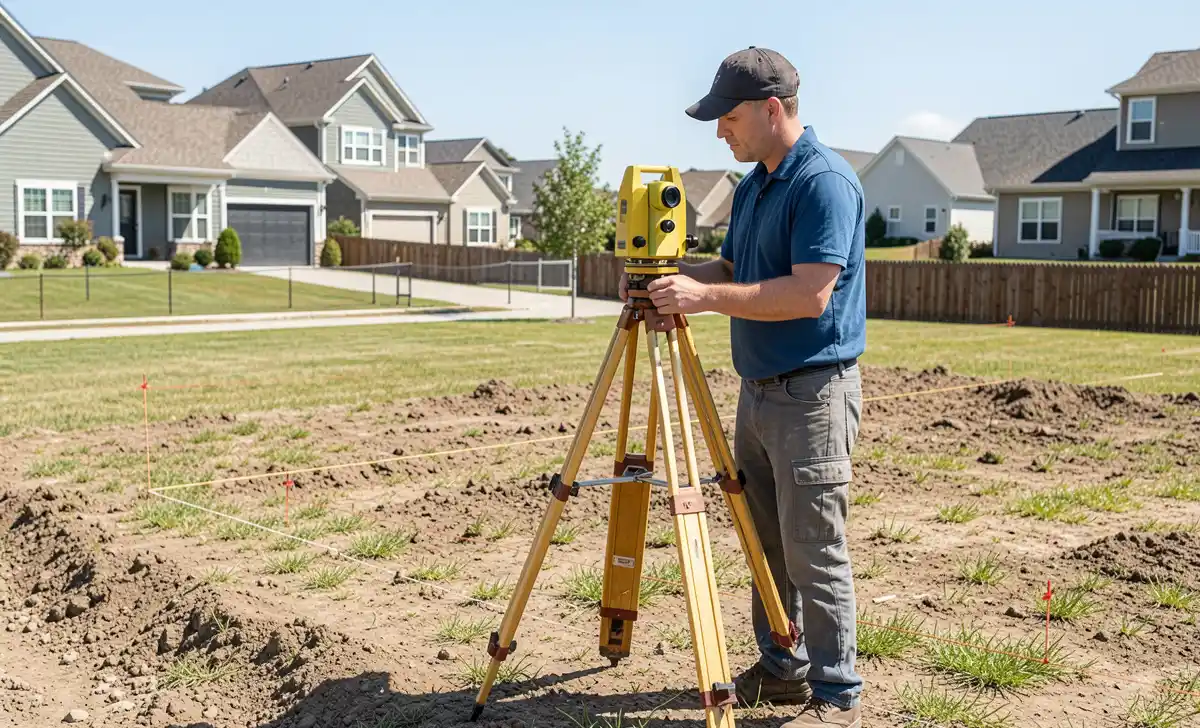
A neighbor builds a fence, and six months after closing, you find out it sits two feet inside your property line. Now you face legal fees, a damaged relationship, and a boundary dispute no one warned you about. This happens more often than buyers expect — and a home inspection checklist alone won’t catch it.
A property survey is a legal document prepared by a licensed surveyor that defines the exact boundaries of a parcel of land. It shows boundary lines, easements, encroachments, and physical features of the property. Lenders, title companies, and real estate attorneys all rely on it to confirm what you are actually buying.
In this guide, you’ll learn everything about property survey before buying a home — what it reveals, why it matters, common risks buyers miss, and how to avoid expensive surprises.
What Is a Property Survey?
A property survey is an official measurement of a piece of land. A licensed surveyor visits the site, measures the lot, and produces a scaled map showing the legal boundaries and anything that affects those boundaries.
What Information Does a Property Survey Show?
A survey typically includes:
- Boundary lines — the exact edges of the property
- Easements — rights others hold to use part of your land
- Encroachments — structures that cross a boundary line
- Lot dimensions — length, width, and total area
- Flood zone classification — relevant for insurance and building permits
- Existing structures — house, garage, shed, fences, and driveways
Types of Property Surveys
| Survey Type | Purpose |
|---|---|
| Boundary Survey | Confirms legal property lines |
| ALTA/NSPS Survey | Required by many commercial lenders; most detailed |
| Topographic Survey | Maps elevation and land contours |
| Mortgage Survey | Basic survey accepted by some residential lenders |
| Construction Survey | Used before building or adding structures |
Why Do You Need a Property Survey Before Buying?
Skipping a survey saves you a few hundred dollars upfront. It can cost you thousands later. Here are the specific problems it protects you from.
Boundary Disputes
Boundary disputes are among the most common post-closing conflicts in residential real estate. Deeds describe land using language written decades ago — often referencing trees, stakes, or monuments that no longer exist. A survey replaces that ambiguity with precise measurements.
Easements and Access Rights
An easement gives someone else the legal right to use part of your property. A utility company may have the right to run lines through your backyard. A neighbor may hold a right-of-way across your driveway. You inherit these rights when you buy. Without a survey, you may not know they exist until you try to build or sell.
Encroachments
An encroachment happens when a structure crosses a property line — a garage that sits partly on the neighbor’s lot, a fence that cuts into a setback zone, or a deck that extends beyond your boundary. These are title issues that can delay or block a future sale.
Zoning and Building Issues
Surveys reveal whether existing structures comply with local setback requirements. If a previous owner built an addition too close to the property line, you inherit a zoning violation. That can stop you from negotiating a lower price or getting permits approved for future work.
What Problems Can a Survey Reveal?
Fence and Driveway Disputes
Fences are the most common source of neighbor conflicts. A fence installed by a previous owner often sits in the wrong location. If it encroaches on a neighbor’s land, you may be required to move it — at your expense.
Shared Structures or Utility Access
Party walls, shared driveways, and utility easements create legal obligations. A survey makes these visible before you sign anything.
Illegal Additions or Extensions
Home additions built without permits sometimes violate setback lines or lot coverage limits. A surveyor will flag these. Left unaddressed, they can make the property uninsurable or unsellable.
Does a Mortgage Lender Require a Property Survey?
Lender Requirements
Requirements vary by lender and loan type. FHA and VA loans often require a survey in rural areas or when the property has irregular boundaries. Conventional lenders may accept a title insurance policy instead — but that does not mean a survey is unnecessary.
Many buyers assume title insurance replaces a survey, but it does not identify physical boundary problems, says licensed surveyor Mark Jensen. Title insurance protects you financially after a claim. A survey prevents the problem before you close.
Title Insurance vs Property Surveys
| Feature | Title Insurance | Property Survey |
|---|---|---|
| Covers ownership disputes | Yes | No |
| Identifies boundary lines | No | Yes |
| Reveals encroachments | No | Yes |
| Required by lenders | Sometimes | Sometimes |
| One-time cost | Yes | Yes |
| Prevents future legal disputes | No | Yes |
Title insurance pays for legal costs after a problem is discovered. A survey prevents you from buying a problem in the first place.
How Much Does a Property Survey Cost in 2026?
Average Survey Costs
Survey costs in 2026 vary by location, lot size, and survey type:
- Residential boundary survey: $400 – $900
- ALTA/NSPS survey: $1,500 – $5,000+
- Topographic survey: $500 – $1,200
- Mortgage survey: $150 – $400
These figures sit well below what a single boundary dispute can cost in legal fees, which often exceeds $5,000 before reaching a resolution.
What Affects the Price?
- Lot size and shape — irregular lots cost more to measure
- Location — rural properties with unclear records require more research
- Survey type — ALTA surveys carry the highest price because of their scope
- Access to historical records — older properties with gaps in documentation take longer
Understanding closing costs for buyers helps you budget for a survey alongside other pre-closing expenses.
When Should You Get a Property Survey?
Before Closing
Order a survey after your offer is accepted, during the due diligence period. This gives you time to review results, raise concerns with the seller, or walk away if problems are serious. Do not wait until after closing.
Before Building or Renovating
Even if you already own the property, get a survey before adding a structure, extending a driveway, or installing a fence. Building across a boundary line creates a legal liability that is expensive to correct.
How to Read a Property Survey
Boundary Lines
Boundary lines appear as solid or dashed lines on the survey map. Each corner of the lot is marked with a monument — often an iron pin or concrete marker. Measurements between corners are shown in feet or meters.
Easement Markings
Easements appear as shaded areas or dotted lines with a notation explaining the type — utility, drainage, or access easement. These areas restrict what you can build.
Encroachment Indicators
An encroachment shows up when a structure extends beyond a boundary line or into an easement zone. Surveyors note these clearly. If you see one, ask a real estate attorney what it means before proceeding.
What Happens If You Skip a Property Survey?
Expert Perspective: Real estate attorney Sandra Cho notes that buyers who waive surveys to speed up closing often spend 10x the survey cost on disputes within three years of ownership. The most common issues — fence placements, utility access, and illegal additions — are all preventable with a basic boundary survey.
Lesser-known insight most buyers miss: An old survey in the listing documents is not the same as a current survey. Property conditions change. Neighbors build additions. Easements get recorded after the last survey date. Always request a new survey dated within the last 12 months.
Checklist — Signs you should never skip a survey
- The property is adjacent to a body of water, road, or shared drive
- The lot is an irregular shape or has an unusual description in the deed
- There are visible fences, sheds, or structures near the property line
- The listing mentions an easement or shared access
- The property has not been surveyed in more than 10 years
- You plan to build, renovate, or subdivide after purchase
- The neighborhood has a history of boundary disputes
Key Takeaways — Is a Property Survey Worth It?
A property survey is one of the least expensive protections you can buy in a real estate transaction. For $400 to $900 on most residential purchases, you get legal confirmation of exactly what you own — and what obligations come with it.
Title insurance and a home inspection address different risks. Neither one shows you where your property ends and your neighbor’s begins. Only a survey does that.
The cost of a survey is fixed. The cost of skipping one is not.