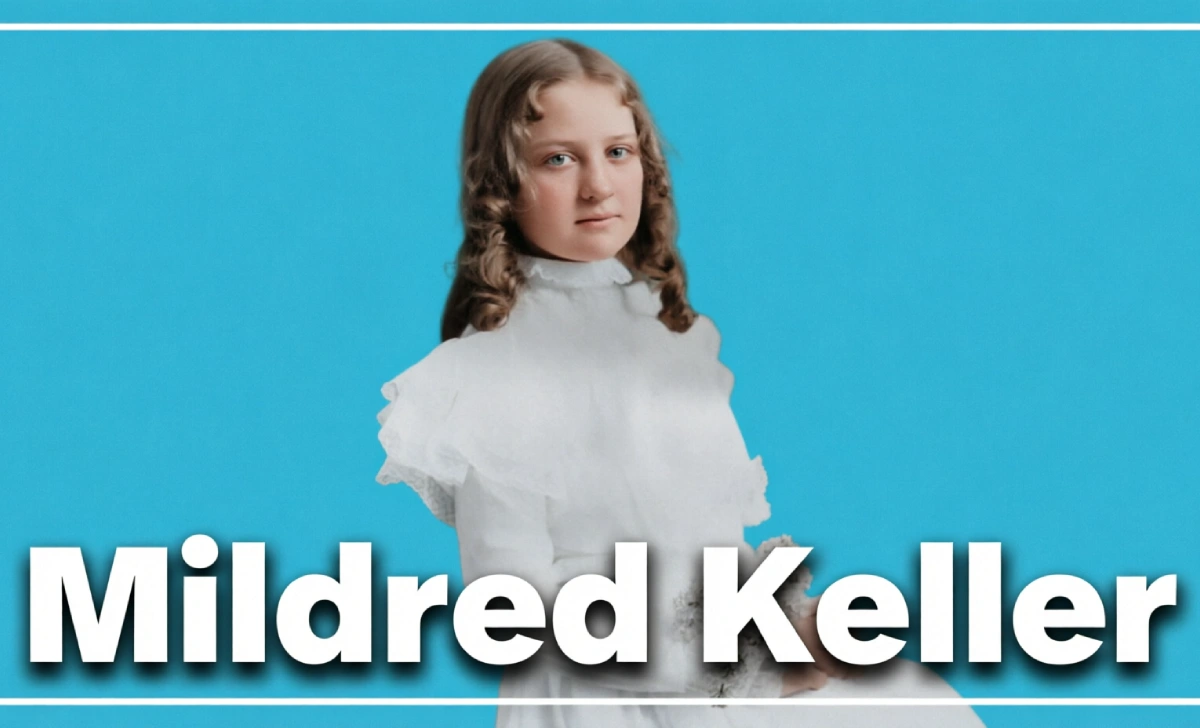
Most people know the name Helen Keller. But very few have ever stopped to ask — who was the girl standing beside her?
Mildred Keller is one of history’s most overlooked figures. Born into the same family that produced one of the most celebrated women of the 20th century, Mildred lived a quiet, dignified life that rarely made headlines. Yet her story — of sibling rivalry, unexpected bonding, and quiet resilience — deserves to be told in full.
From Ivy Green to History: The Keller Family Roots
The Keller family lived on a homestead called Ivy Green in Tuscumbia, Alabama. It was a household shaped by history, hardship, and Southern tradition. Captain Arthur Henley Keller had served in the Confederate Army during the American Civil War, and Kate Keller was a tall, statuesque woman some twenty years younger than her husband.
This was the world Mildred Keller was born into. Mildred Campbell Keller Tyson was born on October 26, 1886, and died on December 18, 1969. She came into a family already marked by extraordinary circumstances. Her older sister Helen had lost both sight and hearing as a toddler, and the entire Keller household revolved around that reality.
Growing up at Ivy Green meant growing up in a house where nothing was ordinary. Visitors came and went. Teachers arrived. The outside world watched. And young Mildred grew up in the middle of all of it — not as the subject of attention, but as a witness to someone else’s miracle.
The Sister No One Talks About: Early Life of Mildred Keller
When Mildred arrived, she was not exactly welcomed with open arms — at least not by Helen.
Helen reveals that for a long time she regarded her little sister Mildred as an intruder on her mother’s love, and was particularly angry when she found her baby sister sleeping in her favorite doll, Nancy’s, cradle.
That kind of jealousy is understandable. Helen had been the center of the family’s concern for years. Every moment of attention was precious. And then — suddenly — here was this new baby demanding the same love.
But one moment changed everything between them. Their mother’s timely arrival saved Mildred during a dangerous incident, and later the love between the hearts of the two sisters prospered, despite the fact that neither of them understood the language of the other.
That’s the part worth sitting with. Two sisters. One blind and deaf. The other fully sighted and hearing. Yet somehow, they found each other. They built a bond across an impossible communication gap — and that bond would last a lifetime.
Growing Up Together: A Bond Forged in Silence
What did childhood look like for Mildred Keller? It was unusual, to say the least.
She watched Anne Sullivan arrive at their home in 1887 and transform her sister’s life. She saw Helen learn to read, write, and eventually speak. She lived through the upheaval of a family constantly in the public eye — journalists, educators, and curious strangers always circling.
Mildred also attended the Cambridge School with Helen for six months, which says something important. These were not two sisters growing apart. They were, in key moments, choosing to be together — even in formal education.
Helen’s own letters make this affection vivid. In a letter dated July 14, 1890, she wrote about her sister with remarkable warmth, calling her the sweetest and dearest little child in the world — words that capture just how much Mildred meant to her.
Though Mildred was never truly able to understand Helen’s finger language, the two eventually developed a close relationship. Language did not define their sisterhood. Something deeper did.
Adventures and Near-Misses: Mildred’s Role in Helen’s Story
Mildred was not just a background character. She appeared at key moments in Helen’s written life — sometimes as a companion, sometimes as a lifeline.
One memorable story involves the two sisters getting lost in the woods while gathering persimmons near their family’s summer retreat. Mildred noticed a trestle that served as a shortcut home, and when they suddenly saw a train approaching, they luckily managed to climb down in time.
It was Mildred’s alertness that saved them both that day.
This moment is small in the grand sweep of history. But it reveals something true about who Mildred was. She was observant. She was quick. She looked out for her sister even when no one was watching.
That quiet competence — the ability to show up without fanfare — defined Mildred Keller throughout her life.
Later Life: Marriage, Family, and a Private Path
Unlike her famous sister, Mildred Keller chose a life away from the spotlight. She married Warren Tyson and became Mildred Campbell Keller Tyson. She settled in Montgomery, Alabama, where she lived for decades in relative privacy.
Historical records confirm her presence in Colbert, Alabama in early census records, and her death on December 18, 1969, in Alabama.
She outlived her mother. She outlived Helen. She watched her sister become a global icon — featured on stamps, honored in films, celebrated by presidents. And through all of it, Mildred kept her distance from fame.
That was a choice. And it was a dignified one.
There is a kind of courage in refusing the spotlight when it is offered. Mildred never traded on her sister’s name. She never published a memoir to claim credit for her role in Helen’s life. She simply lived — and that, in itself, is worth noting.
The Cultural Legacy of Mildred Keller
Why does Mildred matter to us today?
Because the Keller story — the version most people know — is incomplete without her. Helen Keller did not emerge from isolation. She emerged from a family. And Mildred was a central, warm, human part of that family.
Helen’s autobiography, The Story of My Life, and the dramatic cycle it inspired — including the Oscar-winning film The Miracle Worker — shaped how the world understood the Keller household. But Mildred appears only in the margins of those stories. She deserves more than a footnote.
Modern disability historians are beginning to pay closer attention to the full Keller family context. What was it like to be the sibling of someone with such profound disabilities in the 1880s American South? How did Mildred navigate a childhood where her sister’s needs always came first? These questions matter — and answering them requires taking Mildred seriously as a historical figure.
She also represents something rare: a person who witnessed extraordinary history from the inside and chose silence over celebrity. In an era of oversharing and personal branding, that restraint is almost radical.
What Mildred Keller Teaches Us
There is no empire to assess here. No net worth. No business ventures. Mildred Keller was not a public figure in the conventional sense.
But she was something arguably more valuable — a steady, loving presence in the life of a woman who changed the world.
Helen’s own letters describe Mildred as someone she was desperately eager to see, someone whose growth and health she followed with genuine joy. That kind of bond — uncomplicated, enduring, crossing the boundaries of language and disability — is rare at any point in history.
Mildred Keller lived for 83 years. She watched her family’s name become immortal. She watched Helen receive the Presidential Medal of Freedom and be counted among the most admired people of the 20th century. And she remained, throughout it all, simply: a sister.
Conclusion: Remembering Mildred Keller on Her Own Terms
History has a habit of erasing the people who stand beside greatness rather than embodying it. Mildred Keller is one of those people.
She was born into a family unlike any other, formed a bond with her sister despite every barrier, and lived a full private life that history has barely recorded. But her presence in Helen Keller’s story — in the letters, in the adventures, in the quiet companionship of two girls growing up together at Ivy Green — is undeniable.
FAQs
Who was Mildred Keller?
Mildred Keller was the younger sister of Helen Keller, born on October 26, 1886, in Tuscumbia, Alabama. She later married Warren Tyson and lived most of her life in Montgomery, Alabama, away from public attention.
What was the relationship between Helen Keller and Mildred Keller?
Their relationship started with jealousy — Helen saw Mildred as an intruder on their mother’s love. Over time, the two grew into close companions, sharing childhood adventures and genuine affection, though Mildred never fully learned Helen’s finger language.
Did Mildred Keller attend school with Helen?
Yes. Mildred attended the Cambridge School with Helen Keller for a period of six months, showing that despite their differences, the two sisters actively chose to spend time together during key life stages.
How long did Mildred Keller live?
Mildred Campbell Keller Tyson lived from October 26, 1886, to December 18, 1969 — a full 83 years. She outlived her famous sister Helen, who died on June 1, 1968.
Why is Mildred Keller not well-known?
Mildred deliberately stayed out of public life and never sought recognition based on her family name. While Helen Keller became a global icon, Mildred chose a quiet private life in Alabama, which is why history has largely overlooked her.