
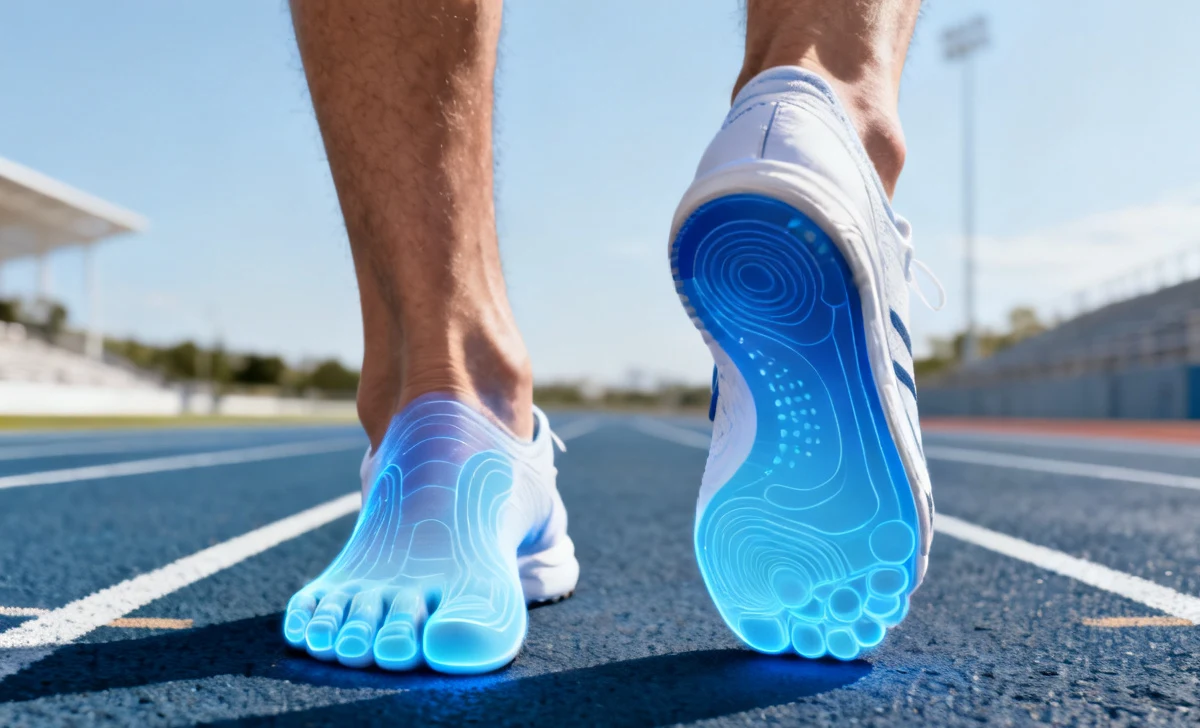
Flat feet are widely labeled a structural weakness in athletes, but several elite performers at the Olympic level compete with pes planus and report no performance disadvantage. In some disciplines, the condition appears to offer measurable benefits rather than limitations.
Flat feet (pes planus) occur when the medial longitudinal arch is absent or reduced, causing the entire sole to contact the ground. This alters force distribution, ankle mechanics, and muscle activation patterns — factors that matter differently across sports.
In this article, you will learn everything about flat feet sports performance — which athletes benefit from them, how biomechanics play a role, and what sports science actually says — all in one place.
What Are Flat Feet and How Do They Affect Athletes?
Understanding Foot Arch Biomechanics
The foot arch acts as a spring-like energy storage system during movement. A high arch compresses and recoils, returning stored energy during push-off. Flat feet skip this spring mechanism — instead distributing load across a wider plantar surface.
This wider contact area changes how ground reaction forces travel through the kinetic chain. Forces move more directly through the ankle and tibia, reducing the elastic energy return but increasing stability at the base of each stance phase.
Research published in the Journal of Foot and Ankle Research found that individuals with flat feet display greater medial foot contact and altered tibial rotation during weight-bearing activities — two factors with both advantages and trade-offs depending on the sport.
Common Misconceptions in Sports Science
The most persistent myth is that flat feet automatically cause injury or underperformance. Clinical data do not fully support this.
A 2012 study in Medicine & Science in Sports & Exercise tracked 1,930 military recruits and found no significant difference in injury rates between flat-footed and normal-arched recruits over a training period. The assumption that arch height directly predicts athletic outcome is an oversimplification.
Can Flat Feet Actually Improve Sports Performance?
Stability Advantages in Strength Sports
In Olympic weightlifting and powerlifting, a flat foot creates a broader base of support. A wider plantar contact area lowers the body’s center of mass during the catch phase of a clean or snatch, improving balance under heavy loads.
This is one of the lesser-known biomechanical advantages: flat-footed lifters often require less conscious effort to maintain foot stability during squats and deadlifts, as the arch does not create an imbalanced pressure point under load.
Ground Contact and Force Distribution
Ground reaction force (GRF) is the force the ground exerts back on the body during athletic movement. Flat feet distribute this force over a larger surface area, which can reduce peak plantar pressure at any single point.
- Lower peak heel pressure during landing
- More even load across the metatarsals
- Reduced localized stress on the lateral column
This distribution pattern is particularly relevant in contact and collision sports where landing mechanics matter.
Which Sports Benefit from Flat Feet?
Weightlifting and Power Sports
Flat-footed athletes in squat-based movements often show greater natural ankle dorsiflexion due to reduced arch height tension. This allows a more vertical shin angle, a mechanical advantage for quad-dominant lifts.
In wrestling and judo, a wide, flat foot increases traction and makes it harder for opponents to disrupt an athlete’s base. Coaches in these disciplines often report that flat-footed athletes adapt faster to stance-based stability work.
Swimming and Water Resistance Efficiency
Swimming is arguably the sport where flat feet provide the clearest advantage. A flatter, more flexible foot acts as a larger paddle surface during the flutter kick and dolphin kick. Greater plantar flexibility — common in pes planus — increases propulsive surface area through the water.
Research from the International Journal of Sports Physiology and Performance noted that elite swimmers tend to display greater foot flexibility and lower arch profiles compared to non-swimmers of the same age group.
Cycling and Endurance Sports
In cycling, the foot sits fixed on a pedal, and the arch plays no spring role whatsoever. Flat-footed cyclists face no disadvantage and sometimes benefit from a more natural, broader forefoot position on the pedal platform.
For breathing efficiency during endurance events, overall athletic conditioning matters far more than arch height — a detail often overlooked when evaluating flat-footed endurance athletes.
Flat Feet vs High Arches in Athletic Performance
Shock Absorption Differences
| Feature | Flat Feet | High Arches |
|---|---|---|
| Arch spring recoil | Low | High |
| Plantar pressure distribution | Wide | Narrow |
| Ankle pronation tendency | Higher | Lower |
| Flexibility | Greater | Less |
| Force absorption area | Larger | Smaller |
High arches store and return more elastic energy per stride — a clear advantage in distance running. Flat feet absorb force across a broader surface — a structural benefit in static strength positions.
Injury Risk Comparison
Neither arch type is universally safer. High arches increase the risk of:
- Stress fractures (concentrated load)
- Plantar fasciitis (tight fascia)
- Lateral ankle sprains (less foot eversion)
Flat feet increase the risk of:
- Posterior tibial tendon dysfunction
- Shin splints (medial tibial stress)
- Knee tracking issues (excess pronation)
The key variable is not arch height but load management and training adaptation.
Do Flat Feet Affect Running Performance?
Sprinting vs Long-Distance Running
In sprinting, the brief ground contact time (under 100ms at the elite level) means arch spring energy return matters less. Flat-footed sprinters compensate through calf and hip muscle activation patterns. Several world-class sprinters have competed and medaled with documented pes planus.
In long-distance running, the cumulative effect of reduced energy return per stride adds metabolic cost over time. However, strong intrinsic foot muscles can partially offset this. A 2019 study in Gait & Posture found that arch stiffness training improved running economy in flat-footed runners by 4.3% over 8 weeks.
Real Athlete Case Insights
Mo Farah, the British long-distance Olympic gold medalist, has been observed with a low arch profile in multiple biomechanical assessments. His training team focused on foot strength and calf conditioning rather than corrective orthotics as his primary intervention — a practical example of managing flat feet through strength rather than suppression.
Biomechanics Behind Flat Feet in Sports
Foot Pressure Distribution
Pedobarographic analysis (in-shoe pressure mapping) consistently shows that flat-footed athletes distribute force across the midfoot during stance — an area high-arched individuals largely skip. This midfoot loading:
- Activates the tibialis posterior more continuously
- Increases proprioceptive feedback from the plantar surface
- Creates a more grounded sensory connection to the surface
In martial arts and gymnastics, this heightened proprioception can improve balance and reaction speed.
Balance and Ground Reaction Force
A 2020 study in PLOS ONE measured balance performance in 120 athletes across three arch height categories. Flat-footed athletes scored comparably or better on static balance tasks, suggesting their wider base compensates for the absence of arch recoil. Dynamic balance tasks showed more variation depending on sport-specific training history.
Expert Opinions on Flat Feet in Athletics
Sports Science Perspective
Dr. Benno Nigg, biomechanics researcher at the University of Calgary and one of the leading figures in running shoe science, has argued for years that the relationship between foot posture and injury is weaker than the footwear industry implies. His position: individual movement patterns and muscle strength matter more than static arch measurements in predicting athletic outcome.
Physiotherapist Insights
Sports physiotherapists working with national-level track and field athletes frequently report that uncorrected, asymptomatic flat feet in well-conditioned athletes rarely require intervention. The clinical concern is not arch height per se — it is whether the athlete’s kinetic chain is compensating in ways that build cumulative stress at the knee or hip.
The consensus in current sports medicine leans toward load management and foot strengthening over automatic orthotic prescription for flat-footed athletes who are performing and training without symptoms.
Should Athletes Train Differently with Flat Feet?
Flat-footed athletes benefit from targeted conditioning rather than wholesale changes to training structure. Key areas to address:
- Intrinsic foot muscle strengthening — short-foot exercises, toe spreads, single-leg calf raises
- Posterior tibial tendon conditioning — eccentric heel drops on an inclined surface
- Hip abductor strength — reduces compensatory knee valgus linked to excess pronation
- Footwear selection — motion-control or stability shoes for high-mileage runners; minimalist shoes may be appropriate for strength sport athletes with strong feet
Orthotics are not automatically necessary. They should be considered only when symptoms — not just arch shape — are present.
Key Takeaways — What Athletes Should Know
- Flat feet are not a disqualifying condition for high-level athletics
- They provide measurable advantages in weightlifting, swimming, and stability-based sports
- Running economy can be maintained with targeted foot and calf strengthening
- Injury risk is driven by training load and muscle strength, not arch height alone
- Expert consensus has shifted away from treating flat feet as an automatic problem
Conclusion
Flat feet challenge a long-standing assumption in sports medicine — that structural deviation from an idealized arch is inherently limiting. The evidence shows a more complicated picture, one where sport specificity, training adaptation, and muscle conditioning determine outcomes more reliably than arch height.