
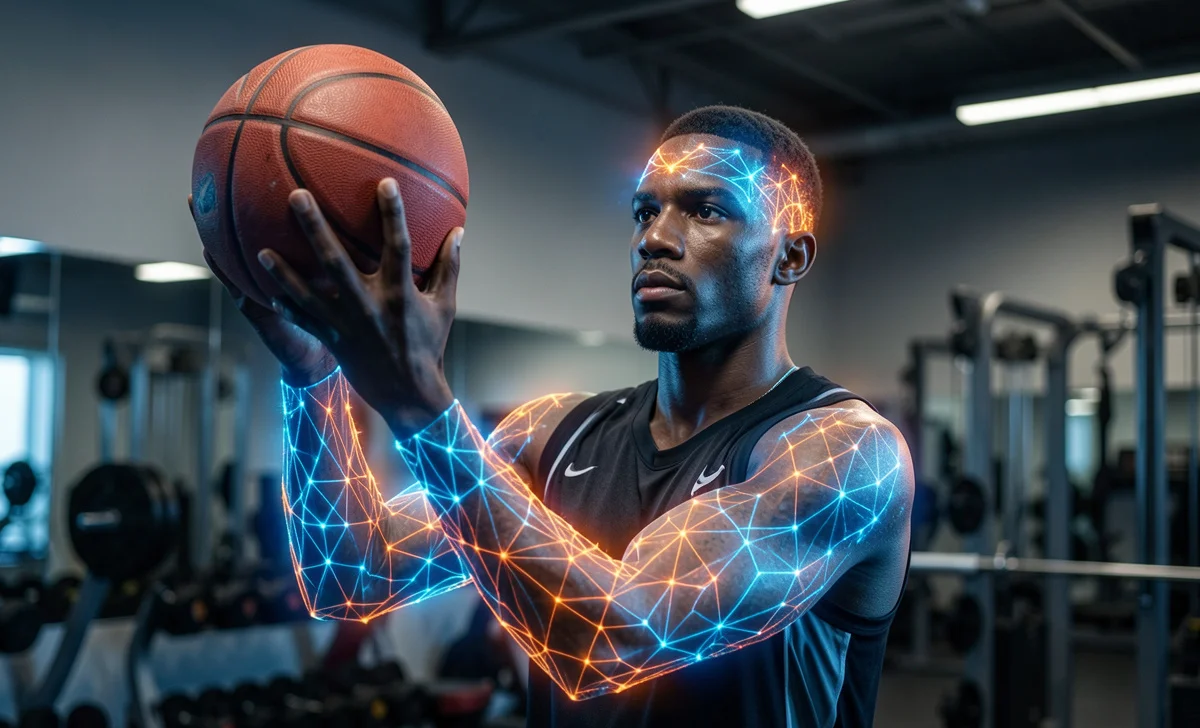
Athletes often regain lost skills faster than beginners learn them — even after months away from training. A footballer who stopped playing for a year can dribble again within days. A swimmer returns after a long break, and their strokes feel natural almost immediately. This is not luck. This is muscle memory at work.
Muscle memory is the process by which your body learns to perform movements automatically through repeated practice. It plays a major role in sports performance, helping athletes move efficiently without thinking about every step.
In this guide, you will learn how muscle memory works, the science behind it, real sports examples, and how to build it faster — everything in one place.
What Is Muscle Memory in Sports Training?
Muscle memory refers to the brain’s ability to recall and repeat physical movements through consistent practice. The term is a bit misleading — muscles themselves don’t store memory. The memory lives in your brain and nervous system.
There are two key types of adaptation involved:
- Neural adaptation — Your brain creates and strengthens neural pathways each time you repeat a movement. Over time, these pathways fire faster and more efficiently.
- Muscular adaptation — Your muscle cells physically change in response to training, storing information at a cellular level that speeds up re-learning later.
Both work together. When you practice a skill long enough, it becomes automatic. Your body can perform it with little conscious thought, which frees your mind to focus on strategy and performance.
How Does Muscle Memory Work? (Science Explained)
Role of the Brain and Nervous System
Every movement you make starts in the brain. When you repeat an action, your brain sends signals through motor neurons to your muscles. With repetition, these signals travel faster and more accurately.
This is called motor learning. The brain builds dedicated neural pathways for each movement pattern. Think of it like a road — the more you use it, the wider and smoother it becomes.
A key brain region involved is the cerebellum, which fine-tunes motor skills over time. Studies show that skilled athletes show more efficient cerebellar activity compared to beginners performing the same task.
If you want to improve your overall athletic movement patterns, learning proper running technique is a great starting point for building strong neural pathways.
Muscle Adaptation and Cellular Memory
Here is where the science gets fascinating. When you train, your muscle fibers gain extra myonuclei — the control centers inside each muscle cell.
A landmark study published in the Journal of Physiology (Bruusgaard et al., 2010) found that myonuclei are retained even after muscle mass is lost due to inactivity. These extra nuclei sit dormant in the muscle tissue, waiting. When training resumes, they help the muscle rebuild much faster than in someone who has never trained before.
This is the real cellular basis of muscle memory. Your muscles literally carry a biological record of your past training.
Why Do Athletes Regain Skills Faster After a Break?
Neural Retention of Motor Skills
Neural pathways built during training do not disappear quickly. Research suggests that motor patterns can be retained for years, even decades. A tennis player who quits for two years still has deeply encoded stroke patterns in their brain. These patterns reactivate rapidly once practice resumes.
This is why athletes who “come back” often look rusty for only a short time before skills return.
Muscle Rebuilding Happens Faster
Because of retained myonuclei, muscles in trained athletes rebuild significantly faster than in untrained individuals. Studies estimate that trained muscles can regain lost size and strength up to 3x faster than it took to build them originally.
This is why a professional athlete returning from injury recovers more quickly than an untrained person starting fresh.
Real Examples of Muscle Memory in Sports
Muscle memory shows up in every sport. Here are common examples:
- Basketball shooting form — A player who trains their free throw consistently will maintain their shooting arc and release point even after weeks off.
- Swimming strokes — Swimmers who learned proper technique as children often return to near-perfect form after years away from the pool.
- Cycling coordination — The phrase “like riding a bike” exists for a reason. Cycling balance and pedaling rhythm are stored as near-permanent motor patterns.
- Gymnastics routines — Elite gymnasts who pause training can often re-execute complex sequences much faster than it took them to learn originally.
In each case, the nervous system and muscles work together to restore what was previously mastered.
Benefits of Muscle Memory in Sports Training
Faster learning — Once a skill is encoded, re-learning it is dramatically quicker. Athletes returning from a break get back to form much faster than beginners starting from scratch.
Better performance under pressure — Automatic movements free up mental resources. An athlete who doesn’t think about footwork can focus entirely on their opponent or game situation.
Reduced injury risk — Proper movement patterns become habitual. Athletes with strong muscle memory for technique are less likely to fall into poor form that causes injury. For example, learning correct ankle positioning through muscle memory can help with ankle sprain prevention.
How to Build Muscle Memory Faster
Repetition and Consistency
There is no shortcut here. Muscle memory is built through consistent, repeated practice. Research suggests it takes approximately 300–500 repetitions to build a new motor pattern and up to 3,000–5,000 repetitions to overwrite a bad habit.
Train regularly, even in short sessions. Frequency matters more than intensity when building motor skills.
Practice With Proper Form
Repetition only works if you are repeating the correct movement. Bad technique practiced repeatedly becomes bad muscle memory. Always prioritize form over speed or volume.
Work with a coach when learning new skills, and use video feedback to identify errors early.
Use Slow and Controlled Movements
Slowing down a movement forces your brain to pay close attention to each phase of the action. This deepens neural encoding. Slow practice with full awareness produces faster long-term results than rushed repetition.
Mental Rehearsal Techniques
Research shows that mental rehearsal — visualizing a movement without physically performing it — activates the same neural pathways as real practice. A 2004 study in Neuropsychologia found that mental practice alone led to measurable improvements in motor performance.
Combine physical practice with mental rehearsal for maximum effect.
Common Mistakes That Slow Muscle Memory Development
Poor technique repetition — Practicing wrong form is worse than not practicing at all. You encode errors into your nervous system, making them harder to fix later.
Inconsistent training — Taking long, irregular breaks disrupts neural pathway reinforcement. Regular practice — even 15 minutes a day — beats occasional long sessions.
Overtraining — Fatigue causes breakdown in movement quality. When the body is exhausted, form deteriorates, and you risk encoding sloppy patterns. Rest and recovery are part of the process.
Can Muscle Memory Last Forever?
Not exactly forever — but it lasts a very long time. Neural motor patterns can persist for decades. The myonuclei retention documented in research suggests that muscular memory may last for years even after significant detraining.
A 2013 study in PLOS ONE found that myonuclei in trained muscles were still detectable 15 years after the cessation of training in athletes. This strongly supports the idea that the body never fully forgets intensive training.
Skills are not permanent, but they fade far more slowly than most people assume.
What Are Scientists and Experts Saying?
The nervous system is remarkably plastic. Motor skills, once deeply learned, leave lasting traces in the brain that can be reactivated long after they seem forgotten. — Dr. Richard Schmidt, Motor Learning Researcher, UCLA
The myonuclei theory has gained strong scientific support in recent years. The Journal of Physiology research by Bruusgaard et al. demonstrated that muscle nuclei gained through training are retained for at least three months of detraining — and possibly much longer.
Sports scientists now believe that early athletic training in childhood creates myonuclear advantages that persist into adulthood, giving trained athletes a lifelong edge in physical re-learning.
For athletes focused on endurance events, even factors like breathing technique while running can be trained into automatic muscle memory patterns over time.
Key Takeaways — Why Muscle Memory Matters in Sports
- Muscle memory is stored in the brain and muscles, not muscles alone
- Myonuclei are retained after detraining, allowing faster muscle rebuilding
- Neural pathways persist for years, making skill re-learning rapid for trained athletes
- Repetition with proper form is the most effective way to build muscle memory
- Mental rehearsal reinforces the same brain pathways as physical practice
- Consistency beats intensity when building motor skills
- Early training creates lasting biological advantages that benefit athletes for life
Conclusion
Muscle memory shows that the body never fully “forgets” training. Whether you are returning after an injury or a long off-season, your nervous system and muscle cells hold onto what you built. The science is clear — past effort creates future advantage. Your effort today becomes your advantage tomorrow.