
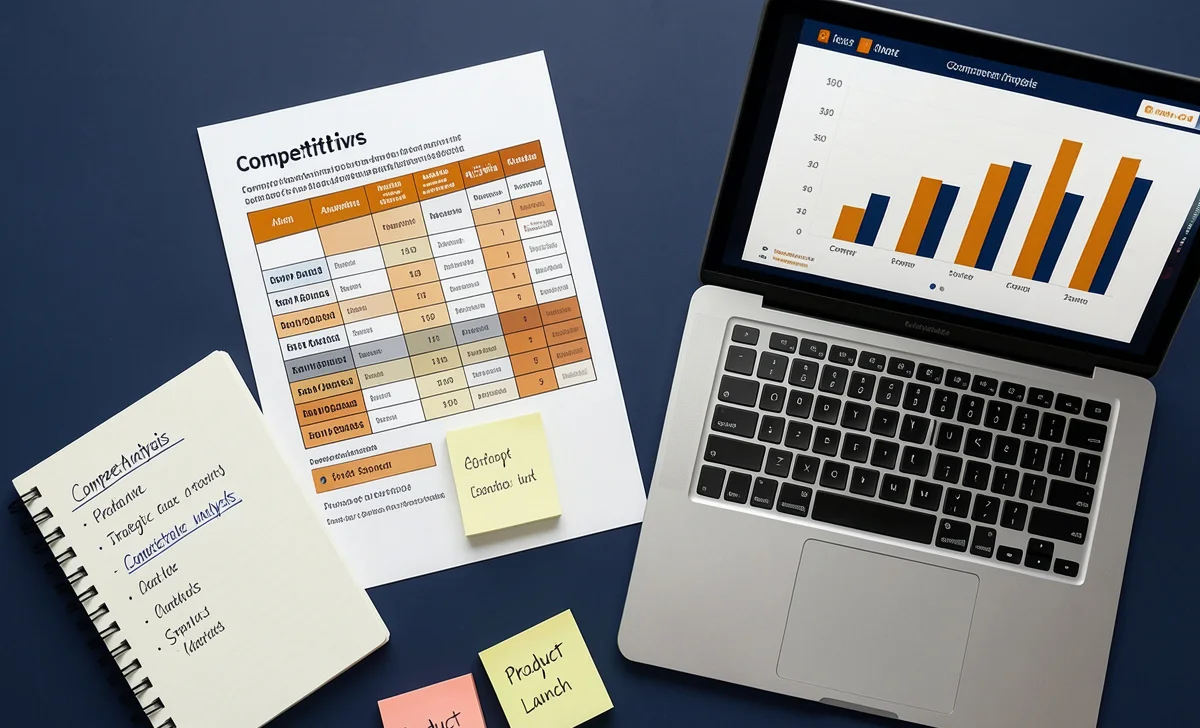
Most startups fail not because their products are bad, but because they misread the market. A CB Insights report found that 35% of startups shut down due to a lack of market need — a problem that thorough competitive analysis product launch research could have caught early.
Before you spend money building and opening a business bank account to fund your launch, you need to understand exactly who you’re up against. This guide walks you through a practical, step-by-step competitive analysis process — covering competitor research, pricing, market gaps, and positioning — so you enter your market with clarity, not guesswork.
What Is Competitive Analysis for a New Product Launch?
Competitive analysis is the process of studying your competitors to understand their products, pricing, strengths, weaknesses, and market positioning. The goal is to find the gaps they are leaving open.
According to Harvard Business Review (2023), companies that run structured competitive analysis are 30% more likely to outperform rivals when entering new markets.
Why It Matters Before You Launch
Skipping competitor research before launch is one of the most common and costly mistakes founders make. Here is what proper analysis gives you:
Reduces risk — You avoid entering a market that is already locked up, or one with no real demand.
Improves product-market fit — You build something customers actually want, not something you assume they want.
Sharpens your pricing — You position your price based on real market data, not gut feeling.
Reveals market gaps — You find unmet needs your competitors are ignoring.
When Netflix entered streaming, it did not compete on price alone. It focused on convenience and original content — two things cable and DVD rentals could not deliver. That is the power of knowing your market before you move.
How to Identify Your Real Competitors
Not every competitor is obvious. You need to look at three categories:
Direct competitors are businesses offering the same product to the same audience. Think Spotify vs Apple Music.
Indirect competitors solve the same problem using a different approach. Netflix and YouTube both compete for screen time, but through completely different models.
Substitute competitors are alternatives customers might choose instead of your category altogether — for example, a gym membership vs a home workout app.
For a thorough analysis, focus on your top 5 to 10 competitors. Going broader than that spreads your research too thin.
Step-by-Step: How to Conduct the Analysis
Step 1: Define Your Market and Customer
Before you research anyone else, get clear on your own position. Ask yourself:
- Who is your target customer?
- What problem are you solving for them?
- What industry or niche are you entering?
If you are launching a fitness app, your market might be adults aged 18–35 looking for mobile-first weight loss tools. Without this definition, your competitive research will lack focus and direction.
Step 2: Identify Your Top Competitors
Use these sources to build your competitor list:
- Google search for “best [your product category]” and “[product] alternatives.”
- App stores if you are launching a digital product
- Amazon for physical products
- Industry reports and trade publications
Once you have your list, organize it into a simple table with columns for competitor name, product, price, and target audience. This gives you a clean view of the field before you go deeper.
Step 3: Analyze Competitor Products
Study what each competitor actually offers. Look at:
- Features and functionality
- Product quality
- User experience
- Customer reviews on platforms like G2 or Capterra
According to G2 (2025), 92% of users read reviews before choosing a product. That means your future customers are already telling you what they hate about your competitors. Pay close attention to recurring complaints — slow support, missing features, confusing interfaces. These are the gaps you can fill.
Step 4: Study Pricing Strategies
Pricing reveals how a company sees itself in the market. Check whether competitors use subscription pricing, one-time payments, free trials, or bundled offers.
Premium pricing signals a luxury or specialist position. Low pricing targets volume and mass-market appeal. When you understand where each competitor sits, you can price based on the value gap you offer — not just what someone else charges.
Do not copy competitor pricing. It is a lazy shortcut that usually ends in a race to the bottom.
Step 5: Evaluate Marketing and Positioning
Look at how competitors communicate their products. Visit their websites, scroll through their social media, and note the ads they run. Ask:
- What problem do they lead with?
- Who is their messaging aimed at?
- What tone and language do they use?
Slack and Discord are both messaging tools, but they are positioned completely differently. Slack targets workplace productivity. Discord targets communities and gamers. Same product category, entirely different audiences. Understanding this kind of positioning gap is where real opportunity lives.
Step 6: Find the Gaps and Opportunities
This is the step most businesses rush or skip entirely. Use a simple SWOT framework to map out where competitors are weak:
| Factor | Competitor Weakness | Your Opportunity |
|---|---|---|
| Features | Overcomplicated interface | Simpler, cleaner experience |
| Pricing | Expensive plans | Affordable entry tier |
| Support | Slow or poor response | Fast, accessible help |
| Branding | Outdated positioning | Fresh, clear identity |
Businesses that prioritize tasks based on competitive gaps — rather than just copying what already exists — are the ones that build durable advantages. Analysis without action is wasted effort.
Tools That Make This Easier
These tools give you real data instead of guesses:
- Ahrefs — SEO and keyword analysis
- SEMrush — Competitor traffic and search visibility
- SimilarWeb — Website performance comparisons
- Google Trends — Demand and interest over time
- G2 / Capterra — Customer reviews and product ratings
Use at least two or three of these together to cross-check your findings.
A Real-World Example
Say you are launching a note-taking app. Your main competitors are Notion, Evernote, and Microsoft OneNote.
After analysis, you find:
- Notion is powerful but has a steep learning curve for new users
- Evernote’s pricing has frustrated longtime users
- OneNote has a cluttered, dated interface
The opportunity: build a note-taking app that is genuinely simple, clean, and affordable. You are not trying to beat Notion on features. You are targeting users who want something that just works without a manual.
This is exactly how many product launches find their footing.
Common Mistakes to Avoid
Copying competitors blindly — Understanding what they do is not the same as doing the same thing. Your goal is differentiation.
Ignoring customer reviews — This is free, direct feedback on what the market wants. Use it.
Analyzing too many competitors — More than ten becomes unmanageable. Focus on the most relevant.
Focusing only on features — Positioning and messaging often matter more than what a product actually does.
Skipping pricing research — McKinsey (2024) found that companies focused on customer needs outperform competitors by 2x. Pricing is a direct signal of how well you understand those needs.
What to Do After the Analysis
A competitive analysis only has value if it changes your decisions. Once you have your findings:
- Write a clear, unique value proposition (UVP) that addresses the gaps you found
- Adjust your product features to directly target competitor weaknesses
- Set a pricing strategy based on where value is being underserved
- Build your marketing message around the positioning gap you identified
Your aim is not to be better at everything. It is to be clearly better at the one or two things that matter most to your target customer.
What Makes a Strong Competitive Analysis
Before you finalize your research, check it against these benchmarks:
- You focused on real competitors, not assumptions
- You used data from actual tools and reviews, not opinions
- You studied pricing, product quality, and positioning together
- You turned your findings into concrete business decisions
- You identified at least one clear gap in the market
One area worth factoring into your strategy is your financial position. Understanding cash flow forecasting for irregular income is especially relevant at the launch stage, when revenue is unpredictable, and spending on research, development, and marketing happens before money comes in.
Final Thoughts
Competitive analysis is not a one-time report you file and forget. It is a decision-making tool you return to as your market shifts. The businesses that win are rarely the biggest — they are the most informed.
Understanding your market better than your competitors is itself a competitive edge. Start there, and your launch will be built on something solid.