
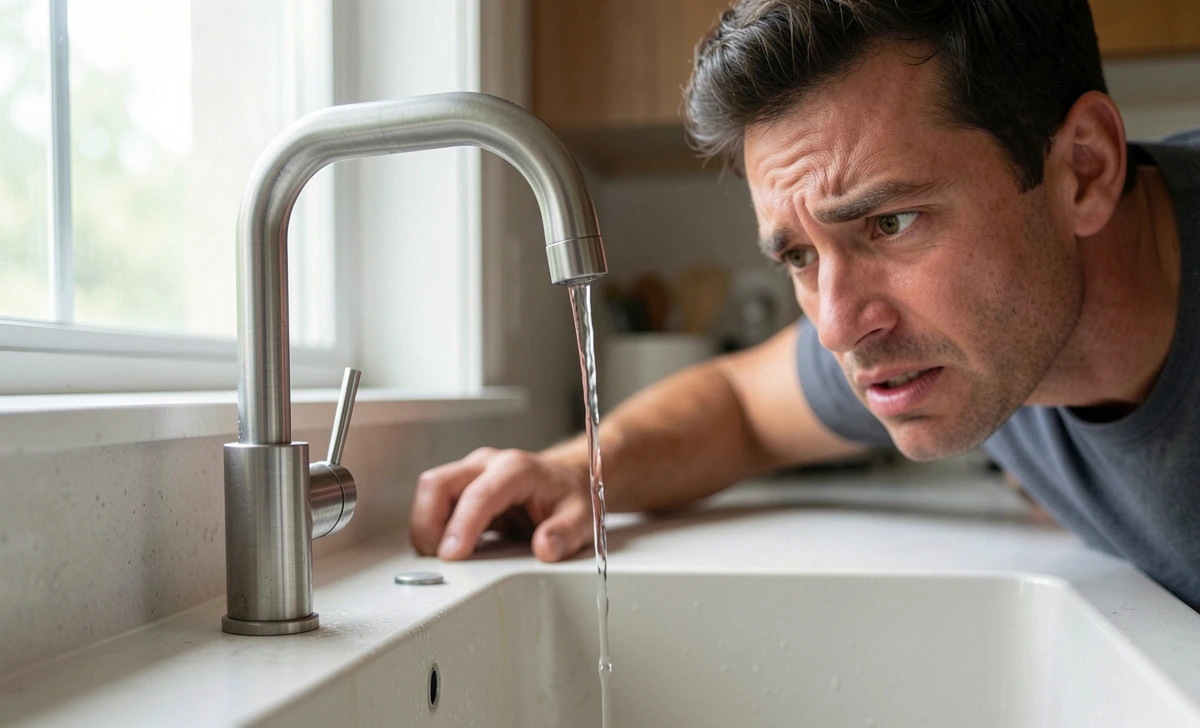
You turn on the kitchen sink. Nothing. Well, not nothing—a sad, weak trickle that barely fills a glass. But walk two steps to the bathroom, and the shower’s blasting like a fire hose. Frustrating, right? If you’re dealing with a low water pressure faucet only, you’re not imagining things—and if that weak water flow is frustrating you, you’re definitely not alone. The good news? Most of the time, this is a quick fix you can handle yourself—no plumber required.
Here’s the thing: when pressure drops in just one spot, it’s rarely a whole-house problem. It’s usually something small, local, and totally solvable. Let’s walk through exactly what to check, in the order that saves you the most time (and money).
Quick Diagnostic: Is It Really Just One Faucet?
Before we dive in—pun intended—let’s make sure we’re solving the right problem. Turn on every faucet in your house. Kitchen, bathroom, laundry, even that weird outdoor spigot. Is the weak flow truly isolated to one fixture?
If yes, great. We’re in the right place. If multiple faucets are struggling, the issue might be further upstream (think main shut-off valve, pressure regulator, or municipal supply). But if it’s just one? That’s actually easier to fix. You’ve probably noticed the problem gets worse when you use hot water, or maybe it happened overnight. That’s a clue. Hold that thought.
Quick Triage (Takes <2 Minutes): → Is it hot, cold, or both?
• Both → Check aerator & local shut-off valves.
• Hot only → Flush water heater or check dip tube.
• Cold only → Look for mineral buildup or branch line restriction. → Did it drop overnight or gradually?
• Overnight → Likely debris/stirred sediment or valve bump.
• Gradual → Age-related scaling or fixture wear.
Top 5 Causes of Low Pressure in a Single Faucet
Clogged Aerator or Showerhead (Most Common Fix)
This is the #1 culprit. Seriously. That little screen at the tip of your faucet? It catches sediment, mineral flakes, even tiny bits of pipe gunk. Over time, it clogs. Water fights to get through. Pressure drops.
The fix: Unscrew the aerator (most twist off by hand; stubborn ones need pliers with a cloth to protect the finish). Rinse it under running water. Use an old toothbrush to scrub away gunk. Soak it in white vinegar for 15 minutes if there’s white, crusty buildup. Reattach. Test. Nine times out of ten, you’re done.
Faulty Cartridge or Valve Assembly
Inside your faucet handle lives a cartridge (or valve) that controls flow and temperature. If it wears out, gets debris stuck in it, or just ages poorly, water can’t move freely. You might notice the handle feels stiff, or the temperature is hard to adjust.
The fix: Turn off the water supply under the sink. Remove the handle (usually a small screw hides under a decorative cap). Pull out the cartridge. Take it to a hardware store to match the part. Replace. Reassemble. If that sounds like too much, a plumber can swap it in 20 minutes.
Partially Closed Local Shut-Off Valve
Check under the sink. See those two small valves (hot and cold)? Make sure they’re fully open. Sometimes, after a minor repair or cleaning, someone nudges them halfway closed. Water flows, but not happily.
The fix: Turn the valve clockwise until it stops, then counter-clockwise one full turn. That’s fully open. Test the faucet. Simple, free, and often overlooked.
Mineral Buildup from Hard Water
If you’ve got hard water, minerals like calcium and lime don’t just stain your shower—they build up inside pipes and fixtures. Over months or years, that rust and mineral buildup narrows the path water travels. Pressure suffers. Homeowners often ask: Is low water pressure a sign of pipe corrosion? Sometimes. Hard water scale builds up just like rust, narrowing your pipes over time.
The fix: For fixtures, vinegar soaks work. For supply lines, you might need a descaling flush (a plumber can do this) or, long-term, a water softener. More on that later.
Aging Fixture Design
Older faucets, especially low-flow models from the 90s or early 2000s, just weren’t designed for strong flow. They conserve water, which is great for the planet, but maybe not great for rinsing shampoo. If your fixture is 15+ years old, the design itself might be the bottleneck.
The fix: Consider upgrading to a modern, high-performance faucet. Look for ones labeled “1.5 GPM but high-pressure feel”—they aerate water smartly so it feels stronger without wasting more.
When One-Faucet Pressure Points to Bigger Issues
Sometimes, a single weak faucet is a symptom, not the disease. Here’s when to look deeper.
Branch Line Restrictions (Especially in Older Homes)
If your home was built before the 1970s, there’s a good chance you have galvanized steel pipes. They rust from the inside out. That rust flakes off, travels downstream, and lodges in the nearest fixture—often the one farthest from the main line. So if you’re seeing low water pressure in older home galvanized pipes, and it’s hitting just one faucet, that branch line—or even the pipe under the sink—might be narrowing.
What to watch for: Discolored water when you first turn the faucet on. A metallic taste. Pressure that gets worse over months, not days.
Hot-Water-Only Low Pressure? Check Your Water Heater
Here’s a classic head-scratcher: cold water flows fine, but when you’re facing low water pressure in hot water only, the cause usually points to one of two places: sediment in the tank or a worn dip tube. Don’t panic. Start with the water heater. Sediment builds up at the bottom of the tank over time. That sediment can get sucked into the hot water line, especially if the dip tube is cracked or worn.
The fix: Flush your water heater once a year. Turn off power/gas, attach a hose to the drain valve, run it to a floor drain or outside, and let it run until the water looks clear. If pressure doesn’t improve, the dip tube or hot water shut-off valve might need attention.
Sudden Drop After Plumbing Work?
Did a plumber just leave your house, and now why is my water pressure low all of a sudden in one spot? It happens. Sometimes debris gets stirred up during repairs. Or a valve wasn’t fully reopened. Or a new part is slightly mismatched.
What to do: Go back to the basics—check the aerator, confirm local valves are open. If it started right after work was done, call the plumber back. A reputable pro will troubleshoot it for free.
Step-by-Step DIY Fixes You Can Try Today
Let’s get practical. Here’s your 15-minute game plan.
How to Clean an Aerator Without Tools
- Place a rag in the sink drain (so you don’t lose small parts).
- Unscrew the aerator by hand. If it’s stuck, wrap it in a cloth and use pliers—gentle pressure.
- Take it apart (note the order of screens/washers).
- Rinse all pieces under hot water. Scrub with an old toothbrush.
- Soak in white vinegar for 15 minutes if you see white crust.
- Reassemble in reverse order. Hand-tighten only.
- Turn on the water. Watch the flow.
That’s it. If pressure improves, you’re golden. If not, keep going.
Testing Pressure Without a Gauge
Don’t have a pressure gauge? No problem. Grab a 1-gallon pitcher. How long does it take to fill from the weak faucet? Then, time the same pitcher from a strong faucet. If the weak one takes 2–3x longer, you’ve confirmed a localized issue. Not scientific, but practical.
When to Call a Plumber (Red Flags Checklist)
Stop DIY-ing and call a pro if:
- You see water leaking under the sink during testing
- Pressure drops in multiple fixtures after your fixes
- You suspect galvanized pipes (discolored water, home built pre-1970)
- The faucet is still weak after cleaning the aerator AND checking valves
- You’re uncomfortable working with plumbing connections
Truth is, knowing when to stop is as important as knowing how to start.
Prevention Tips to Avoid Future Pressure Problems
Fixing the issue is great. Avoiding it next time? Even better.
Water Softener Considerations
If hard water is your nemesis, a water softener isn’t just about softer skin. It reduces mineral buildup in pipes and fixtures, which helps maintain pressure long-term, and controls moisture and mold growth in your bathroom. They’re not cheap, but if you’re fighting scale every few months, the math might work.
Annual Maintenance Checklist for Older Homes
If your home’s got age (and character), add this to your yearly to-do list:
- Flush each faucet’s aerator (5 minutes total)
- Run hot water from each fixture for 2 minutes to clear sediment
- Check under-sink valves are fully open
- Note any changes in flow, color, or taste
- Schedule a professional pipe inspection every 3–5 years if you have galvanized lines
Small habits prevent big headaches.
FAQs
Could low pressure in one faucet mean a hidden leak?
Possibly, but it’s rare. Leaks usually cause pressure drops in multiple fixtures or visible water damage. If you suspect a leak, check your water meter: turn off all water, note the reading, and wait 2 hours. If it moves, you’ve got a leak somewhere.
How much does a plumber charge to fix this?
For a simple aerator clean or valve adjustment, expect $75–$150 for a service call. If it’s a cartridge replacement or branch line work, $200–$400. Always ask for an estimate before work begins.
Will a water pressure booster fix one weak faucet?
Probably overkill. Boosters raise pressure for the whole house. If only one faucet is weak, you’re better off fixing the local issue first. Save the booster for whole-house low pressure.
Can I use chemical drain cleaner to clear a clogged faucet?
Please don’t. Those chemicals are harsh on fixtures, can damage seals, and won’t reach the actual clog (usually the aerator). Stick with vinegar, elbow grease, and mechanical cleaning.
Wrapping It Up
Dealing with low water pressure in one faucet only doesn’t have to mean calling a pro or resigning yourself to weak flow. Most of the time, it’s a small, fixable issue hiding in plain sight—like a clogged aerator or a half-closed valve. Start with the simple checks. Work your way down the list. And if you’ve tried everything and it’s still not right? That’s when you bring in backup.
If you found this helpful, you might also like our guide, which walks you through checking your whole system, so you know exactly where you stand.
And hey, if you want that printable 5-Minute Faucet Diagnostic Flowchart we mentioned, drop your email below. We’ll send it over—no fluff, just a clear path to figure out what’s going on with your water. Because sometimes, the right question at the right time saves you an hour of guessing.