
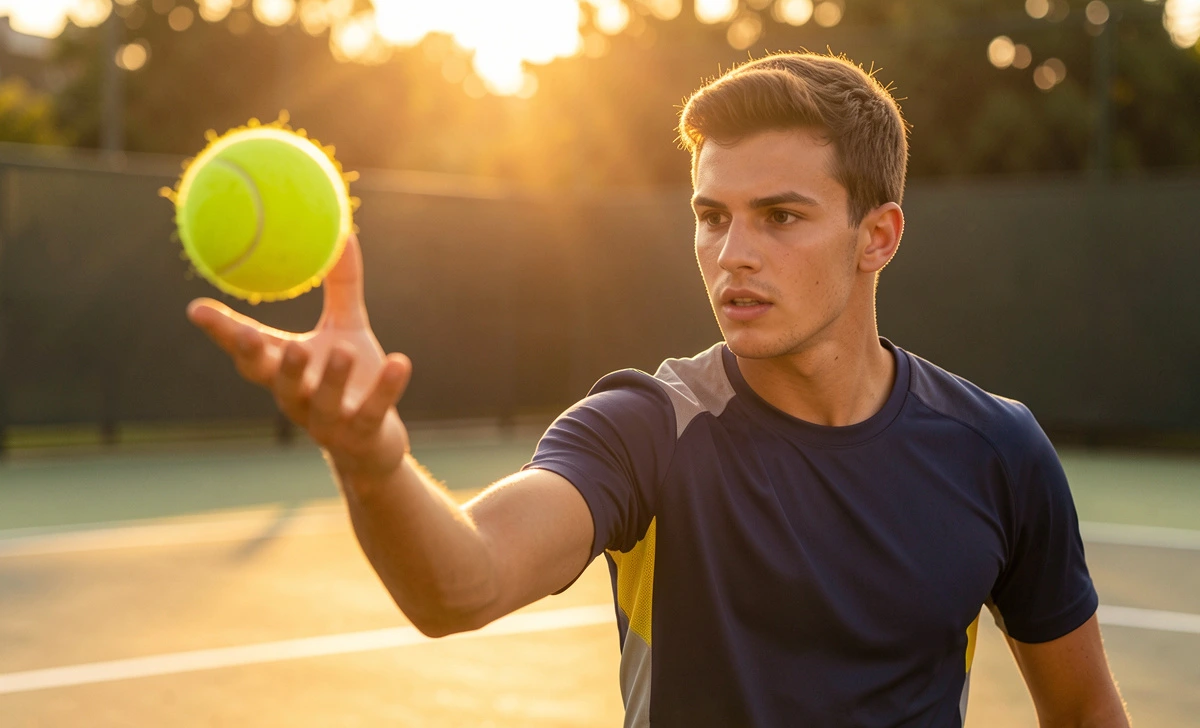
Missing a catch you should have made. Reacting a split second too late on a pass. Misjudging a ball’s trajectory mid-game. These frustrating moments all trace back to one trainable skill — and that’s exactly what hand-eye coordination drills sports are designed to fix.
Hand-eye coordination is what connects what your eyes see to what your body does. In baseball, cricket, basketball, tennis, and volleyball, the gap between a good player and a great one often comes down to how fast and accurately this connection fires. The good news: it responds to training.
In this guide, you’ll learn the best hand-eye coordination drills for sports — reaction exercises, tracking techniques, and daily habits that help athletes react faster and perform better.
What Is Hand-Eye Coordination in Sports?
Hand-eye coordination is the brain’s ability to process visual input and direct the hands to respond accurately and on time. It involves four key systems working together:
- Visual tracking — following a moving object with your eyes
- Reaction speed — how fast your brain sends a motor signal after seeing a stimulus
- Timing — matching your movement to the object’s position at the right moment
- Motor control — executing the movement with precision
Research in sports science confirms that coordination is a trainable skill, not a fixed trait. The brain forms stronger neural pathways through repeated, focused practice — a process tied directly to muscle memory in sports training.
Why Good Hand-Eye Coordination Matters in Ball Sports
Better Catching and Throwing Accuracy
When your visual system and motor system are well-synced, you catch cleaner, throw more precisely, and make fewer errors under pressure. Athletes with strong coordination waste less energy compensating for mistimed movements.
Faster Reaction Times During Play
A tennis serve can travel at over 100 mph. A cricket delivery reaches the batter in under half a second. Faster coordination means your body starts moving before your conscious mind processes the decision.
Improved Confidence and Performance
Athletes who trust their reactions play more freely. Hesitation during play often comes from poor coordination confidence — once your reactions sharpen, decision-making gets cleaner.
Best Hand-Eye Coordination Drills You Can Practice at Home
Tennis Ball Wall Toss Drill
Stand 3–4 feet from a wall. Throw a tennis ball at the wall with one hand and catch it with the other.
How to do it:
- Start slow — focus on clean catches, not speed
- Gradually increase throw speed over sessions
- Try closing one eye to challenge your depth perception
Reps: 3 sets of 30 catches per session
Common mistake: Watching your hands instead of tracking the ball from the wall
One-Hand Catch Exercise
Use a smaller ball — a golf ball or lacrosse ball. Toss it upward and catch it with the same hand.
How to do it:
- Keep your elbow slightly bent
- Track the ball’s arc, not just its peak
- Progress to behind-the-back catches over weeks
Reps: 2 sets of 20 per hand
Common mistake: Reaching too early — wait for the ball to fall into the catch zone
Juggling for Coordination Training
Three-ball juggling is one of the most studied tools for improving visual-motor coordination. A 2012 study found that juggling practice increased gray matter in brain regions linked to motion processing.
How to do it:
- Start with two balls in one hand — toss one, then the other
- Add the third ball only when two-ball exchanges feel automatic
- Practice 10 minutes daily, not 40 minutes once a week
Common mistake: Looking at your hands. Keep your eyes up and let peripheral vision track the balls.
Reaction Ball Bounce Drill
A reaction ball (six-sided rubber ball) bounces unpredictably. Drop it and catch it before the second bounce.
Reps: 3 sets of 15 drops
Progress: Move to catching with your non-dominant hand
This drill is particularly useful for goalkeepers, cricket fielders, and basketball players who need to read chaotic ball movement.
Mirror Reaction Exercises
Stand facing a partner. One person leads random hand movements — the other mirrors them in real time with zero delay.
Duration: 45 seconds per round, 4 rounds
Why it works: Forces your visual and motor systems to sync without preparation time
Field and Court Drills for Athletes
Partner Passing Drills
For basketball: rapid chest passes at increasing distances.
For football/soccer: one-touch passing with a moving partner.
For cricket: throw-and-catch with varied bounce trajectories.
Key rule: The passer should vary timing unpredictably so the receiver can’t anticipate the ball.
Multi-Ball Tracking Exercises
Have a coach or partner hold three balls. They drop any two — you catch both. This forces split-second visual decision-making under pressure.
Sets: 5 rounds of 6 drops
Speed and Agility Cone Reactions
Set five cones in a random layout. A partner calls a cone number — you sprint to it and return. Add a catch at the cone to link coordination with movement.
Athletes who train reactions while moving perform significantly better in game situations than those who train coordination standing still.
How Vision Training Improves Coordination
Peripheral Vision Exercises
Fix your eyes on a point directly ahead. Without moving your eyes, identify objects or movements at the edges of your field of view.
Athletes who train peripheral awareness read plays earlier and react before the play fully develops.
Focus Switching Drills
Alternate focus rapidly between a near object (your outstretched thumb) and a far object (a wall target 10 metres away). Repeat for 60 seconds.
This trains the eye’s focusing muscles and speeds up the visual system’s ability to lock onto moving targets. Combine this with good breathing techniques while running to keep your body composed during intense training sessions.
Eye Tracking Practice
Follow a moving pendulum or a swinging tennis ball with your eyes only — no head movement. Keep your gaze smooth and continuous, not jumping.
Duration: 2 minutes per session
Best Reaction Time Exercises for Faster Reflexes
Light Reaction Training
Use a light board or reaction light system. When a light activates, touch it as fast as possible.
Studies show that 6 weeks of light-reaction training can reduce average response time by 15–20% in trained athletes.
Audio Cue Drills
Have a partner call “left” or “right” randomly. React by catching a ball thrown in that direction. The verbal cue trains a different sensory pathway than visual-only drills.
Sprint-and-Catch Exercises
Sprint 5 metres. At the end of your run, a partner throws a ball at varying heights. Catch and immediately pass back.
This replicates real game demands where your body is already in motion when the ball arrives.
Common Mistakes That Hurt Coordination Development
Training too fast too soon. Coordination requires accurate repetitions, not fast ones. Sloppy fast reps reinforce bad patterns.
Ignoring footwork. Your hands can only be in the right place if your feet are. Most catching errors start with foot positioning, not hand-eye failure.
Staring directly at the ball. Many athletes fail coordination drills because they track the ball with hard focus instead of using soft peripheral vision. This narrows your visual field and slows reaction.
Lack of consistency. Ten minutes daily outperforms one-hour sessions twice a week. Coordination is built through repetition over time, not volume in bursts.
Skipping the non-dominant side. Training only your strong hand creates coordination imbalance. Always balance drills across both hands.
Daily Habits That Improve Hand-Eye Coordination Faster
Sleep and Recovery
Visual processing and motor learning consolidate during sleep. Athletes who sleep fewer than 7 hours show measurably slower reaction times. Recovery is part of coordination training.
Nutrition and Hydration
Dehydration slows nerve conduction. Even mild dehydration (2% body weight) reduces reaction speed and concentration. Omega-3 fatty acids support neural efficiency — include fatty fish or flaxseed regularly.
Consistent Short Practice Sessions
10-minute daily drills are the most effective format for coordination improvement. Set a consistent time — pre-training warm-up works well. Coordination gains compound across weeks, not days.
How Long Does It Take to Improve Hand-Eye Coordination?
Beginners: Noticeable improvement in reaction accuracy within 3–4 weeks of daily drills.
Youth athletes (under 16): Faster adaptation due to neuroplasticity. Significant improvement possible in 2–3 weeks of structured practice.
Adult athletes: Measurable improvement in 4–6 weeks. Progress continues steadily with consistent training. Adults can reach high-level coordination — the timeline is longer, not impossible.
The critical factor is consistency. Skipping sessions breaks the neural reinforcement cycle. You can also accelerate visual learning by watching sports to improve reaction time — studying how elite athletes track and respond to ball movement trains your visual system passively.
Key Takeaways — The Fastest Way to Improve Coordination
- Start with 10-minute daily sessions — consistency beats volume
- Use a reaction ball for unpredictable bounce training
- Train peripheral vision separately from hand-eye drills
- Always train both hands — avoid dominant-hand bias
- Track the ball’s path, not its destination — keep your gaze on movement, not the endpoint
- Pair coordination drills with footwork — your feet determine where your hands can reach
- Sleep 7–9 hours — motor patterns consolidate overnight
Final Thoughts
Better hand-eye coordination changes more than your sports performance. It sharpens focus, improves balance, and builds the kind of physical awareness that transfers across every athletic activity you do.
The one thing to apply immediately: replace one passive warm-up activity with a 10-minute reaction ball or wall toss drill before your next training session. That single shift, repeated consistently, is where measurable improvement begins.