
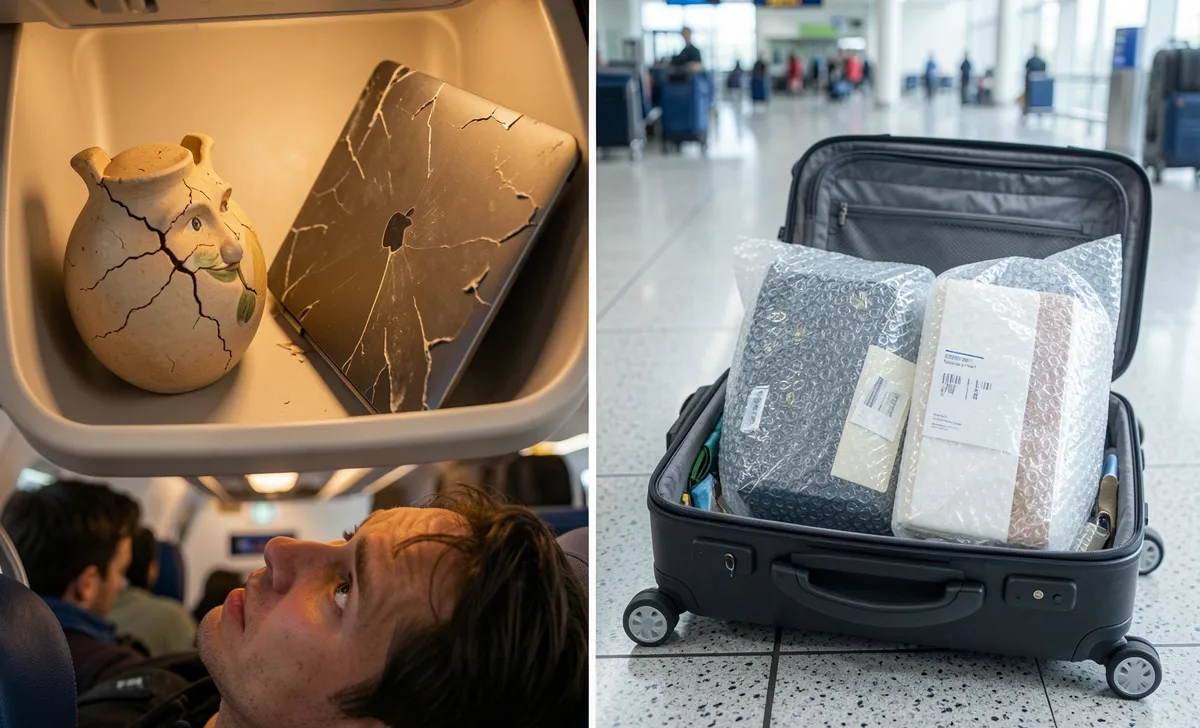
Most travelers grip their carry-on like a lifeline, convinced the overhead bin is the safest place for anything breakable. But every year, thousands of electronics, glass souvenirs, and camera lenses crack inside those same bins — not from baggage handlers, but from shifting bags, turbulence, and rushed passengers forcing overstuffed luggage into too-small spaces.
The checked baggage vs carry-on debate usually centers on lost bags — but for fragile items, the real risk is damage, and checked luggage often wins that comparison. A properly packed, hard-shell suitcase riding in a pressurized, temperature-controlled cargo hold frequently offers more protection than a soft bag crammed into an overcrowded overhead compartment.
In this guide, you’ll learn when checking baggage is safer than carrying on, which items are exceptions, and how to protect fragile belongings while flying.
Why Do Most Travelers Think Carry-On Is Safer?
Fear of Lost Checked Bags
The fear is real but statistically overstated. According to SITA’s 2024 Baggage IT Insights report, airlines mishandled 4.5 bags per 1,000 passengers globally — a rate that has fallen steadily for over a decade. Most mishandled bags are delayed, not permanently lost.
That fear, however, is enough to make millions of travelers avoid the baggage carousel entirely, even when their items would travel far more safely below deck.
Airline Horror Stories and Social Media Influence
A single viral video of baggage handlers tossing suitcases spreads faster than ten years of safe handling data. Social media amplifies extreme cases, which shape traveler behavior more than actual risk statistics. If you’ve lost luggage at an airport before, that experience sticks — but it doesn’t mean carry-on is categorically safer for fragile items.
Why Carry-On Luggage Sometimes Causes More Damage
Overhead Bin Pressure and Shifting
Overhead bins were not designed for maximum protection. During boarding, bags get shoved, stacked, and compressed by other passengers fitting in their own luggage. A 2023 travel insurance analysis by Berkshire Hathaway Travel Protection found that overhead-bin shifting was cited in more in-flight electronics damage claims than lost or mishandled checked baggage claims.
A ceramic souvenir wrapped in one layer of clothing inside a soft carry-on bag has almost no protection against a 15-pound bag dropped on top of it.
Turbulence and Passenger Handling
Moderate to severe turbulence can cause unsecured items in overhead bins to move significantly. Items that weren’t packed tightly shift, collide, and crack. Checked luggage in the cargo hold, strapped and stacked, experiences the same turbulence but with far less room to move.
Security Screening Risks
TSA officers conduct manual bag inspections when items trigger alarms. During these checks, carefully arranged packing is often disturbed. Fragile items that relied on specific positioning for protection can end up repacked loosely. This risk exists for carry-ons going through cabin security screening; checked bags, when inspected, are repacked by trained TSA baggage screeners following specific protocols.
When Checking Baggage Is Actually the Safer Choice
Fragile Souvenirs and Glass Items
Glass bottles, ceramic figurines, and handmade pottery have almost no chance in an overhead bin. Packed in the center of a hard-shell checked suitcase, surrounded by bubble wrap and clothing on all sides, they can survive the journey reliably. The cargo hold doesn’t have passengers pulling bags in and out over turbulent stretches of ocean.
Musical Instruments and Sports Equipment
For instruments too large to carry on — guitars, violins in hard cases, brass instruments — checked luggage with proper hard cases is often the better option. Airlines including Delta and United, offer specific handling tags for fragile instruments. Some musicians work directly with gate agents to have instruments stowed carefully. Learning how to pack a carry-on bag efficiently helps, but for larger instruments, checking is often unavoidable and preferable.
Properly Packed Electronics
A DSLR camera body packed in a foam-lined, rigid camera case checked as baggage faces less real-world risk than the same camera body tucked into a soft backpack shoved into an overhead bin. The key qualifier is “properly packed.” Loose electronics in a checked bag are at high risk. Electronics in dedicated hard cases with custom foam inserts are not.
What Data Says About Airline Damage Risks
Lost Luggage vs Damaged Carry-Ons
The conversation around airline baggage almost always focuses on lost bags. Damage to carry-on items rarely gets tracked as a separate category by airlines, which means the data gap itself distorts perception. Airlines compensate for checked baggage damage. They have no formal liability for overhead bin damage, which means those claims rarely get filed — not because the damage doesn’t happen, but because travelers don’t know they can report it.
TSA and Security Inspection Statistics
TSA screened over 893 million passengers in fiscal year 2023. A small but meaningful percentage of carry-on bags undergo manual inspection. Each manual inspection introduces handling risk for fragile items that passengers believe are safely in their control.
How to Pack Fragile Items for Checked Luggage
Best Protective Materials
- Bubble wrap (two full layers minimum for glass)
- Foam sheets for flat items like framed art or tablets
- Packing peanuts for irregular shapes
- Clothing layers as secondary cushioning around the protected core
The Center-of-Suitcase Method
Place fragile items at the geometric center of your suitcase — equidistant from all six sides. This is the most protected position. Surround the item with at least 3–4 inches of padding on every side. Never place fragile items near the corners or edges of the suitcase.
Hard-Shell vs Soft-Shell Suitcases
Hard-shell suitcases provide structural protection against compression — critical if other bags are stacked on top in the cargo hold. Soft-shell bags offer no resistance to crushing weight. For genuinely fragile items, a hard-shell case is not optional.
Which Valuable Items Should NEVER Be Checked?
Passports, Jewelry, and Medication
These belong in your carry-on without exception. Losing a passport mid-trip creates a crisis that no insurance policy makes easy. Jewelry and prescription medication have high replacement difficulty or cost. Keep them within arm’s reach.
Lithium Batteries and Restricted Electronics
FAA regulations prohibit lithium batteries in checked baggage unless they are installed in devices. Spare laptop batteries, power banks, and certain camera batteries must travel in the cabin. This is not a preference — it is a federal regulation, and violating it can result in fines.
Airline Policies and Insurance Coverage in 2026
Compensation Limits for Damaged Bags
Under the Montreal Convention, airlines are liable for checked baggage damage up to approximately $1,700 per passenger on international flights. Domestic U.S. flights follow DOT regulations with similar limits. Airlines are not required to compensate for inherent defects in the baggage itself.
No equivalent liability exists for overhead bin damage. If your laptop cracks because someone forced their roller bag in next to it, the airline owes you nothing by default.
Travel Insurance vs Airline Liability
Travel insurance with baggage coverage fills the gaps airline liability leaves open. Policies vary widely, so check whether your policy covers fragile items and whether it requires documented proof of value. High-value items like cameras or instruments often require a scheduled personal property rider for full coverage.
Expert Perspective — What Frequent Travelers Recommend
Travel photographer David Guttenfelder, a longtime National Geographic contributor, has spoken in interviews about checking camera equipment in hard cases for international assignments rather than fighting for overhead bin space with a heavy camera bag. His reasoning: a properly packed Pelican case in checked luggage is more predictable than a cabin environment where other passengers control what goes near your gear.
Flight attendants consistently advise passengers traveling with glass or ceramics to check those items and carry their valuables on. The logic is straightforward — the cargo hold is a controlled, static environment once the door closes. The cabin is not.
One insight most travel blogs skip: TSA PreCheck lanes reduce but do not eliminate manual inspection risk for carry-ons. PreCheck passengers skip the body scanner queue, but high-density bags still trigger manual review. Checked baggage inspection, when it happens, is conducted by trained handlers following documented procedures.
Key Takeaways — Is Checking Baggage Safer Than Carry-On?
The answer depends on what you’re carrying and how you pack it.
- Checked baggage in a hard-shell suitcase with proper padding often protects fragile items better than a carry-on in an overhead bin
- Overhead bins cause more damage than most travelers realize — and that damage goes largely unreported because airlines have no liability for it
- Items that must never be checked: passports, medication, lithium batteries, jewelry
- Items that often travel safely checked: glass souvenirs, instruments in hard cases, foam-packed electronics
- Travel insurance matters more than the choice of carry-on vs checked if you’re traveling with anything genuinely valuable
Final Thoughts
The carry-on vs checked baggage debate is usually framed around loss risk. The real question for fragile items is damage risk, and on that measure, checked luggage with proper packing materials frequently wins.
The one thing worth remembering: the safest bag is the one packed deliberately, not the one that happens to stay within arm’s reach.