
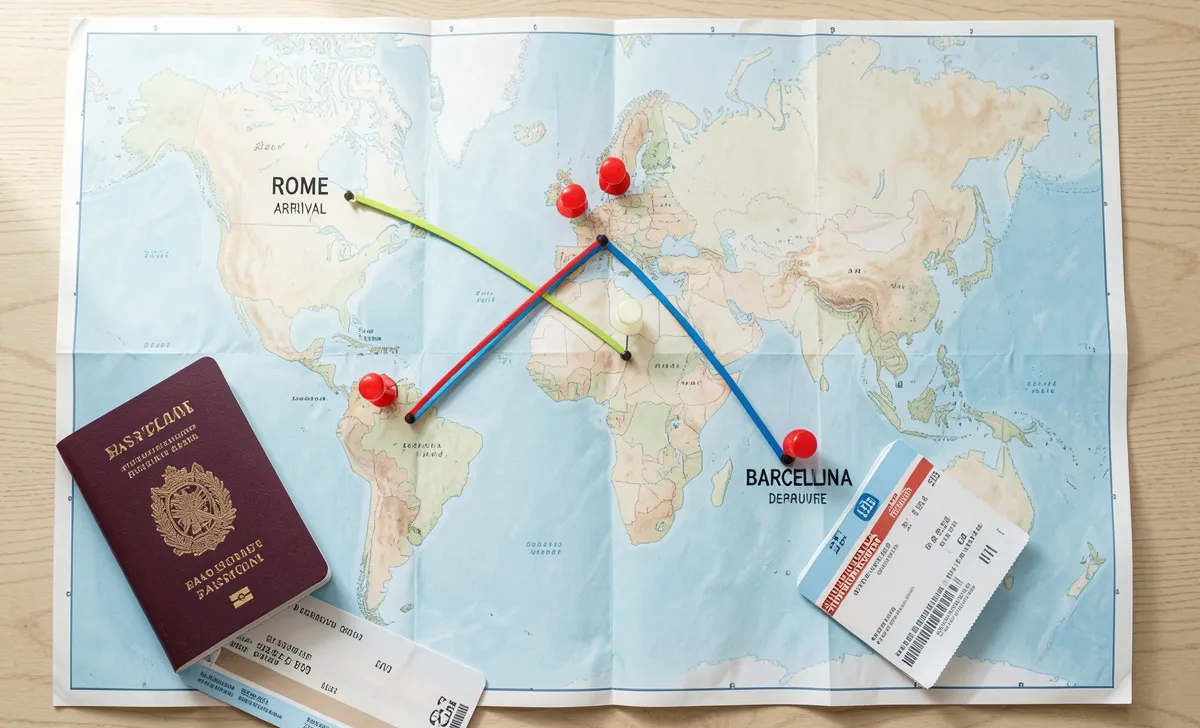
You fly into Rome, spend two weeks exploring Italy, and then board a flight home from Rome. But your journey ended in Barcelona. Now you’re stuck on a 2-hour train back just to catch your return flight. That’s time wasted. That’s money wasted. Open-Jaw Flights Booking solves exactly this problem. They let you fly into one city and out of a completely different one — no backtracking, no redundant travel.
In this guide, you’ll learn what open-jaw flights are, how they work, when to book them, and how to use them to save time and money on your trips.
What Are Open-Jaw Flights?
An open-jaw flight is a type of airline ticket where your departure and arrival airports are different. Unlike a round-trip, you don’t return to the same city you started from.
Simple example: You fly from New York → Paris, travel through France and Spain overland, then fly from Barcelona → New York. That gap in the middle — Paris to Barcelona — is the “open jaw.”
This structure removes the need to retrace your route just to catch a return flight.
How Do Open-Jaw Flights Work? (With Examples)
Simple Open-Jaw Flight Example
The most common type involves one open jaw on one side of the trip.
- Outbound: New York (JFK) → Rome (FCO)
- Return: Barcelona (BCN) → New York (JFK)
You travel overland from Rome to Barcelona at your own pace. The airline handles both flight legs as a single booking, often at a price comparable to a standard round-trip.
Before you go, make sure you know what to pack. A smart carry-on packing strategy can save you from checked baggage fees and keep your open-jaw itinerary flexible.
Double Open-Jaw Explained
A double open-jaw means both ends of the trip involve different cities.
- Outbound: New York (JFK) → London (LHR)
- Return: Paris (CDG) → Los Angeles (LAX)
This works well for travelers relocating, honeymooners, or anyone doing a point-to-point journey across continents. It’s less common but very powerful for complex itineraries.
Open-Jaw vs Round-Trip vs Multi-City Flights
| Feature | Round-Trip | Open-Jaw | Multi-City |
|---|---|---|---|
| Return to origin? | Yes | No | Optional |
| Flexibility | Low | Medium | High |
| Booking complexity | Simple | Simple | Moderate |
| Typical cost | Lowest | Similar to RT | Highest |
| Best for | Simple trips | Linear routes | Multiple stops |
Key difference: A multi-city booking lets you add multiple stops with separate legs. An open-jaw is simpler — just two flights, with a self-arranged gap in between.
When Should You Book Open-Jaw Flights?
Best Travel Scenarios
Europe’s rail and bus networks are extensive and affordable. Flying into Paris and out of Rome — with overland travel in between — is often faster and cheaper than backtracking.
EXPERT PERSPECTIVE: Travel experts recommend open-jaw itineraries for Europe trips due to dense rail networks connecting major cities like Paris, Amsterdam, Berlin, and Rome.
Road trips, flying into Denver and out of Los Angeles for a classic US road trip make perfect sense. No need to drive back to where you started.
Backpacking routes in Southeast Asia are ideal for open-jaw travel. Fly into Bangkok, travel overland through Vietnam and Cambodia, then fly home from Ho Chi Minh City.
When It Doesn’t Make Sense
- Short trips (2–3 days): Overland travel eats into your limited time.
- Island destinations: No overland connection means the open jaw doesn’t work logistically.
- When one-way fares are expensive: Some routes have inflated single-leg pricing that makes open-jaw costlier.
Are Open-Jaw Flights Cheaper or More Expensive?
Cost Comparison (Data-backed)
Google Flights data shows that multi-city and open-jaw routes can reduce backtracking costs by eliminating internal transport legs that travelers would otherwise need to book separately.
For example:
- Round-trip NYC → Rome + separate Rome → Barcelona train: ~$850 flight + $80 train = $930
- Open-jaw NYC → Rome / Barcelona → NYC: ~$870 total
The difference is small in airfare, but the time and stress savings are significant.
When They Save Money
Open-jaw flights save money when:
- The overland segment between cities is short and cheap
- Internal flights within a region are expensive
- You’d otherwise pay for accommodation just to transit back to your origin
Many travelers don’t realize open-jaw flights reduce both airfare and internal transport costs — especially on routes where backtracking requires an expensive domestic flight.
One thing worth considering when budgeting: lost luggage at airports can be a real headache on multi-leg itineraries. Travel light or use tracking tags to protect yourself.
How to Book Open-Jaw Flights (Step-by-Step Guide)
Most major booking platforms support open-jaw tickets. Here’s how to do it on Google Flights:
- Go to Google Flights (flights.google.com)
- Select “Multi-city” from the trip type options (not “Round trip”)
- Enter Flight 1: New York (JFK) → Rome (FCO) — your travel dates
- Enter Flight 2: Barcelona (BCN) → New York (JFK) — your return dates
- Search and compare — the system will show combined pricing for both legs
- Book directly through the airline or via the platform
You can also book directly on airline websites. Most major carriers (Delta, United, Lufthansa, British Airways) allow multi-city booking through their own search tools.
Pro tip: Use airline alliance networks (Star Alliance, Oneworld, SkyTeam) to combine legs from partner airlines under one booking — often at better pricing.
Pros and Cons of Open-Jaw Flights
Pros:
- Eliminates unnecessary backtracking
- Saves time on longer trips
- Often priced similarly to round-trips
- Enables more natural, linear travel routes
- Reduces the need for expensive internal flights
Cons:
- Slightly more complex to book than round-trips
- Overland gap must be self-arranged and paid for
- Fewer last-minute availability options
- Not all destinations have good overland connections
Tips to Get the Best Deals on Open-Jaw Flights
Book early — but not too early. The sweet spot for international open-jaw flights is 6–10 weeks before departure. Too early and prices are inflated; too late and availability drops.
Use a flexible date search. Google Flights’ calendar view shows price variations by day. Shifting your open-jaw return by 1–2 days can save $50–$150.
Leverage airline alliances. Booking both legs within the same alliance (e.g., Star Alliance) often gives better combined pricing and smoother baggage transfer. Lufthansa + United, for example, are both Star Alliance members.
Compare open-jaw vs separate one-ways. Sometimes booking two separate one-way tickets beats the bundled open-jaw price. Always check both options before committing.
Set price alerts. Use Google Flights or Hopper to track your open-jaw route. Prices fluctuate regularly, and alerts notify you when fares drop.
While planning your open-jaw adventure, it’s also worth thinking beyond flights — understanding overtourism effects on travelers can help you choose less-crowded destinations and time your visits for a better experience.
Key Takeaways — Are Open-Jaw Flights Worth It?
Open-jaw flights are one of the smartest tools for experienced travelers. They match how people actually travel — in a line, not a loop — and eliminate the wasted time and money of returning to your starting point.
If you’re planning a multi-city Europe trip, a cross-country road trip, or a backpacking route through Asia, an open-jaw itinerary almost always makes more sense than a standard round-trip.
The next time you’re booking, don’t default to round-trip out of habit. Check the multi-city booking option and see what an open-jaw route could look like. You might be surprised how little extra it costs — and how much time it saves.