

In this article
- What Are Closing Costs?
- What Fees Do Buyers Typically Pay at Closing? (Full Breakdown)
- How Much Are Closing Costs for Buyers?
- Who Pays Closing Costs — Buyer or Seller?
- Can You Reduce Closing Costs?
- Closing Costs vs Down Payment — What’s the Difference?
- Common Mistakes Buyers Make About Closing Costs
- What Should You Do Before Closing Day? (Checklist)
- Key Takeaways — Closing Costs Simplified
- Final Thoughts
Many homebuyers are shocked to discover they owe thousands of dollars beyond their down payment on closing day. In fact, most closing costs for buyers are underestimated by $3,000–$5,000 on average.
Closing costs are the fees and expenses you pay to finalize a home purchase. They cover everything from your lender’s paperwork to government recording fees — and they’re due the day you sign.
In this guide, you’ll learn what closing costs are, the exact fees buyers pay, and how to estimate your total cost before buying.
What Are Closing Costs?
Closing costs are the fees paid at the end of a real estate transaction — the moment ownership officially transfers from seller to buyer. They are separate from your home’s purchase price and your down payment.
Most buyers pay between 2% and 5% of the home’s purchase price in closing costs. On a $350,000 home, that means $7,000–$17,500 in additional fees due at closing.
These costs are paid on closing day, though your lender is required to give you a Loan Estimate within three business days of your mortgage application. This document breaks down every expected fee so there are no surprises. Understanding closing costs in real estate ahead of time gives you a major financial advantage.
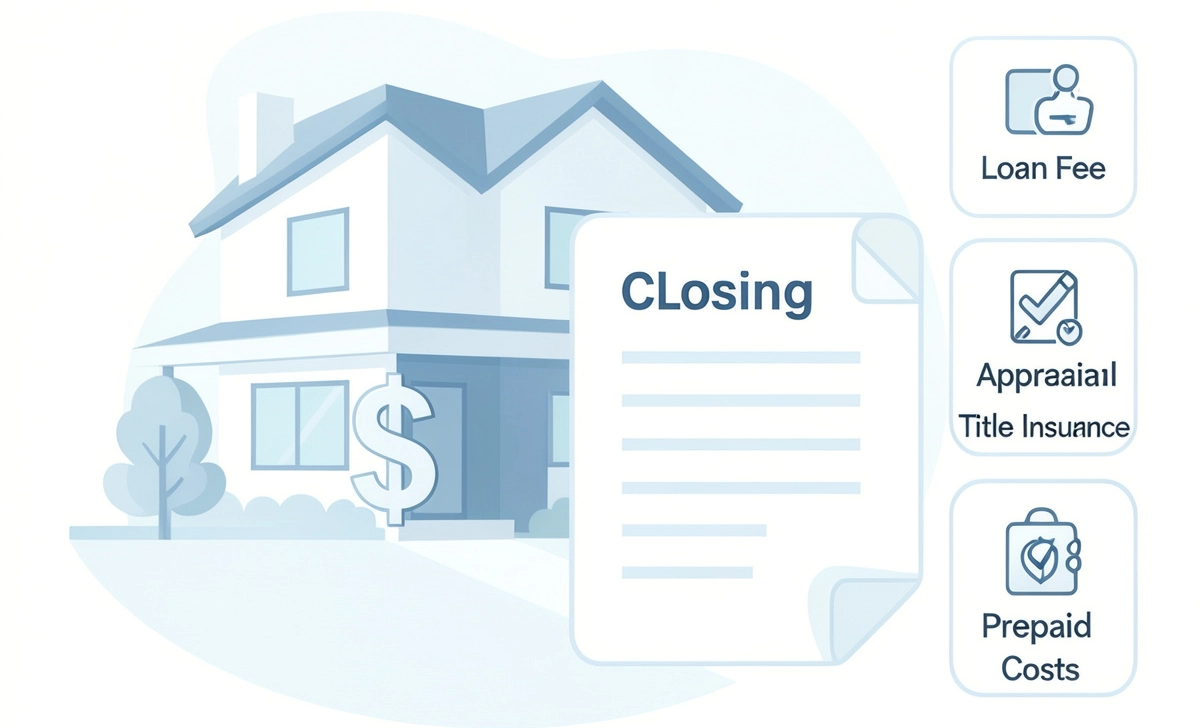
What Fees Do Buyers Typically Pay at Closing? (Full Breakdown)
Loan-Related Fees
These fees are charged by your lender for processing and approving your mortgage.
- Loan origination fee — Typically 0.5%–1% of the loan amount. On a $300,000 loan, that’s $1,500–$3,000.
- Application fee — A flat charge for processing your application, usually $75–$300.
- Underwriting fee — The lender’s cost to evaluate your financial risk, typically $400–$900.
Property-Related Fees
These fees ensure the property is accurately valued and in good condition.
- Appraisal fee — A licensed appraiser confirms the home’s market value. Expect to pay $300–$600.
- Home inspection fee — A thorough home inspection checklist examination costs $300–$500 and can save you from costly surprises after purchase.
Title and Legal Fees
Title fees protect both you and your lender from ownership disputes.
- Title search — Verifies the seller legally owns the home. Usually $75–$200.
- Title insurance — A one-time premium protecting against past ownership claims. Costs roughly $1,000–$1,500, depending on home price.
- Transfer fees — Covers legal transfer of ownership documents, typically $25–$250.
Government and Recording Fees
These are paid to local and state governments to officially record the sale.
- Recording fee — Paid to the county to register the deed. Usually $25–$250.
- Registration charges — Some states and municipalities add their own transfer or registration taxes, which vary widely by location.
Prepaid Costs
Prepaids are not fees — they are future expenses you pay upfront at closing.
- Property taxes — You may need to prepay several months of property taxes into an escrow account.
- Home insurance — Lenders require proof of coverage, and the first year’s premium is often paid at closing ($800–$2,000+).
- Interest prepayment — You prepay the mortgage interest from the closing date to the end of that month. This is a lesser-known cost that surprises many first-time buyers — it can add $500–$1,500, depending on your loan size and timing.
Expert Tip: “Always request your Closing Disclosure at least three business days before closing,” advises mortgage advisor practice guidance. “Compare it line-by-line to your Loan Estimate — any unexpected increases over 10% must be explained by the lender.”
How Much Are Closing Costs for Buyers?
Closing costs generally range from 2% to 5% of the home’s purchase price. Here’s a real-world example:
| Home Price | 2% (Low) | 3.5% (Average) | 5% (High) |
|---|---|---|---|
| $200,000 | $4,000 | $7,000 | $10,000 |
| $350,000 | $7,000 | $12,250 | $17,500 |
| $500,000 | $10,000 | $17,500 | $25,000 |
Your actual costs depend on your lender, loan type, location, and whether you negotiate any fees. FHA loans, for example, include an upfront mortgage insurance premium that adds to closing costs.
Who Pays Closing Costs — Buyer or Seller?
In most transactions, buyers pay the majority of closing costs — particularly lender fees, title insurance, and prepaids. Sellers typically cover the real estate agent commissions and transfer taxes.
However, this split is negotiable. You can ask the seller to contribute toward your closing costs as part of the purchase offer. This is called a seller concession and is common in buyer-friendly markets.
If you’re also looking to negotiate a lower price when buying a home, rolling in a closing cost concession as part of your offer strategy can save you significantly upfront.
Sellers covering 2%–3% of closing costs is a reasonable ask in most markets, especially if the home has been sitting unsold.
Can You Reduce Closing Costs?
Negotiation Tips
- Ask the seller for a concession to cover part of your closing costs.
- Request that the seller pay your transfer taxes or title fees as a deal condition.
- Negotiate with your real estate attorney to reduce their flat fees.
Lender Comparison
- Get Loan Estimates from at least 3 lenders — fees vary by hundreds or thousands of dollars.
- Watch for “junk fees” like courier charges, document prep fees, or admin fees that some lenders inflate.
- A no-closing-cost mortgage rolls fees into your loan balance or a higher interest rate — cheaper upfront, but costs more long-term.
Closing Cost Assistance Options
- Down payment assistance programs often cover closing costs, too.
- State and local housing agencies offer grants or second mortgages for eligible first-time buyers.
- Lender credits let you accept a slightly higher interest rate in exchange for reduced upfront fees.
Closing Costs vs Down Payment — What’s the Difference?
Many buyers confuse these two. They are completely separate expenses.
| Down Payment | Closing Costs | |
|---|---|---|
| Purpose | Equity in your home | Fees to process the transaction |
| Amount | 3%–20% of the home price | 2%–5% of the home price |
| Goes To | Applied to your mortgage balance | Paid to lenders, title companies, government |
| Refundable? | Builds equity | No — one-time cost |
On a $350,000 home with 10% down and 3.5% closing costs, you’d need $35,000 for the down payment and $12,250 for closing costs — a combined cash requirement of over $47,000.
Common Mistakes Buyers Make About Closing Costs
- Forgetting about prepaid costs. Many buyers budget for fees but overlook property taxes and insurance escrow, which can add $2,000–$4,000.
- Assuming the Loan Estimate is final. Fees can change — always review your Closing Disclosure carefully.
- Not shopping lenders. Origination fees and underwriting fees vary significantly. One lender could charge $2,500 more than another on the same loan.
- Draining savings for the down payment. Leaving no cash reserve for closing costs forces buyers into last-minute scrambling or borrowing.
- Ignoring the closing date. Closing earlier in the month means more days of prepaid interest. Closing near the month-end minimizes this cost.
What Should You Do Before Closing Day? (Checklist)
Use this checklist in the final days before you close:
- Review your Closing Disclosure — compare it to your original Loan Estimate
- Wire your closing funds — confirm the exact amount and wire instructions with your title company (beware of wire fraud scams)
- Complete a final walk-through — verify the home’s condition matches the contract
- Confirm homeowner’s insurance is active before closing day
- Bring a valid government-issued ID to the closing table
- Ask questions — you have the right to understand every line item before signing
If you’re preparing to sell instead, knowing how to prepare property for sale quickly can help you close faster and with fewer complications.
Key Takeaways — Closing Costs Simplified
- Closing costs are 2%–5% of the home’s purchase price, paid on closing day
- Major fees include loan origination, appraisal, title insurance, and prepaid expenses
- Buyers pay most closing costs, but sellers can contribute through negotiation
- Always compare Loan Estimates from multiple lenders to find the best deal
- Prepaids (taxes, insurance, interest) are often overlooked — budget for them
Final Thoughts
Closing costs are one of the biggest financial blind spots in homebuying. The buyers who navigate them best are the ones who plan, compare lenders, and read every document carefully.
The single best thing you can do is request your Loan Estimate early and treat closing costs as a non-negotiable part of your budget — not an afterthought.