
Many people spend money on physiotherapy, painkillers, and specialist appointments without ever questioning the one thing they spend eight hours on every night: their mattress. If your mattress causing back pain is something you have started to suspect, and you are not wrong to look there first.
Poor spinal alignment during sleep is a well-documented contributor to chronic lower back pain, and your bedtime habits and sleep quality play a direct role in how your body recovers overnight. Before you book another doctor’s visit or buy an expensive new bed, run a few simple tests at home. They take less than ten minutes and can tell you a lot.
What Happens to Your Spine During Sleep
Your spine has a natural S-curve. When you lie down, a good mattress maintains that curve — keeping your neck, mid-back, and lower back in a neutral position. A mattress that is too soft lets your hips sink too deeply, which pushes the lumbar region out of alignment. One that is too firm creates pressure points at the shoulders and hips, forcing your spine to compensate.
Either way, your muscles spend the night working to correct the imbalance instead of resting. By morning, you feel it.
A 2026 review covering nearly 40 studies confirmed that medium-firm mattresses are most consistently linked to better comfort, improved spinal alignment, and lower reported back pain. That single finding rules out a large portion of mattresses currently on the market — both the ultra-plush “cloud” beds and the rock-hard orthopaedic slabs that were popular in the 1990s.
The At-Home Tests You Can Run Tonight
1. The Cardboard Test
This is the most widely recommended method among physical therapists and sleep specialists.
What you need: One large, flat piece of cardboard — the kind that comes with appliance packaging works well.
What you do:
- Place the cardboard flat on top of your mattress
- Sleep on it for one full night
- Note how your back feels in the morning compared to a typical night
What the results mean:
- Pain improves → Your mattress is too soft. The cardboard reduced the sinking effect and gave your spine the support it was missing.
- Pain worsens → Your mattress may already be too firm. Adding cardboard pushed it further in the wrong direction.
- No change → The mattress is probably not the primary cause. Look elsewhere.
2. The Floor Test
Sleep on a thin mat or folded blanket directly on the floor for one or two nights.
- Back feels better → Your mattress lacks support
- Back feels worse → You need more cushioning, not less
- No difference → The issue is likely postural or muscular, not the mattress
3. The Morning Pain Pattern Test
Track your pain levels for seven consecutive days. Note the time of day your pain is worst.
- Pain is worst in the first 30 to 60 minutes after waking, then fades → Strong indicator of a mattress problem
- Pain is consistent throughout the day → More likely a medical or muscular issue
- Pain improves on weekends when you sleep in a different bed → The mattress is almost certainly the cause
4. The Visual Sag Test
Get out of bed and look at your mattress from the side.
- Press down firmly with both hands across different sections
- Look for visible dips, soft spots, or uneven areas
- Run your hand across the surface to feel for lumps or compressed areas
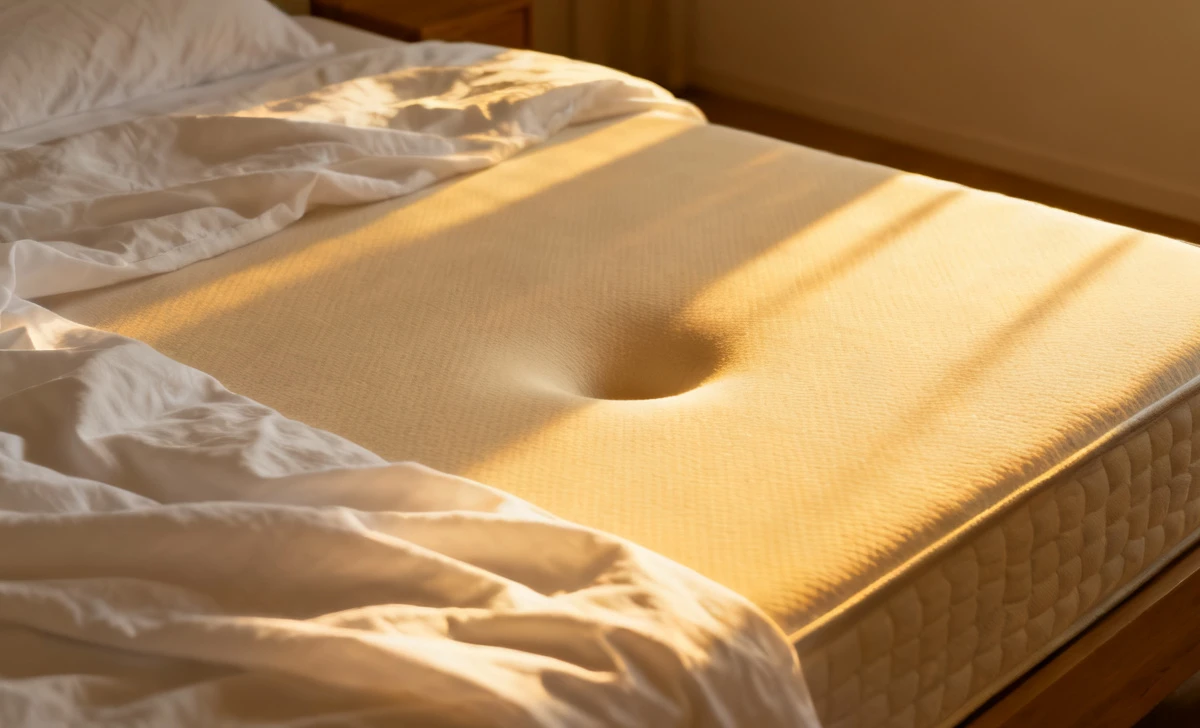
A sag deeper than 1.5 inches is a clear sign the mattress has lost structural integrity. No amount of toppers or adjustments will fully compensate for this.
Clear Signs Your Mattress Is the Problem
The following signs, taken together, point strongly toward a mattress issue:
- You wake up with stiffness in the lower back that was not there when you went to bed
- The stiffness eases within an hour of getting up and moving around
- You sleep noticeably better in hotels, at a relative’s home, or anywhere other than your own bed
- Your mattress is more than seven to ten years old
- There is visible sagging or lumping on the sleep surface
- You find yourself unconsciously shifting positions throughout the night trying to get comfortable
If three or more of these apply to you, there is a high probability your mattress is contributing to the problem.
When the Mattress Is Not the Issue
It is worth being honest about the limits of this diagnosis. Not all back pain originates from your sleep surface.
Other common causes include:
- Sedentary lifestyle and weak core muscles
- Poor posture during the day
- Muscle strain from physical activity
- Sciatica, where the sciatic nerve is compressed or irritated
- Herniated or bulging discs
- Degenerative conditions affecting the lumbar vertebrae
Waking up tired despite sleeping through the night — sometimes described as chronic fatigue — can overlap with sleep-related back pain, but the two are not always connected. If your pain is constant rather than worst in the morning, if it radiates down one or both legs, or if it does not improve at all after a few days on a different sleep surface, consult a doctor. These symptoms can point to conditions that a new mattress will not fix.
What to Do If the Mattress Is the Cause
Short-Term Fixes
If replacing the mattress immediately is not an option, these measures can help:
Add a mattress topper. A medium-firm memory foam topper (around 5 to 7 cm thick) can temporarily correct a mattress that is too soft. It will not fix a severely sagging bed, but it can buy you time.
Rotate or flip the mattress. Many people sleep on the same section of a mattress for years. Rotating it 180 degrees distributes wear more evenly. If your mattress is double-sided, flipping it can restore some of the original support.
Place plywood under the mattress. A sheet of plywood between the mattress and the base reduces the sink effect on soft mattresses. It is a temporary measure, but an effective one.
Check your sleep position. Side sleepers benefit from placing a pillow between their knees to keep the hips aligned. Back sleepers should place a pillow under the knees to reduce lumbar pressure. Stomach sleeping is hard on the spine in most cases and is best avoided if you have back pain.
Long-Term Solution: Choosing the Right Replacement
When it is time to buy a new mattress, the research is detailed. Medium-firm mattresses perform best for the majority of back pain sufferers, regardless of sleep position. Experts note that overly firm mattresses create pressure points while overly soft ones throw the body out of alignment — medium-firm sits in the middle and works for the widest range of body types and sleeping positions.
The three main categories worth considering:
Memory Foam — Contours to the body and distributes pressure well. Good for side sleepers. Can retain heat, so look for gel-infused or open-cell foam variants if you sleep warm.
Hybrid Mattresses — Combine a coil support core with foam or latex comfort layers. Provide good airflow and a balance of bounce and pressure relief. A reliable option for most sleepers.
Latex — Responsive and durable. Naturally cooler than memory foam. Good for people who find memory foam too constricting.
Whatever you choose, try to test the mattress for at least 30 nights before making a final judgement. Most back pain sufferers report that it takes four to eight weeks for the body to fully adapt to a new sleep surface.
Lifestyle Factors That Work Alongside a Good Mattress
A mattress can support your spine, but it cannot compensate for everything happening during the other sixteen hours of the day. Staying physically active, maintaining a healthy body weight, and keeping your core muscles strong all reduce the load placed on your spine during sleep.
Dehydration is also worth mentioning. The spinal discs between your vertebrae are largely water-based and rely on adequate hydration to maintain their height and shock-absorbing capacity. Recognising the early signs of dehydration and addressing them consistently can support disc health over time — a small habit with a measurable effect on spinal function.
Key Takeaways
Your mattress and your back pain may be more directly connected than you think. The cardboard test, floor test, and morning pain pattern test give you reliable data without spending any money. A sag deeper than 1.5 inches is a structural failure. Medium-firm is the most evidence-backed firmness level for back pain. Short-term fixes exist, but if your mattress is older than eight years and causing daily discomfort, replacing it is the most practical long-term step.
Back pain tied to a poor sleep surface tends to follow a predictable pattern: worst in the morning, improving as the day goes on. If that pattern matches your experience, the answer may be simpler — and cheaper — than you expect.
A consistent nighttime routine paired with the right mattress gives your body the conditions it needs to recover properly. That combination, done consistently, makes a real difference over time.