
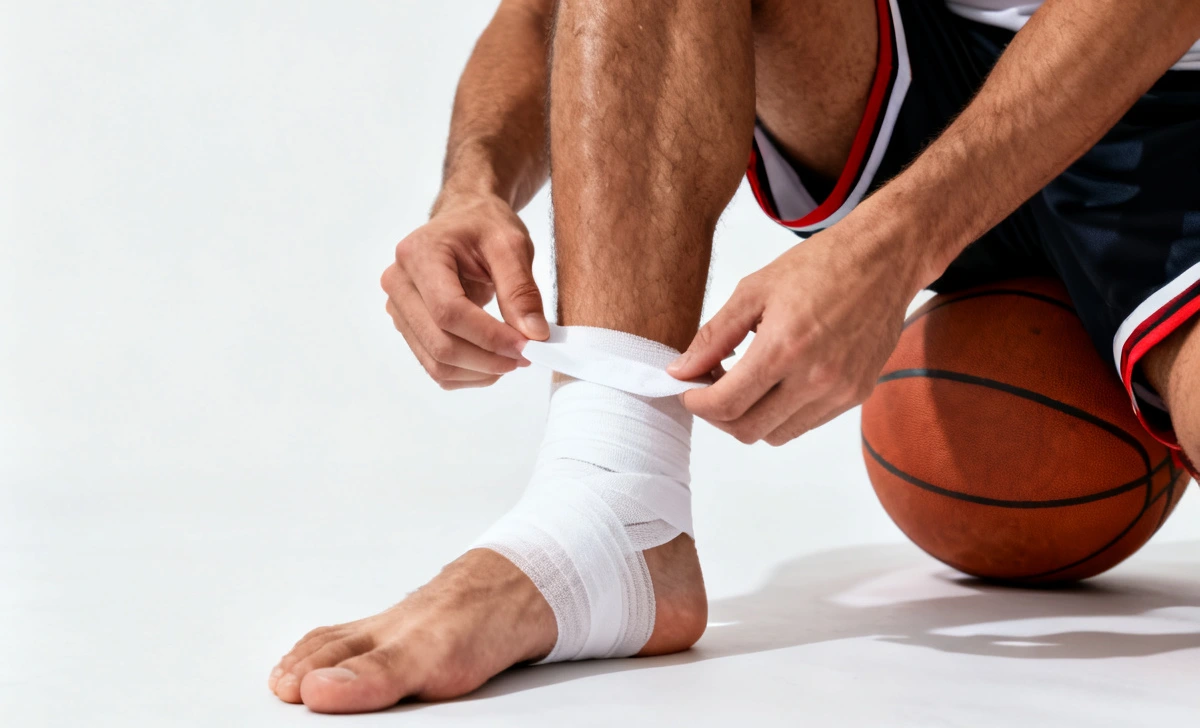
Every 13 seconds, an athlete suffers an ankle sprain prevent sports, making it the single most common sports injury across basketball, football, soccer, and trail running. Yet most athletes treat it as a minor inconvenience rather than a serious performance threat.
What Is an Ankle Sprain and Why Does It Happen in Sports?
An ankle sprain is a ligament injury caused by the foot rolling, twisting, or turning beyond its normal range of motion. The lateral ankle ligaments — particularly the anterior talofibular ligament (ATFL) — absorb most of the force and are most frequently damaged. Sprains are graded from Grade I (mild stretching) to Grade III (complete ligament tear).
Common Causes in High-Impact Sports
Ankle sprains account for approximately 20–40% of all sports injuries in basketball and football, according to sports injury research. The primary causes include:
- Landing on another player’s foot during jumps or cuts
- Sudden lateral changes in direction at high speed
- Running on uneven or wet surfaces
- Muscle fatigue during the final stages of training or competition
- Poor footwear with inadequate lateral support
Risk Factors Athletes Often Ignore
A history of previous ankle sprains is the single strongest predictor of re-injury — athletes who have sprained once are three to five times more likely to sprain again. Weak peroneal muscles, limited ankle dorsiflexion range, and poor proprioception all significantly increase risk. Most recreational athletes skip the neuromuscular training that addresses these gaps.
Why Ankle Sprain Prevention Matters for Athletes
Prevention is not just about avoiding pain — it directly protects athletic output, training continuity, and long-term joint health. A single Grade II sprain can sideline an athlete for three to six weeks, disrupting conditioning, team availability, and competitive momentum.
Impact on Performance and Recovery Time
Even after an ankle sprain heals structurally, neuromuscular deficits can persist for months if rehabilitation is incomplete. Studies show that athletes return to sport with measurable balance and reaction-time impairments if proprioception is not specifically retrained. This explains why repeat sprains cluster within the first 12 months after the initial injury.
Long-Term Injury Risks
Untreated or poorly managed ankle sprains lead to chronic ankle instability (CAI) in up to 40% of cases. CAI causes progressive cartilage damage, early-onset ankle arthritis, and altered gait mechanics that shift stress to the knee and hip. Prevention now is far less costly than managing joint degeneration later.
How to Prevent Ankle Sprains During Sports (Core Strategies)
A structured pre-sport routine dramatically reduces ankle injury risk. According to a 2024 systematic review in the British Journal of Sports Medicine, athletes who followed a consistent neuromuscular warm-up protocol reduced ankle sprain incidence by up to 35% compared to those who did not warm up.
Proper Warm-Up Routine for Ankle Protection
A proper warm-up raises core temperature, increases synovial fluid production in the ankle joint, and activates the stabilizing muscles before loading begins. Skipping this step leaves cold, stiff tissues exposed to high-force demands. Spend at least 8–10 minutes on your pre-sport warm-up.
- 2 minutes of light jogging or cycling
- Ankle circles — 10 reps each direction, both feet
- Heel-to-toe walks — 20 meters
- Lateral shuffles — 3 sets of 10 meters
Dynamic Stretching vs Static Stretching
Dynamic stretching — controlled movement through a range of motion — is the superior pre-sport choice. It improves blood flow, activates motor pathways, and prepares muscles for reactive loads without reducing strength output. Static stretching, holding a stretch for 30+ seconds, is better reserved for post-activity cool-down when muscles are warm, and the goal is flexibility.
Pre-Game Activation Drills
Activation drills specifically fire the peroneal muscles and posterior tibialis before competition begins. Include:
- Banded ankle eversions — 15 reps each side
- Single-leg calf raises — 3 × 12
- Lateral band walks — 3 × 10 steps each direction
- Mini-band monster walks — 2 × 15 steps forward and back
Best Ankle Injury Prevention Exercises
Targeted exercise is the most evidence-supported method for reducing ankle sprain risk. A 2025 sports medicine meta-analysis confirmed that athletes who completed structured balance and strengthening programs showed significantly fewer first-time and recurrent ankle injuries across team and individual sports.
Balance and Proprioception Training
Proprioception — the body’s ability to sense joint position and respond reflexively — is the most neglected element of ankle health. Most athletes focus on strength but overlook the neurological component that controls split-second stabilization responses. Training proprioception rebuilds this protective reflex system.
- Single-leg stance — 3 × 30 seconds each leg, eyes closed to progress
- BOSU ball balance — 3 × 45 seconds per leg
- Balance board squats — 3 × 12 reps
- Star Excursion Balance Test drills — reach in 8 directions from one leg
“Proprioception training is not optional for high-impact athletes — it is the primary mechanism through which the nervous system learns to protect the ankle before a sprain can occur. Strength alone does not replicate this reflex response.”
— Physiotherapist recommendation based on current neuromuscular rehabilitation guidelines
Strengthening Exercises for Ankles
Strong peroneal and calf muscles act as dynamic ligament support, absorbing force before it transfers to passive connective tissue. Perform these 3–4 times per week as part of your off-field routine:
- Standing calf raises — 3 × 15 (add weight as strength improves)
- Eccentric heel drops off a step — 3 × 12
- Tibialis anterior raises — 3 × 15 (flex foot upward against gravity)
- Peroneal strengthening — ankle eversion with resistance band, 3 × 15
Resistance Band Workouts for Stability
Resistance bands allow targeted strengthening of all four primary ankle movement planes: dorsiflexion, plantarflexion, inversion, and eversion. Perform each movement slowly and with control — speed reduces the neuromuscular training effect.
- Band dorsiflexion pulls — 3 × 15
- Band plantarflexion pushes — 3 × 15
- Inversion pulls — 3 × 12 (most important for lateral sprain prevention)
- Eversion pulls — 3 × 12
How to Improve Ankle Stability for Athletes
Ankle stability develops through a combination of muscular strength, joint range of motion, and neuromuscular coordination. Athletes who train single-leg patterns and controlled plyometrics build the most transfer to sport-specific ankle demands.
Single-Leg Training Techniques
Single-leg training forces each ankle to manage full body weight independently, exposing and correcting side-to-side stability deficits. Integrate these into strength sessions:
- Single-leg Romanian deadlifts — 3 × 8–10 per leg
- Bulgarian split squats — 3 × 10 per leg
- Single-leg box step-downs — controlled descent, 3 × 10
- Single-leg lateral hops with stick landing — 3 × 8 per leg
Plyometric Control Exercises
Plyometric control — landing and absorbing force efficiently — directly replicates the ankle demands of basketball, football, and sprinting. Focus on landing quality first; add speed and height only when mechanics are consistent.
- Box drops to single-leg landing — land softly, hold for 2 seconds
- Lateral cone hops — 3 × 10 each direction
- Broad jump to single-leg stick — 3 × 6 reps
- Depth drops with directional cut — 3 × 5 each side
Ankle Taping Techniques and Support Methods
External ankle support — through taping or bracing — reduces the range of injurious motion without significantly limiting athletic performance. Research shows that prophylactic ankle support reduces sprain incidence by 50–70% in athletes with prior injury history.
Athletic Taping for Injury Prevention
Closed basket-weave taping is the most widely used technique in professional sports settings. It limits inversion (the motion that causes most lateral sprains) while preserving plantarflexion and dorsiflexion for athletic movement. A trained athletic trainer or physiotherapist should apply it correctly to avoid pressure points.
- Apply pre-wrap to protect skin before adhesive tape
- Use 1.5-inch athletic tape (non-stretch) for anchors
- Apply stirrups running from the inner to the outer ankle under the heel
- Finish with heel locks to limit rotational movement
- Reapply every session — tape loses up to 50% of its restriction within 20 minutes of activity
Braces vs Taping — Which Works Better?
Lace-up ankle braces offer comparable protection to taping at a fraction of the per-session cost and can be self-applied consistently. Tape is preferable when a custom fit or specific joint positioning is required. For daily training loads, braces are more practical and cost-effective over an entire season.
Best Footwear and Gear for Ankle Protection
Footwear is the first line of mechanical ankle protection. Shoes that lack lateral support, have excessive heel drop, or show significant midsole compression from overuse leave the ankle structurally unsupported during high-impact movement.
Choosing the Right Sports Shoes
Select sport-specific footwear designed for your movement patterns. Basketball shoes with high-cut collars restrict inversion under court-cutting loads. Trail running shoes with reinforced sidewalls stabilize the foot on uneven terrain. Replace sports footwear every 400–600 kilometers of use or every 6 months under heavy training loads — whichever comes first.
- Look for a firm lateral midsole, not just cushioning
- Choose shoes fitted at the end of the day when feet are slightly swollen
- Ensure a thumb-width of space at the toe box
- Avoid minimalist shoes for high-impact lateral sports unless transitioning gradually
When to Use Ankle Braces
Use prophylactic ankle braces if you have a prior sprain history, are returning from injury, or play on uneven surfaces regularly. Lace-up braces (such as the ASO or McDavid styles) outperform rigid stirrup braces for sport-specific movement restriction without limiting performance. Athletes who have never sprained but participate in high-risk sports may benefit from a brace during the first few months of a new season.
What to Do Immediately After a Minor Ankle Twist
Immediate management determines how quickly you recover and whether scar tissue forms in a way that compromises long-term stability. Acting within the first 15–20 minutes reduces swelling, bruising, and subsequent tissue damage significantly.
R.I.C.E Method Explained
The R.I.C.E protocol remains the standard immediate-care framework for acute ankle sprains:
- Rest — Stop activity immediately. Avoid weight-bearing if pain is sharp or walking is altered.
- Ice — Apply a cold pack wrapped in cloth for 15–20 minutes every 2 hours for the first 48–72 hours.
- Compression — Wrap the ankle with an elastic bandage from the toes upward to reduce swelling.
- Elevation — Raise the ankle above heart level when resting to assist fluid drainage.
When to Stop Training and Seek Help
Seek medical assessment if you experience immediate severe swelling, inability to bear weight, audible pop at the time of injury, or numbness in the foot. These are indicators of a Grade III sprain or possible fracture requiring imaging. Attempting to “walk off” a severe sprain accelerates tissue damage and prolongs recovery.
Expert Tips to Avoid Recurrent Ankle Injuries
Recurrent sprains stem from incomplete rehabilitation — specifically, from returning to sport before proprioception and dynamic stability are fully restored. Sports medicine professionals consistently identify this gap as the primary driver of the re-injury cycle.
- Complete balance and proprioception training for at least 6 weeks after any sprain before returning to full sport
- Perform ankle stability exercises year-round, not just during injury recovery
- Use a functional movement screen at the start of each season to identify asymmetries before they become injuries
- Strengthen your hip abductors and glutes — weak hips shift lateral loading stress onto the ankle
- Work with a physiotherapist to develop a sport-specific return-to-play protocol rather than using subjective pain as your only guide
- If you play on hard indoor courts, consider using sport-specific insoles to reduce repetitive impact forces
One critical insight most athletes overlook: improving your running form and movement mechanics significantly reduces abnormal joint loading that predisposes you to ankle injuries. Proper gait, stride rate, and foot strike patterns distribute impact forces more efficiently across the kinetic chain. You can explore the fundamentals of movement efficiency in this guide on how to improve your running form — the principles apply directly to reducing injury risk in high-impact sports.
Key Takeaways — How to Stay Injury-Free in Sports
- Ankle sprains account for 20–40% of sports injuries — prevention is a performance strategy, not just safety
- Dynamic warm-up + activation drills reduce sprain risk by up to 35%
- Proprioception training is the most underdone and most impactful prevention tool available
- Resistance band exercises strengthen all four ankle movement planes
- Lace-up braces offer daily-training-friendly protection comparable to professional taping
- Sport-specific footwear with firm lateral midsoles provides foundational mechanical support
- R.I.C.E., within 15–20 minutes of a sprain, significantly reduces recovery time
- Incomplete proprioception rehab is the leading cause of recurrent ankle sprains
Final Thoughts
Ankle sprain prevention represents more than just injury avoidance — it is a direct investment in athletic longevity, consistent training, and peak performance output. Athletes who build structured prevention habits stay on the field longer, recover faster when setbacks occur, and develop the neuromuscular resilience that separates durable performers from those constantly managing re-injury.
Injury prevention is not a reactive process — it is the daily discipline of building a body that can handle what sport demands of it.