
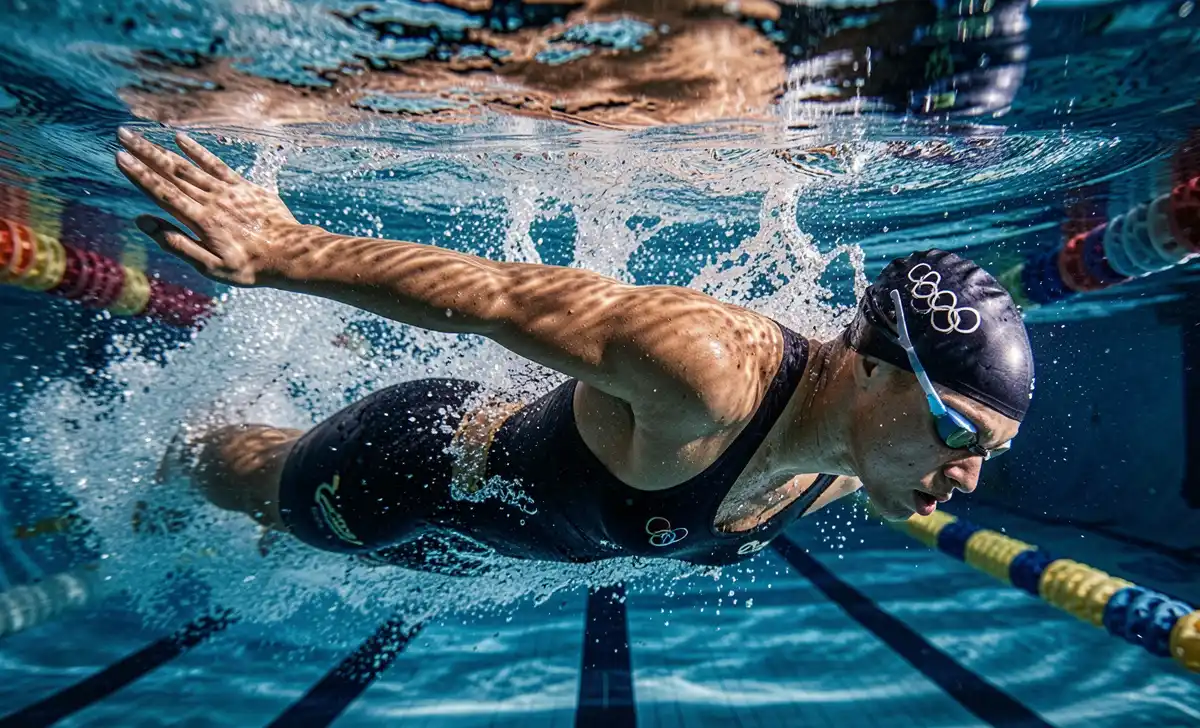
You’ve probably heard a coach say it a hundred times: “Breathe every three strokes. Keep it even.” It’s the golden rule of freestyle. So why does it completely fall apart the moment you watch an Olympic final on TV? If you’ve ever wondered why Olympic swimmers breathe every 2 strokes instead of sticking to the standard rhythm, you’re not alone. The short answer? They’re not trying to be symmetrical. They’re trying to win. Understanding proper breathing techniques helps you see why oxygen delivery becomes the priority when speed matters most.
The Bilateral Breathing Myth: Where Did “Every 3 Strokes” Come From?
Let’s clear something up right away. Breathing every third stroke isn’t a racing strategy. It’s a training drill.
Coaches love it because it forces you to develop a balanced stroke on both sides. If you only breathe right, your left arm crosses over, your shoulders roll unevenly, and you end up fighting your own wake. Breathe every three, and you fix those muscle imbalances.
That’s great for Tuesday morning lap swim. It’s terrible when you’re racing for your life at the end of a 200m heat. Truth is, the “three-stroke rule” was never meant to survive outside of practice lanes.
Oxygen vs. Symmetry: What Elite Swimmers Actually Do in Races
Here’s the thing: speed costs oxygen. A lot of it.
When a swimmer drops into a race, their heart rate spikes, muscles burn, and the clock starts ticking. Waiting for a third stroke just to get a single breath means going longer without fresh air. In a sprint or a hard middle-distance race, that extra half-second of holding your breath can ruin your rhythm and drop your pace.
Watch a 100m or 200m freestyle final. You’ll see a steady one-breath-per-two-strokes pattern. They pick a dominant side, stick to it, and keep their head in a predictable spot. It’s not about looking pretty in the water. It’s about grabbing air the millisecond they need it.
The difference comes down to aerobic versus anaerobic energy systems. When you’re pushing hard, your body switches to anaerobic metabolism, which demands constant oxygen replenishment. That’s why elites ditch the symmetry.
Bilateral Breathing vs. Breathing Every 2 Strokes: When to Use Which
So which one actually belongs in your toolbox? Both. But they serve completely different purposes.
Think of bilateral breathing like stretching. You do it to stay loose, prevent injury, and keep your mechanics clean. You use breathing every two strokes like a gear shift. You drop into it when the pace picks up, and your body starts begging for more oxygen.
I’ve talked with age-group swimmers who panic when they switch patterns. They feel lopsided. That’s normal. The trick is knowing when to flip the switch. Pool training? Stick to threes or fours. Time trials and meets? Drop to twos and let your faster side do the heavy lifting.
Does Bilateral Breathing Actually Make You Faster?
This question pops up constantly on swim forums, and the answer is messy. Does bilateral breathing make you faster? In training, absolutely. It fixes lazy strokes and keeps your drag low by forcing you to rotate evenly. In a race? Rarely.
Drag matters less when you’re already maxing out. If breathing every third stroke makes you gasp at the wall, you’ve lost the advantage. I’ve seen swimmers shave half a second off their 50-yard splits just by picking their stronger side and breathing every other stroke consistently. The physiology backs this up, too. Oxygen delivery trumps perfect symmetry once you cross the 75-meter mark.
Your Action Plan: Should You Breathe Every 2 or 3 Strokes in Freestyle?
If you’re staring at the bottom of a pool, wondering whether to breathe every 2 or 3 strokes in freestyle, match the pattern to your distance. Here’s a quick breakdown:
- Sprints (25m–100m): Breathe every 2 strokes. Pick your comfortable side. Focus on quick, sharp exhales underwater so your inhale is fast.
- Middle Distance (200m–400m): Start with every 2. If your pace settles, switch to a pattern of 2-3-2-3 or just stick to 3s to keep your heart rate manageable.
- Distance & Open Water (800m+): Here’s where bilateral breathing earns its keep. Breathe every 3 or even 4 strokes. You need that symmetry for endurance, plus you’ll want to scan both sides in open water for buoys and other swimmers.
There’s no single right answer. There’s only what keeps you moving without drowning your lungs.
The Distance-Dependent Breathing Framework (Your Quick-Reference Cheat Sheet)
Since most articles treat “elite breathing” as one-size-fits-all, here’s the practical tool competitors skip: a race-length decision tree.
| Race Length | Recommended Pattern | Why It Works |
|---|---|---|
| 25–50m sprint | Every 2 strokes (dominant side) | Max oxygen, minimal rhythm disruption |
| 100–200m | Every 2 strokes, occasional 3s on turns | Balance speed with brief recovery |
| 400–800m | Mix 2s and 3s; shift based on fatigue | Adapt to lactate buildup without panic |
| 1500m+ / Open Water | Every 3–4 strokes, bilateral | Symmetry reduces fatigue; scanning for navigation |
Save this. Screenshot it. Use it next time you’re planning a set.
How to Practice Without Getting Dizzy or Tired
Switching patterns feels awkward at first. You’ll probably take a sip of water or two. That’s fine. Build it up slowly.
Try a simple 500-yard set: 50 bilateral, 50 single-side, 50 bilateral. Focus on exhaling completely before your mouth clears the surface. If you still have air in your lungs when you turn your head, you’ll panic-breathe, lift your head too high, and sink your legs. Keep your head low. Rotate from your core, not your neck.
You’ve probably noticed that feeling of lightheadedness when you try to stretch out your breath. That’s just CO₂ buildup. Your body adapts to it within a few weeks. Don’t fight the rhythm. Just let it settle. Building muscle memory through consistent repetition makes these pattern switches feel natural instead of forced.
FAQs
Will breathing only on one side ruin my stroke?
Only if you do it exclusively in practice. If you rotate sides during warm-ups and drill sets, your shoulders will stay balanced. Races are too short for long-term asymmetry to cause damage.
Do I need to breathe every stroke in a 50m sprint?
Some elite sprinters do. Most stick to every two or three. If you find yourself holding your breath until the wall, you’re sacrificing speed for air. Take a breath.
Is it okay to change my breathing pattern mid-race?
Absolutely. Lots of distance swimmers start with every 3 strokes, then flip to every 2 when they push off the 300m mark. Your body will tell you when it needs more oxygen. Listen to it.
What if I feel dizzy breathing every three strokes?
You’re likely holding your breath too long underwater. Exhale steadily through your nose and mouth the moment your face goes under. A slow, controlled release prevents that heavy, lightheaded feeling.
Conclusion
Freestyle breathing isn’t a one-size-fits-all rule. It’s a tool you adjust based on distance, pace, and your own lungs. Next time you step onto the blocks, forget the old coaching mantra. Try a pattern that actually matches your race strategy. You’ll feel the difference by the third lap. If you’re working on longer sets, learning to build endurance without overtraining will help you maintain these breathing patterns when fatigue sets in.