
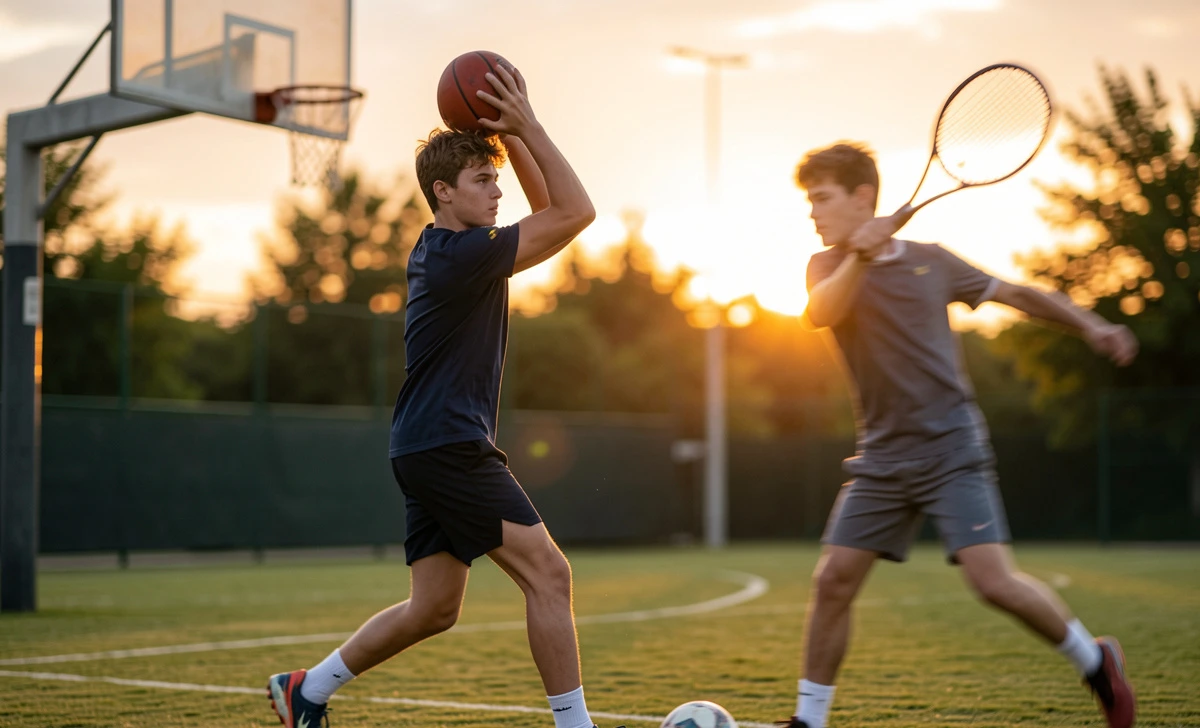
You know that feeling? You’re on the court, the field, the pool—whatever your thing is—and your body just knows what to do. No overthinking. No hesitation. The ball finds the net, your feet find the rhythm, your swing just… clicks.
That’s not magic. That’s muscle memory. And here’s the good news: you don’t need to be a prodigy to get there. If you want to build muscle memory sports skills faster, you’re already on the right track. This isn’t about talent. It’s about training your brain and body to work together—on purpose.
Truth is, most beginners waste time repeating drills without a plan. They get frustrated when progress feels slow. They wonder if they’re “just not athletic.” Nope. You’re probably just missing the roadmap.
Let’s fix that.
What Is Muscle Memory (and What It Isn’t)
First, let’s clear up a myth: your muscles don’t actually remember anything. Wild, right?
The term “muscle memory” is a shortcut for something called motor learning, and if you want to learn more about muscle memory training, the research is detailed. It’s your brain creating efficient neural pathways—like wearing a path through tall grass by walking it every day. The more you repeat a movement correctly, the stronger that pathway gets. Eventually, your body executes the skill without your conscious mind having to micromanage every detail.
So, when a tennis player serves without thinking about their toss, or a soccer player dribbles while scanning the field? That’s not instinct. That’s repetition, wired into their nervous system.
How does muscle memory help in sports? Simple: it frees up mental bandwidth. Instead of focusing on how to move, you can focus on when and why. Strategy. Awareness. Flow. That’s where the real game happens.
How Muscle Memory Speeds Up Sports Skill Acquisition
Think about your first time trying a new sport. Everything felt clumsy. You had to think about your feet, your hands, your breathing—all at once. Exhausting.
Now picture an athlete who’s practiced the same skill hundreds of times. Their body handles the basics automatically. You see this exact pattern in real-world muscle memory examples for athletes: a tennis player tossing a ball without thinking, a swimmer holding rhythm under fatigue, a golfer repeating a smooth swing under pressure.
These aren’t “natural gifts.” They’re the result of deliberate, structured repetition. And here’s the kicker for beginners: your brain is actually more adaptable when you’re new to a skill. Neuroplasticity is on your side. You just need to harness it.
Step-by-Step: Building Muscle Memory as a Beginner
Alright, let’s get practical. If you want to know how to build muscle memory for beginner sports, forget “just practice more.” Quality beats quantity every time.
I call this approach the 30-Day Muscle Memory Blueprint. It’s built to take you from clumsy repetition to automatic execution without the guesswork.
Here’s a simple 3-phase framework that actually works:
Phase 1: Learn It Right (Days 1–7)
- Break the skill into tiny pieces. Don’t try to master a full tennis serve—start with just the toss.
- Go slow. Speed hides mistakes. If you practice sloppily, you’re wiring in sloppiness.
- Use mirrors, video, or a coach for instant feedback. Your brain needs accurate input to build the right pathway.
Phase 2: Repeat With Purpose (Days 8–21)
- Aim for 10–15 minutes of focused repetition daily. Consistency trumps marathon sessions.
- Add one small variable at a time: change your stance, add light movement, introduce a target.
- Track your reps. Research suggests it takes anywhere from 300 to 1,000+ correct repetitions for a movement to start feeling automatic—depending on complexity.
Phase 3: Automate Under Pressure (Days 22–30)
- Simulate game conditions: add time pressure, mild distractions, or fatigue.
- Practice the skill after a light warm-up, not when you’re fresh. Real performance happens when you’re not at 100%.
- End each session with one “perfect” rep. Your brain remembers the last thing you did—make it count.
You’ve probably noticed: this isn’t about grinding until you drop. It’s about smart, intentional repetition. And yes, it works even if you’re starting from zero.
Can Adults Build Muscle Memory Faster? Debunking Age Myths
Let’s address the elephant in the room: “Am I too old to learn this?”
Short answer: no. Longer answer: Your brain stays capable of forming new motor pathways well into adulthood. Sure, kids might pick things up faster in some ways—but adults have advantages too: better focus, clearer goals, and the discipline to stick with a plan.
Can adults build muscle memory faster? Not “faster” than a teenager, necessarily—but absolutely efficiently. The key is leveraging what you already have:
- Use mental rehearsal. Visualizing the movement activates similar brain regions as physical practice. Five minutes of focused visualization post-session can boost retention.
- Prioritize sleep. Motor memories consolidate during deep sleep. Skimp on rest, and you’re undoing your work.
- Embrace “micro-practice.” Can’t do 30 minutes? Do three 10-minute bursts. Your nervous system responds to frequency, not just duration.
Age isn’t a barrier. Impatience is. Give your brain the repetition + recovery it needs, and you’ll be shocked at what sticks.
Sport-Specific Muscle Memory Drills You Can Start Today
Theory’s great. Action’s better. Here’s how to apply this right now, no matter your sport.
For individual sports (running, swimming, golf):
- The 3×3 Drill: Pick one technical element (e.g., golf grip, swim catch, running cadence). Practice it for 3 minutes, rest 1, repeat 3x. Focus only on that piece. For runners specifically, pairing this with work to improve running form compounds your progress.
- Blind Reps: Once you feel comfortable, try 3–5 reps with your eyes closed (safely!). This forces your body to rely on feel, not sight—accelerating neural encoding and boosting hand-eye coordination at the same time.
For team sports (soccer, basketball, volleyball):
- Partner Mirror Drill: Face a partner. They make a slow movement (lateral shuffle, passing motion); you mirror it. Builds reaction + muscle patterning together.
- Constraint Games: Play a simplified version with one rule: “only use your weak foot” or “no dribbling.” Constraints force your brain to adapt faster.
No equipment? No problem:
- Shadow practice: Go through your sport’s movements without gear. A boxer shadowboxing, a pitcher miming their windup—it all counts.
- Balance challenges: Stand on one leg while mimicking your sport’s stance. Stability + repetition = stronger neural wiring.
The beauty of tailoring these muscle memory drills to your actual sport is that they scale to any skill level. Swap in your sport, tweak the variables, keep the core principle: precise, repeated, progressive.
What to Do When You Lose Progress (Injury, Breaks, Plateaus)
Life happens. You get injured. You take a break. You hit a wall. Now what?
First: don’t panic. Muscle memory isn’t “lost”—it’s just dormant. Studies show that relearning a motor skill takes far less time than learning it for the first time.
Here’s how to bounce back:
- After a break: Start at 50% intensity. Focus on form, not speed. Your pathways are still there; you’re just dusting them off.
- Post-injury: Work with a physio or coach to rebuild movement patterns safely. Small, pain-free reps rebuild confidence and neural connections.
- Plateauing? Change one variable: tempo, angle, environment. Novelty sparks new neural growth.
And don’t sleep on mental practice. Even when you can’t move, visualizing the skill keeps those pathways warm. It’s not a replacement—but it’s a powerful bridge.
FAQs
How long does it actually take to build muscle memory for a new sport skill?
There’s no magic number, but most beginners notice movements feeling more “automatic” after 2–4 weeks of consistent, focused practice. Complex skills (like a golf swing) take longer; simple ones (like a passing motion) can click faster.
Do I need to practice every single day?
Ideally, yes—but “practice” can be 10 minutes. Frequency matters more than duration. Missing a day? No crisis. Just get back to it. Your brain adapts to patterns, not perfection.
What if I keep making the same mistake?
Slow down. Record yourself. Often, we’re unaware of small form errors that get wired in. One session with a coach (or even a knowledgeable friend) can reset your trajectory.
Can I build muscle memory for multiple sports at once?
You can, but prioritize one skill at a time. Your brain consolidates motor memories best when focus isn’t split. Master the foundation in one area before layering on another.
Wrap-Up: Your Turn to Build That Blueprint
Look, building muscle memory isn’t about grinding harder. It’s about practicing smarter—breaking skills down, repeating with intention, and trusting the process.
You don’t need to be young, gifted, or fearless. You just need a plan and the patience to follow it. Start small. Stay consistent. Let your nervous system do what it does best: adapt.
And if you’re worried about burning out, learn how to build endurance without overtraining so your practice stays sustainable.
And if you’re looking for sport-specific drills to pair with this framework, we’ve got you covered: 10 Muscle Memory Drills for Basketball, Soccer, and Tennis.
Your future self—the one moving with confidence, reacting without overthinking, just flowing—is waiting. All you have to do is start. One rep at a time.