
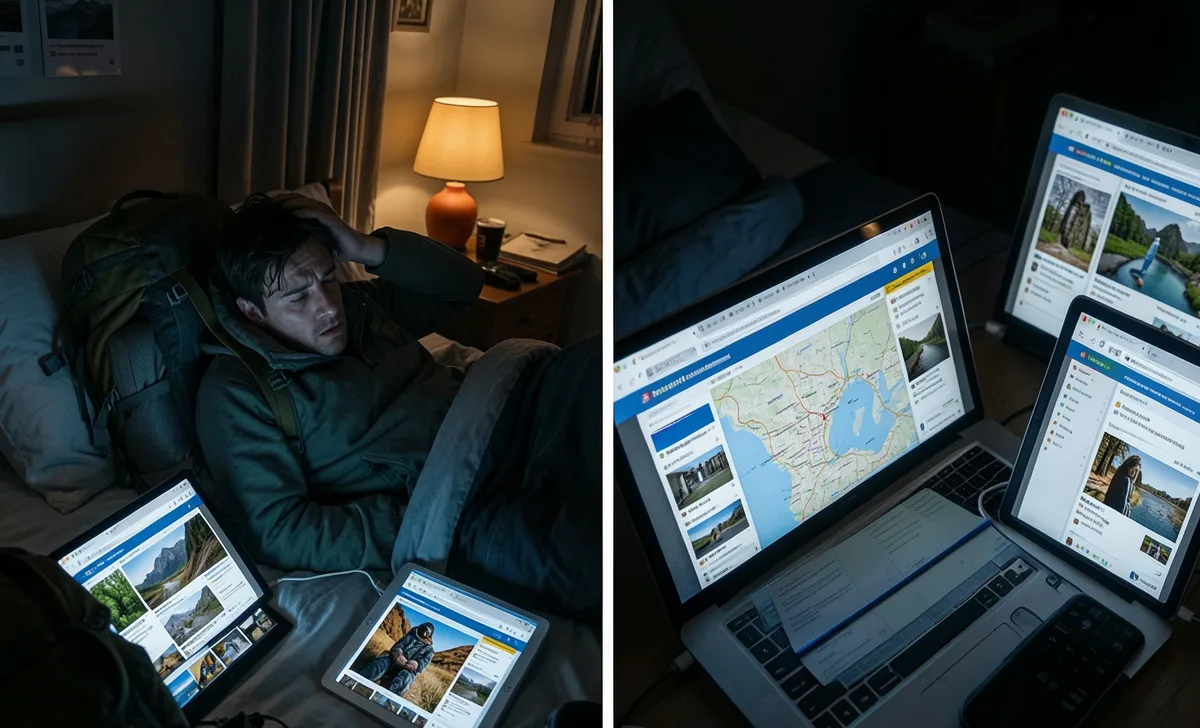
You’ve spent three evenings scrolling through Grand Canyon sunsets. Your Pinterest board has 247 pins of New York City rooftops. You know the exact cafe with the blue door in New Orleans. And yet… You feel weirdly flat about the trip you’ve been counting on for months.
Here’s the uncomfortable truth: Can you research a destination too much? Absolutely. Too much travel research isn’t about wasting time — it’s about how flooding your brain with perfect, curated images before you go can actually dull the real experience.
Let’s fix that — without throwing your planning out the window.
The Anticipation Paradox: Why Planning Feels Good… Until It Doesn’t
Planning a trip is fun. Really fun. Picking spots, saving photos, mapping routes — it gives you little hits of dopamine, like a preview of the joy to come. That’s the psychology of waiting for vacation happiness in action — research shows travel time perception shifts when we over-anticipate. Your brain loves the “almost there” feeling.
Researchers have found that when we over-saturate ourselves with images and details beforehand, the actual moment can feel… underwhelming. It’s not the destination’s fault. It’s that your brain has already “lived” pieces of it through screens. The surprise, the discovery, the raw “whoa” factor? They get softened.
I learned this the hard way in the Smoky Mountains. I’d watched so many golden-hour ridge reels that when I finally stood there, my first thought wasn’t awe — it was, “Huh. Looks just like the video.” My brain had filed it as “already experienced.” Ouch.
How Travel Photos Rewire Your Expectations (For Better and Worse)
Photos aren’t evil. They inspire us. They help us dream. But they also set a script.
When you ask, does looking at too many destination photos ruin surprise, the answer leans yes — but with nuance. A study in the Journal of Experimental Psychology showed that taking (or viewing) too many photos can impair memory of the experience because your brain offloads the job to the camera.
Think of it like this: if you’ve already “seen” a place through 50 perfect shots, your brain has less work to do when you arrive. Less novelty. Less engagement. The magic isn’t gone — it’s just competing with a highlight reel you’ve already memorized.
Ever wonder why travel photos make destinations feel less special? It’s not the place’s fault — it’s your brain comparing reality to a highlight reel. Example: You’ve pinned a pristine, empty Antelope Canyon beam of light. You arrive to find a crowd, timed entry slots, and a rushed photo op. That disconnect isn’t disappointment — it’s your brain recalibrating from curated to real. And when popular spots feel underwhelming, it’s often tied to the overtourism traveler experience, too.
5 Signs You’ve Crossed Into Travel Research Overload
How do you know if you’ve tipped from prepared to overprepared? Watch for these:
- You feel bored before you leave. If your USA road trip already feels “done” in your head, that’s a red flag.
- You’re stressed about matching the photos. Worrying that your Yellowstone experience won’t look like the Instagram version? That’s pressure, not excitement.
- Decision fatigue hits early. You’ve researched every diner on Route 66, every trail in Zion, and now choosing feels exhausting.
- You’ve lost the “why.” You’re so deep in logistics, you forget what you actually wanted to feel on this trip.
- You’re avoiding new info. Ironically, over-researchers sometimes stop looking because it’s just… too much.
If two or more of these sound like you, it’s time to pull back. Not stop — just recalibrate.
The Balanced Planner’s Framework: Research Without Ruining Surprise
So, how to plan a trip without over-researching? You don’t need to wing it. You just need boundaries.
I call this the Anticipation Audit — a simple filter I use with clients to keep research joyful, not draining. Three simple steps to keep your planning joyful, not draining.
1. Curate with intention (not compulsion)
Pick 3-5 “must-see” spots. Just 3-5. Save photos that spark genuine excitement, not FOMO. Ask: “Does this image help me connect with the place, or just fuel comparison?” Maybe it’s the Northern Lights in Alaska or a jazz club in Memphis — choose what truly moves you.
2. Limit your deep-dive time
Set a research budget. Example: 90 minutes total for accommodation, 60 for activities. Use a timer. When it dings, you’re done. This forces prioritization — and protects your mental energy.
3. Protect the mystery on purpose
Leave one meal unplanned. One afternoon, unscripted. One stretch of Pacific Coast Highway un-Google-Maped. These aren’t gaps — they’re invitations for real discovery. Making mindful travel choices means protecting space for the unplanned.
Truth is, the best travel stories often come from the unplanned detours. The wrong turn that led to the family-run BBQ joint in Texas. The rainy afternoon spent chatting with a local in a Portland bookstore. You can’t pin those. But you can make space for them.
When Disappointment Hits: Resetting Expectations On the Ground
Maybe it’s too late. You’ve already over-researched. You land in Miami, and the beach feels… smaller than your mental version.
Try the 24-hour no-photo challenge. For the first day, don’t take a single picture. Just look. Smell. Listen. Let your senses catch up without the pressure to document. You’d be surprised how quickly the “real” place starts to shine when you’re not framing it.
Next, shift your goal. Instead of “see everything on the list,” try “notice three small, beautiful things today.” The way light hits a Chicago market stall. The sound of jazz drifting from a New Orleans doorway. The weight of redwood bark under your palm in California.
Disappointment isn’t failure. It’s data. It’s your brain saying, “Hey, I was expecting a movie. But this is life — and life is messier, richer, and way more interesting.”
FAQs
Is it bad to look at travel photos before a trip?
Not at all — in moderation. Photos inspire and prepare us. The issue is volume and passivity. If you’re mindlessly scrolling hundreds of images of American landmarks, you risk dulling your own reaction. Try curating a small, intentional mood board instead.
How far in advance should I stop researching?
A good rule: taper off deep research 3-5 days before departure. Use that time to pack, rest, and mentally shift into “experience mode.” Let the anticipation build naturally, not through more screens.
What if I’m an anxious planner? I need details to feel safe.
Totally valid. Safety and logistics matter. Focus your research on practical needs (transport, visas, neighborhoods) and leave the experiential stuff — cafes, viewpoints, walks — more open. You can prepare for safety without scripting joy.
Does this apply to repeat destinations?
Less so. If you’ve been somewhere before, photos might help you rediscover favorites or spot new angles. The “overload” risk is highest for first-time visits to places like the Grand Canyon or NYC, where novelty is part of the magic.
Conclusion
So yes, you can research a destination too much. But you don’t have to choose between preparation and presence. With a little intention, you can plan wisely and still leave room for wonder.
Next time you’re deep in a travel rabbit hole, pause. Ask: “Is this helping me connect, or just compare?” Then close the tab. Take a breath. Trust that the real place — imperfect, alive, waiting — will be worth it. And if you’re balancing research with realism, balanced trip planning starts with permitting yourself to leave some things unknown.
P.S. If you found this helpful, share it with a friend who’s deep in pre-trip research mode. Sometimes we all need permission to stop planning and start anticipating — the healthy way.