
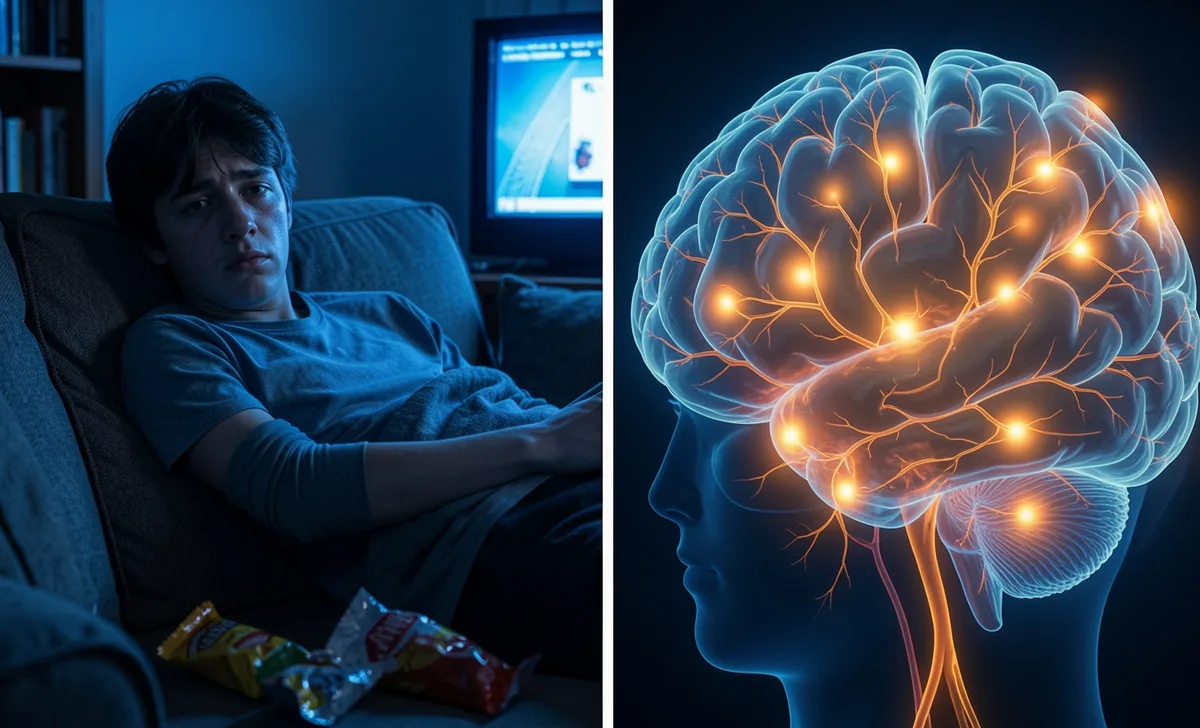
You know that feeling. You finish an episode. Then another. Then suddenly it’s 2 AM, your eyes are dry, and you feel… weirdly hollow. Like you just ate a whole bag of chips—satisfying in the moment, but not exactly nourishing. That’s not just fatigue. That’s your brain’s reward system sending you a memo. If you’re stuck wondering what to watch when bored, that’s actually part of the cycle we’re talking about. Let’s talk about what binge watching reward system effects actually look like, and more importantly, how to feel like yourself again without swearing off Netflix for good.
How Your Brain’s Reward System Actually Works
Dopamine 101: “Wanting” vs. “Liking” Explained
Here’s the thing about dopamine: it’s not really the “pleasure chemical” we’ve been sold. It’s more like the “anticipation chemical.” Your brain releases it when it expects a reward—not necessarily when you get it. That’s why the cliffhanger before the auto-play countdown feels so irresistible. Your brain is literally chasing the promise of resolution.
So, does binge-watching affect dopamine levels? Short answer: yes, but not how you might think. Binge-watching doesn’t flood your brain with extra dopamine. Instead, it trains your reward circuitry to expect quick, effortless hits of anticipation. Over time, that can make slower, real-world rewards—like finishing a work project or having a deep conversation—feel less compelling by comparison.
What Happens to Your Brain During a Binge Session
The binge-watching reward system effects, step by step
Picture this: You press play. The opening theme hits. Your brain goes, “Oh, story! People! Drama!” and releases a little dopamine to keep you engaged. The episode ends on a twist. Auto-play counts down: 3… 2… You click “Next” without thinking. That’s the loop. Each episode delivers a micro-dose of anticipation, and your brain learns: This is easy. This works.
The problem isn’t the watching itself. It’s the pattern. When we repeatedly pair relaxation with high-stimulus, low-effort rewards, we subtly rewire what “relaxing” even means.
Why do you feel empty after binge-watching (the dopamine crash)
Ever notice that post-binge slump? That’s the other side of the dopamine coin. After hours of anticipated rewards (plot twists, reunions, reveals), the stimulation stops. But your brain’s expectation machine is still revving. The mismatch—high anticipation, zero new input—creates that flat, slightly anxious emptiness.
You’re not broken. You’re just experiencing a very human neurochemical comedown. It’s the same reason you might feel restless after scrolling social media for an hour. The medium changes; the mechanism doesn’t. And if you’re dealing with those earworm removal techniques for songs stuck in your head, it’s the same principle—your brain is looping.
The Hidden Cost: Binge-Watching and Motivation Loss
How overstimulation dulls real-life rewards
This is where binge watching and motivation loss start to overlap. When your brain gets used to fast, predictable rewards from screens, slower-burn activities can feel… tedious. Why write that email when you could see what happens next? Why go for a walk when the next episode is already loading?
It’s not laziness. It’s your reward system recalibrating its baseline. Think of it like turning up the volume on a song. After a while, normal conversation sounds quiet. Your brain isn’t broken—it just needs a little retuning.
I had a client (let’s call her Maya) who told me she’d lost her spark for painting. “I’d rather just watch something,” she said. We didn’t quit streaming. We just added one tiny rule: one episode, then 10 minutes with her sketchbook. No pressure to create a masterpiece. Just reconnect with the process. Two weeks later, she told me she’d forgotten how satisfying it felt to get lost in making something, not just consuming it.
Streaming Shows and Brain Chemistry: What 2024-2026 Research Says
Short-term focus dips vs. long-term mood impacts
Recent studies are getting more nuanced about streaming shows on brain chemistry effects. It’s not “screens bad, books good.” It’s about patterns, context, and what you’re replacing.
One 2024 review in Computers in Human Behavior noted that passive, marathon viewing can temporarily reduce activity in brain regions linked to self-control and future planning. But—and this is key—the same research found that intentional, moderated viewing showed no negative effects. The difference? Agency. Choosing to watch vs. feeling pulled in.
Another angle: content matters. A tense thriller triggers different neurochemical responses than a comfort rewatch. Your brain isn’t just processing “screen time.” It’s responding to story, pacing, and emotional arcs. That’s why a cozy baking show might feel restorative, while a dystopian drama leaves you wired. If you’re trying to follow complex TV series without burning out, this balance becomes even more critical.
How to Reset Your Reward System (Without Quitting Netflix Forever)
You don’t need a dopamine detox. You need a dopamine balance. Here are five tiny, sustainable shifts that actually work:
- The “One More Thing” Rule: After an episode, pause for 60 seconds. Ask: “Do I genuinely want to keep watching, or am I just avoiding stopping?” That tiny gap rebuilds intentionality.
- Pair Streaming with a Low-Stakes Activity: Fold laundry while you watch. Sip tea mindfully. This anchors viewing to a real-world sensory experience, not just a digital void.
- Schedule “Binge Windows”: Instead of “I’ll stop after this episode” (which rarely works), try “I’ll watch from 8–10 PM, then switch to music/podcasts.” Boundaries feel less restrictive when you set them before you’re in the loop.
- End with a “Landing Ritual”: After you turn off the screen, do one small thing to signal closure: stretch, write down one thought about the episode, or step outside for three deep breaths. This helps your brain transition out of “anticipation mode.”
- Curate Your Queue with Purpose: Keep a shortlist of shows you’re genuinely excited about—not just whatever’s trending. When viewing feels chosen, not default, it lands differently in your nervous system. You don’t need expensive gear to create budget home entertainment that actually supports your wellbeing.
When to seek help: red flags for problematic viewing
Most of us can course-correct with small tweaks. But if you notice these patterns, it might be time to talk to a professional:
- You’ve tried to cut back multiple times and can’t
- Watching interferes with work, relationships, or sleep regularly
- You feel intense anxiety or irritability when you can’t watch
- You use streaming to numb emotions consistently
There’s zero shame in that. Sometimes our brains need a little extra support to reset.
FAQs
Is it bad to binge-watch occasionally?
Not at all. Your brain is adaptable. The issue isn’t a weekend marathon—it’s making it your default way to unwind, every day, without variety.
How long does it take to “reset” after a binge?
For most people, 24–48 hours of balanced activities (movement, real-world connection, low-stimulus hobbies) is enough to recalibrate. You don’t need a week-long detox.
Can certain shows actually help my brain?
Absolutely. Stories that spark curiosity, empathy, or reflection can have positive cognitive effects. The key is noticing how you feel after—energized and thoughtful, or drained and foggy?
What if I just love getting lost in a story?
That’s a gift! The goal isn’t to stop enjoying narratives. It’s to protect that joy so it doesn’t tip into autopilot. Try savoring one episode fully instead of rushing through three.
Conclusion
Truth is, your brain isn’t fragile. It’s responsive. Every time you choose to pause, to reflect, to mix up your downtime, you’re not “fixing” yourself—you’re practicing flexibility. And that’s a skill that pays off far beyond your watch history.