
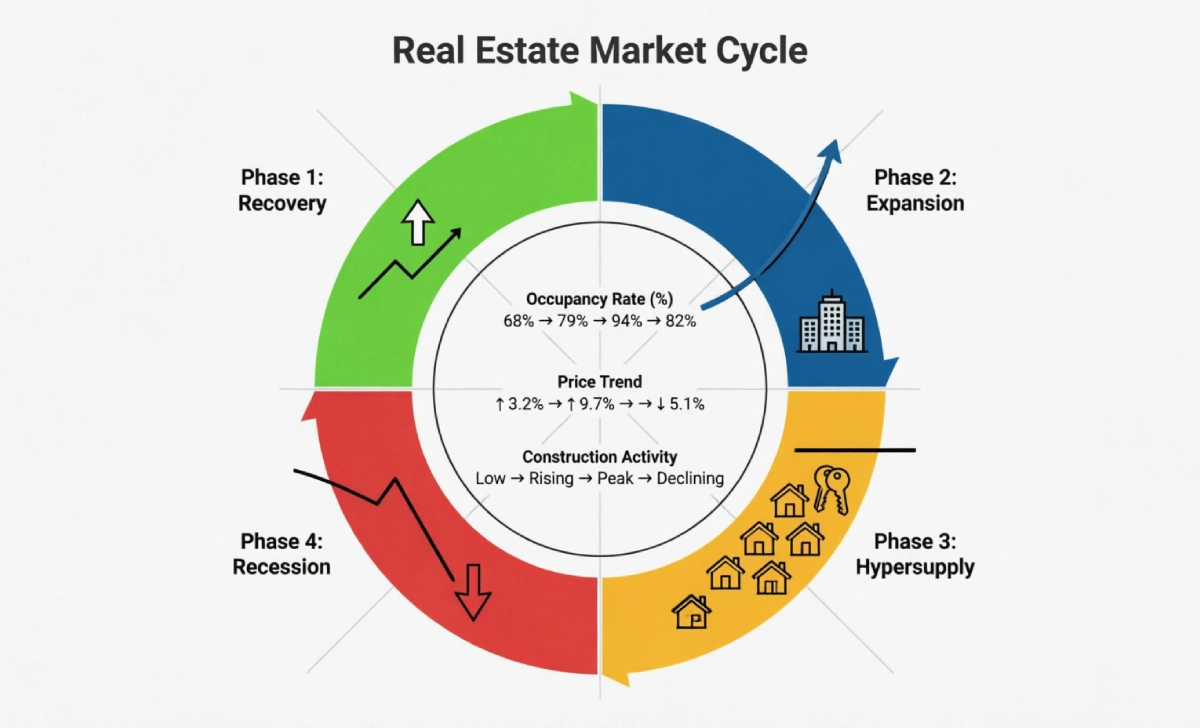
You’ve seen the headlines. “Is the housing market crashing?” “Now or never to buy?” It’s exhausting. And honestly? Most of it misses the point. Because real estate doesn’t just swing randomly. It moves in patterns—what we call the real estate market cycle. If you’re wondering what the 4 phases of the real estate market cycle are and, more importantly, how to actually use that knowledge where you live… you’re in the right place. No jargon. No fluff. Just a clear way to read the room before you make a move. And if you’re worried about buying near a peak, learning to spot real estate bubble signs early can save you from costly timing mistakes.
Why Understanding Real Estate Market Cycles Matters for Investors
Here’s the thing: timing isn’t about predicting the future. It’s about recognizing where you are right now.
Think of it like checking the weather before a hike. You don’t need a meteorology degree. You just need to know if you should pack a rain jacket. Same with real estate. Knowing the current phase helps you decide: Is now a time to buy cautiously? To hold steady? To sell into strength?
It won’t make you psychic. But it will keep you from making emotional decisions when everyone else is panicking—or getting greedy.
The 4 Phases of the Real Estate Market Cycle Explained
Real estate cycles aren’t neat, calendar-perfect loops. They’re messy, overlap, and move at different speeds depending on your city. But broadly? They break down into four repeating phases. Let’s walk through each one—and what to actually look for on the ground.
Phase 1: Recovery – Signs the Market Is Bottoming Out
This is the quiet phase. The one most people miss because, frankly, it’s boring. Prices have stopped falling. The news is still gloomy. But if you know where to look, you’ll spot the first green shoots.
What to watch for:
- Vacancy rates start to flatten (or dip slightly) after a long climb
- Rents stop declining—even if they’re not growing yet
- Distressed sales (foreclosures, short sales) begin to taper off
- Construction permits hit rock bottom and stay there
Truth is, recovery feels like waiting. But for patient buyers—especially investors—this is when you can find deals before the crowd shows up. That’s one of the key real estate market recovery phase signs most beginners overlook: silence isn’t always bad news. Sometimes, it’s opportunity knocking softly.
Phase 2: Expansion – When Demand and Prices Rise
Now things get lively. More people are renting. More buyers are touring homes. Headlines shift from “crash” to “competitive.”
What’s happening under the hood:
- Days on market drop noticeably
- Rent growth accelerates (3–5%+ year-over-year)
- New construction picks up—but cautiously at first
- Mortgage applications tick upward
This phase feels good. Maybe too good. It’s easy to get caught up in the momentum and overpay. That’s why it’s worth asking yourself: Am I buying because the fundamentals make sense, or because I’m afraid of missing out? If you’re evaluating a neighborhood during this uptick, understanding property value appreciation trends helps you separate real growth from hype.
Phase 3: Hypersupply – The Warning Signs Most Miss
Here’s where things get tricky. The market looks strong. Prices might still be creeping up. But the engine is sputtering.
Real estate hypersupply phase indicators to track:
- Inventory starts rising while prices flatten
- New construction completions surge, but absorption slows
- Sellers begin offering concessions (closing cost help, rate buydowns)
- “Price reductions” have become a common tag on listings
You’ve probably noticed a neighborhood where every other house has a “price improved” sign. That’s not a glitch. That’s a signal. Hypersupply doesn’t always mean a crash is imminent—but it does mean caution. Keep an eye on housing bubble warning indicators like these to avoid buying at the wrong moment. This is when holding, refining your criteria, or even trimming your portfolio can be smarter than chasing the last bit of upside.
Phase 4: Recession – How to Spot the Downturn Early
This phase gets a bad rap. Yes, prices can fall. Yes, it feels uncomfortable. But recessions also reset the board.
Spotting real estate recession early warning signs isn’t about doom-scrolling. It’s about watching leading indicators:
- Mortgage delinquency rates ticking up (even slightly)
- Job growth is slowing in your metro area
- Building permits dropping for two+ consecutive quarters
- Media coverage shifts from “hot market” to “uncertainty.”
If you see three or more of these lining up? It’s not the time to panic. It’s time to prepare. Recession phases reward liquidity, patience, and a clear checklist—not impulse.
How to Tell If the Real Estate Market Is Peaking Right Now
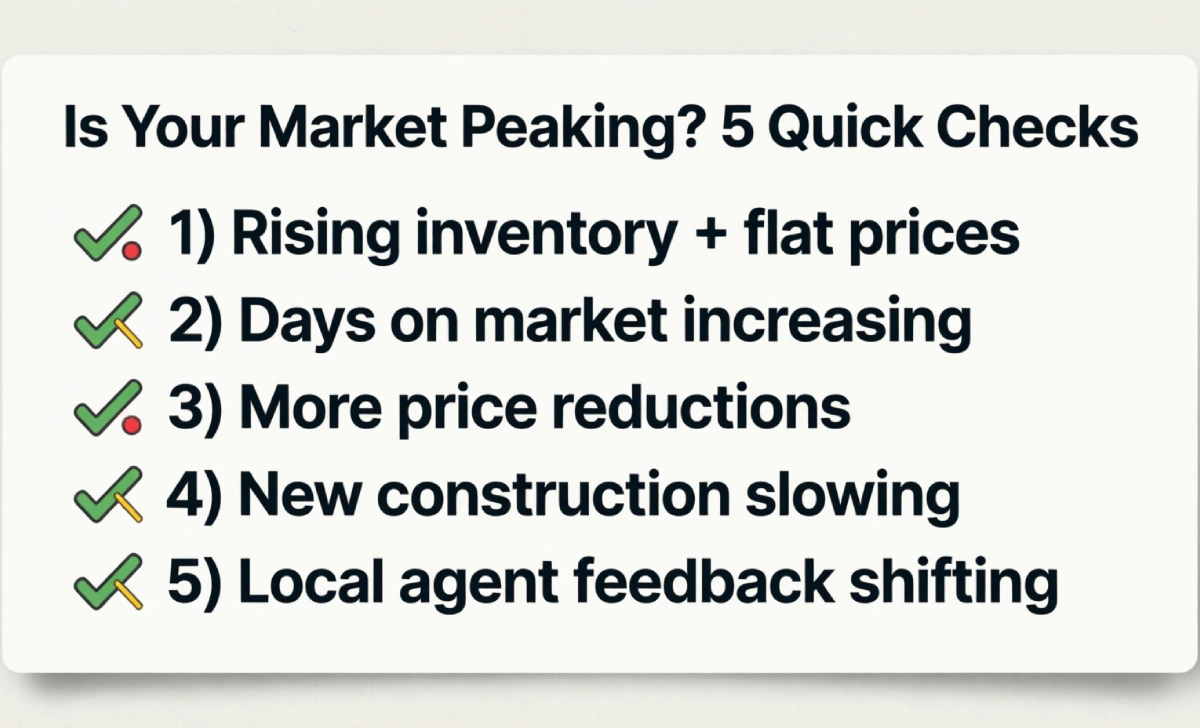
You don’t need a crystal ball. You need a shortlist of practical checks.The 4 Phases of the Real Estate Market Cycle Explained
Start here:
- Pull your local inventory trend (Zillow Research or your MLS). Is active listings growth outpacing demand?
- Check median days on market. A sudden jump (e.g., from 18 to 35 days) often precedes price softening.
- Watch the rent-to-price ratio. When home prices rise much faster than rents, affordability strain builds.
- Scan new construction permits. A spike followed by slowing sales? Classic late-cycle signal.
- Listen to local agents (not national headlines). Ask: “Are your buyers hesitating more? Are sellers adjusting expectations?”
Knowing how to tell if the real estate market is peaking isn’t about calling the exact top. It’s about avoiding buying at maximum optimism. That alone can save you tens of thousands.
Real Estate Cycle Timing for Beginners: A Simple Framework
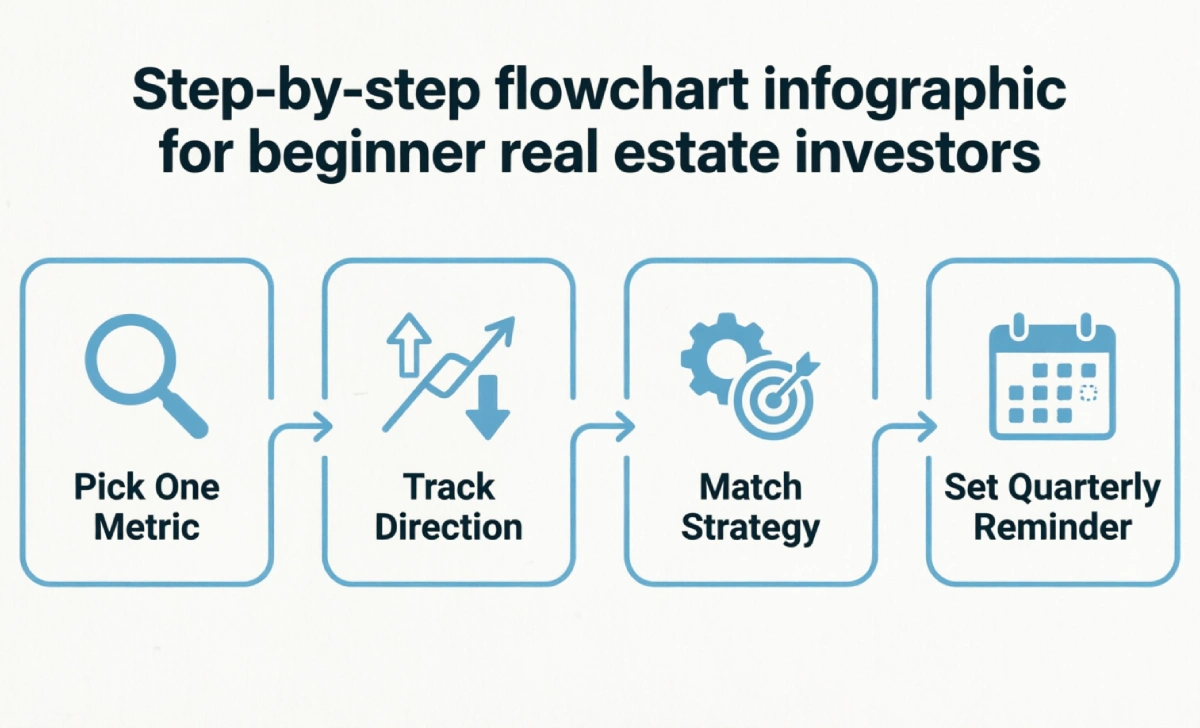
If you’re new to this, don’t overcomplicate it. Here’s a no-stress way to start thinking about real estate cycle timing for beginners:
- Step 1: Pick one metric to track monthly. Start with “median days on market” for your zip code. Simple. Free. Actionable.
- Step 2: Note the direction, not the number. Is it trending up, down, or flat for 3 months straight? That’s your signal.
- Step 3: Match your strategy.
- Trending down + low inventory? Consider buying (but verify affordability).
- Trending up + rising concessions? Time to be selective or hold.
- Step 4: Set a reminder. Re-check every quarter. Cycles move slowly—you don’t need daily updates.
That’s it. No complex models. No paying for premium data. Just consistent, small observations that compound into smarter decisions.
Local Market Variations: Why Your City’s Cycle May Differ
National headlines are noise if you’re buying in Boise, not Brooklyn. Real estate is hyperlocal. Always.
A gateway city like Austin might be in hypersupply while a secondary market like Cincinnati is still in recovery. Why? Job growth, migration patterns, local zoning, and even weather events can decouple markets.
So how do you apply this? Simple: research your market. Use free tools:
- Your county assessor’s site for sales volume trends
- Local news for major employer announcements
- Apartment List or RentCafe for hyperlocal rent data
Don’t assume your market follows the national narrative. Verify. Then act.
FAQs
How long does each real estate cycle phase last?
There’s no fixed timeline. Recovery might take 1–3 years; expansion 2–5. The full cycle historically averages 18 years (per Homer Hoyt’s research), but recent cycles have compressed. Focus less on duration, more on directional signals in your area.
Can I use this framework for rental properties, not just buying to sell?
Absolutely. In recovery? Look for value-add rentals. In expansion? Focus on cash flow stability. In hypersupply? Prioritize tenant retention. The phase changes your tactics, not your goal.
What if my local data conflicts with national trends?
Trust your local data. Always. National averages smooth over massive regional differences. Your zip code’s vacancy rate matters more than the U.S. median.
Is now a good time to buy in 2026?
That depends entirely on your market’s phase—and your personal timeline. Use the checklist above. If three or more recovery signs align where you live? It could be a smart entry point. If you see hypersupply warnings? Maybe wait, or negotiate harder.
Wrapping This Up
Understanding the real estate market cycle isn’t about timing the market perfectly. It’s about making informed, calm decisions while others react to headlines.
Start small. Pick one indicator. Track it for 90 days. See what it tells you about your neighborhood. That’s how you move from confused to confident. Even in a shifting market, knowing how to negotiate lower price terms can give you an edge when conditions favor buyers.