
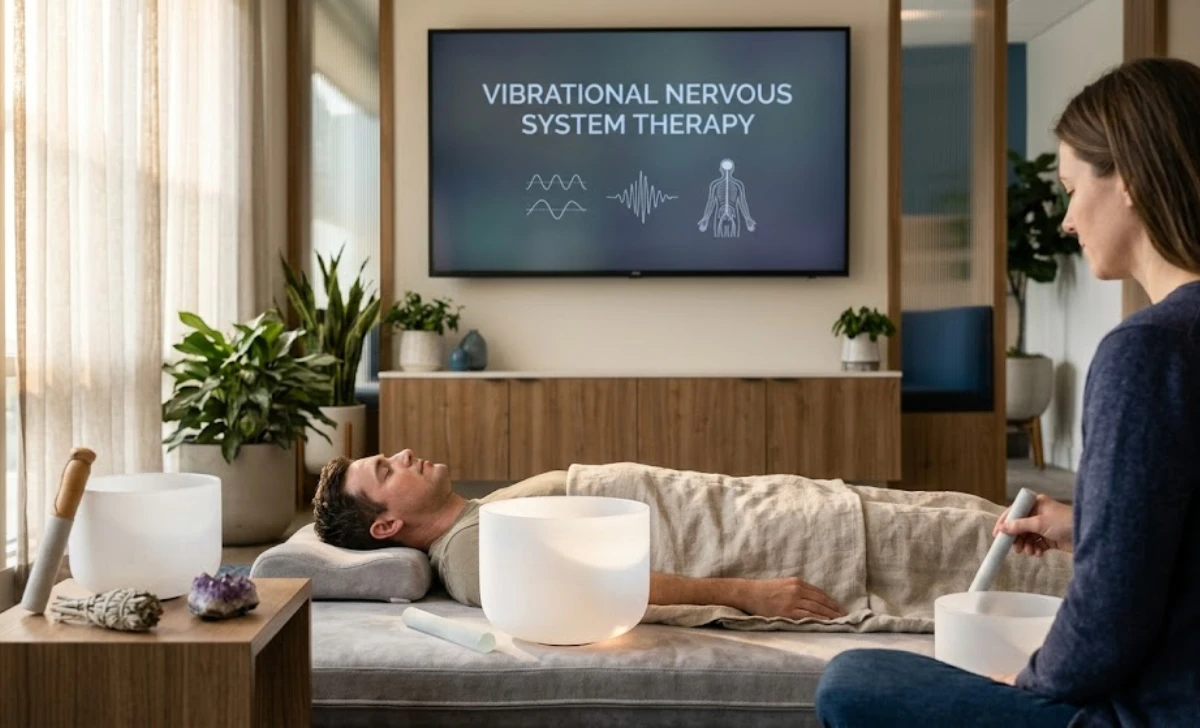
You know that feeling when your mind races and your shoulders stay tight, and nothing you try helps you settle. Deep breathing and meditation apps may not break the cycle. Now imagine if simply listening could shift your body into genuine calm. That is the promise at the heart of sound healing.
What makes this different from putting on a playlist is the intention. Sound healing uses specific vibrations to interact with your body in measurable ways, much like how a benefits guide helps you nourish from the inside out. Every ancient culture from Greece to the Himalayas understood this power, and modern science is finally explaining why.
By the end of this guide, you will understand what sound healing is and exactly how sound waves talk to your nervous system. You will also learn a simple practice you can try right now, using nothing but your own voice. Let’s start with the most basic question.
What Exactly Is Sound Healing?
If you have ever felt your whole body relax when a deep, resonant note is played near you, you have brushed against the edges of sound healing. At its core, sound healing is the intentional use of vibrational frequencies to bring your body and mind back into balance. It is not entertainment or a catchy tune; it is about the direct physical effect organized sound waves have on your tissues and cells.
Think of it like an acoustic massage. A practitioner uses vibrations from instruments to reach places hands cannot touch. Because your body is over seventy percent water, sound travels easily, creating gentle internal ripples that help stuck tension begin to dissolve.
Sound healing is not passive music listening. While music can move your emotions, sound healing works with the raw, physical properties of frequency. It is the difference between admiring a wave from the shore and actually feeling it move through you.
The Ancient Roots of Healing with Sound
Long before scientists could measure brainwaves, our ancestors used sound as a direct medicine. The idea that vibration restores harmony in the body is ancient, running through almost every indigenous culture on Earth. You are tapping into a timeless thread when you explore this practice today.
In ancient Greece, Pythagoras prescribed specific musical intervals to soothe emotional distress. He saw music not as art alone but as mathematical medicine. Similarly, the chanting of Gregorian monks and the overtone singing of Tibetan monks were never performances; they were technologies meant to shift consciousness.
These early practitioners understood that your body is a rhythmic symphony, not a solid object. The steady pulse of a drum or the drone of a gong was used to remind a person’s body of its own healthy rhythm. Today’s research is validating what they knew intuitively.
How Does Sound Healing Work on a Scientific Level?
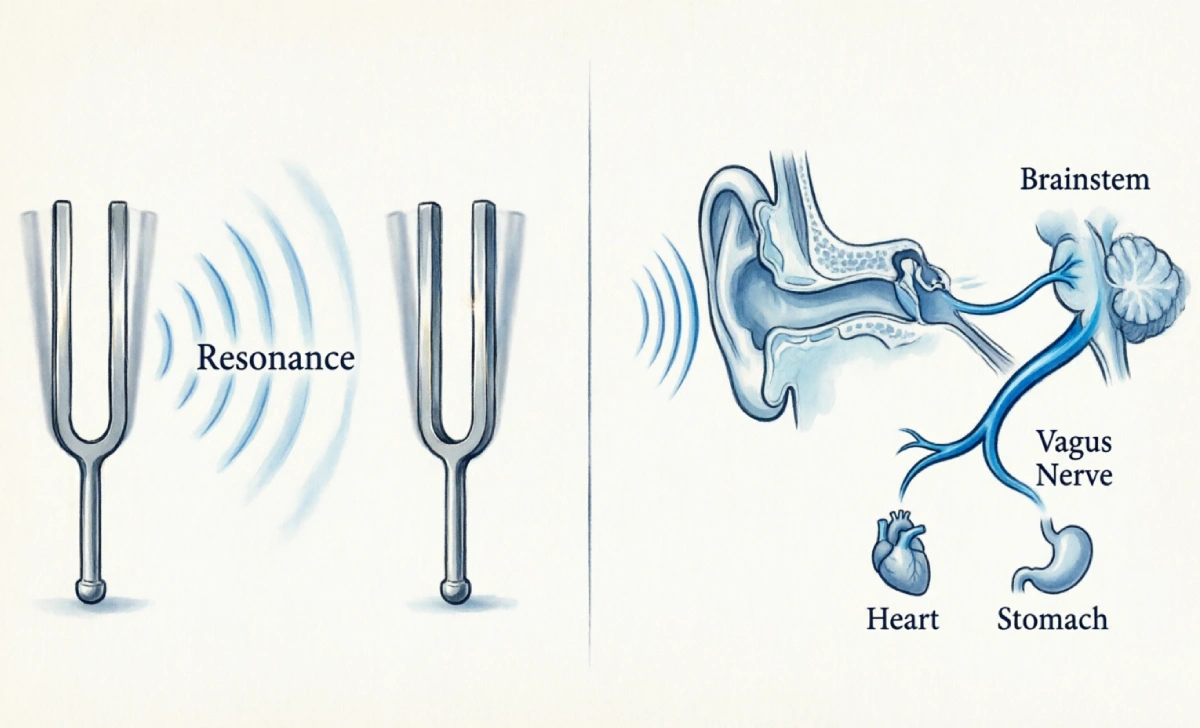
This is where we move from the mystical to the measurable. Two principles explain the entire process: resonance and entrainment. Resonance happens when a strong vibration causes a nearby object to vibrate in sympathy, like a singer shattering a wine glass. When a singing bowl’s organized vibration meets your stressed body, it gently coaxes your cells toward a more coherent state.
Entrainment is how a steady rhythm pulls a chaotic rhythm back into sync. Your body has many natural rhythms: heartbeat, breath, and brainwaves. During a sound bath, your brain and nervous system lock onto the steady, calming frequency of the instrument. It is as if the sound offers your frazzled system a simple blueprint for calm, and your body simply follows.
The physical pathway is direct. Sound waves enter your ear and become electrical signals that travel the auditory nerve straight to your brainstem. From there, the signal reaches a powerful nerve that influences your entire body. Scientists have visualized this with cymatics, showing how sound creates geometric patterns in matter, confirming vibration’s tangible effect.
What Happens to Your Brain During a Sound Bath?
When you lie down and let the sounds wash over you, your brain’s electrical chatter begins to change. In a stressed-out day, you spend most of your time in a beta brainwave state, which is alert and often anxious. The steady frequencies of a sound bath act like a gentle guide, encouraging your brain to slow down.
Your brain naturally wants to match an external rhythm. As a gong or bowl produces a long, sustained tone, your brainwaves shift from fast beta to a slower, relaxed alpha state. This is that blissful feeling just before sleep, where your mind is clear and your body at ease.
For many, the journey goes even deeper. The frequencies may guide your brain into a theta state, linked to deep meditation and vivid creativity. The sound practitioner holds a steady sonic ladder for your brain to climb down, into the restorative states your body craves but often cannot access on its own.
Can Sound Healing Really Help Your Physical Body?
The bridge between the sounds in your ear and the relief in your tight shoulders is a powerful cranial nerve. Once the auditory signal reaches your brainstem, it stimulates the vagus nerve, the main engine of your “rest and digest” response. This is not just a nice theory; it is a hardwired biological pathway.
Think of the vagus nerve as the captain of your relaxation team. When activated, it sends an immediate full-body signal that it is safe to stand down from high alert. Your heart rate drops, your blood pressure lowers, and your muscles begin to unclench. At the same time, your body reduces production of cortisol, the stress hormone that keeps you wired and tired.
This biological cascade also changes how you perceive physical discomfort. When your parasympathetic system takes charge, the volume on pain receptors can be turned down. It is not that the source of pain vanishes, but your nervous system’s emergency broadcast about it becomes quieter. Many people find that pairing sessions with other self-care, like trying out diy body scrubs, deepens the sense of renewal.
What Are the Different Types of Sound Healing Instruments?
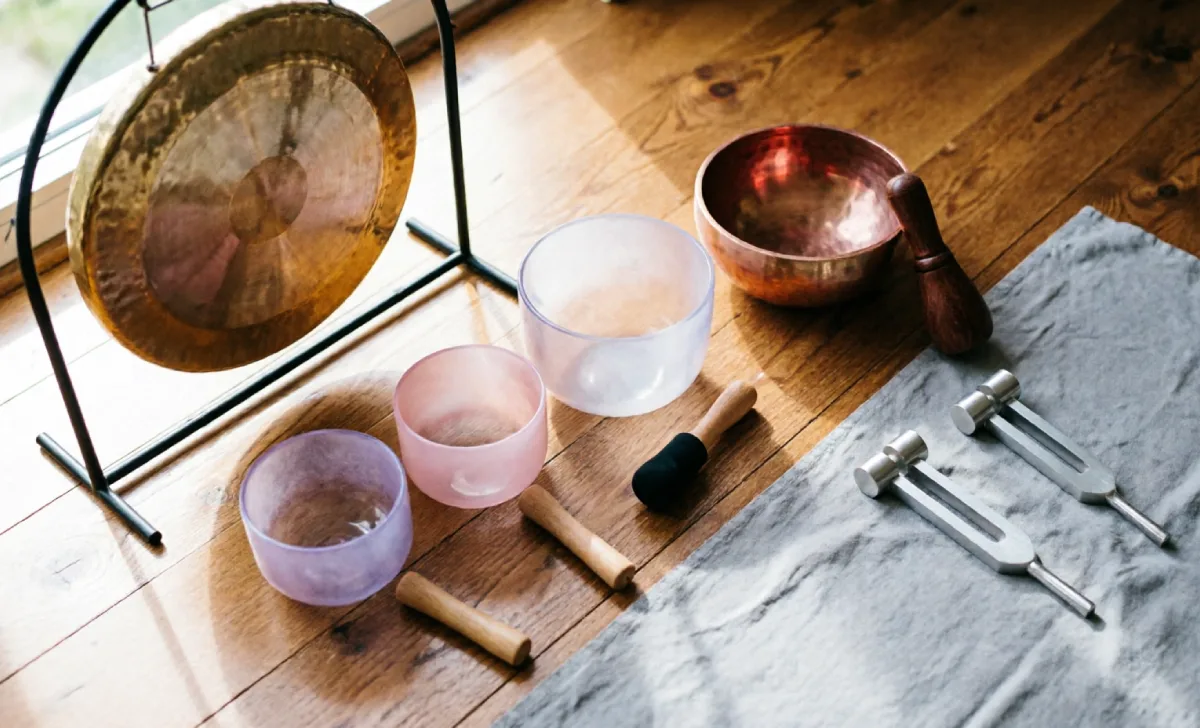
Walking into a sound healing studio can feel like entering a world of curious shapes and shimmering metals. Each instrument has a distinct personality, and knowing them helps you understand what you are hearing. The voice is the most fundamental tool, but practitioners use many others to bathe you in vibration.
The crystal singing bowl is perhaps the most recognized modern icon. Made from pure quartz, it produces a clear, penetrating tone that seems to cut through mental fog. Many people feel its focused vibration like a laser of light moving through the body. In contrast, the gong creates a vast, complex ocean of sound that floods your senses. Your brain cannot track a single melody, so it surrenders, and your mind finally goes quiet.
Other instruments have targeted uses. A weighted tuning fork placed on the body sends concentrated vibration deep into bones and joints. Tibetan singing bowls, made from a multi-metal alloy, produce a warmer, earthier tone that feels grounding. Drums and rattles speak directly to your primal body, using rhythm to entrain your heartbeat into grounded coherence.
What Should You Expect in Your First Sound Healing Session?
If you are considering booking a session, it is natural to feel a little nervous. A sound healing session, often called a sound bath, is one of the most passive practices imaginable. Your only job is to lie down, get comfortable, and listen. Think of it as a deep reset that supports your inner week-long glow up.
When you arrive, you will find a quiet, dimly lit room with mats, blankets, and bolsters. You will be invited to make a comfortable nest, often on your back with a cushion under your knees. The session begins not with a crash of sound but with a guide inviting you to close your eyes and take a few conscious breaths.
For the next forty-five to sixty minutes, you are immersed in a landscape of sound. You might feel vibrations physically hitting your body, especially from lower-pitched gongs. Your mind may wander, drift through memories, or fall into a dreamlike state. Eventually, the sounds fade to silence, and the guide gently calls you back. You will likely feel heavy, peaceful, and profoundly relaxed, so plan to take it easy afterward and drink plenty of water.
Simple Sound Healing Practices You Can Try at Home

You do not need expensive instruments to begin. The most powerful healing instrument is the one you carry everywhere: your own voice. Your voice is a direct line from your intention to your nervous system, and you can use it right now to shift your internal state.
A gentle humming practice is remarkably effective. When you take a soft breath in and produce a steady hum on a long, slow exhale, you are not just making noise. The vibration created in your throat, chest, and head directly stimulates the vagus nerve, flipping the master switch for relaxation. It is internal sound therapy that costs nothing.
Try it where you sit. Close your eyes, take a deep breath, and as you exhale, press your lips together and create a soft, steady hum like a contented bee. Feel the vibration in your lips, throat, and chest. Do this three or four times and notice if something inside feels softer or quieter. You have just sent a powerful signal of safety to your body, using only your own voice.
Frequently Asked Questions About Sound Healing
Is sound healing the same as music therapy?
No, they are distinct. Music therapy is a board-certified clinical practice where a trained therapist uses music to achieve specific goals like emotional processing or motor skill rehabilitation. Sound healing is a more passive, vibrational experience. It focuses on the direct physical effects of frequency and resonance to induce deep relaxation and balance in your nervous system and energy field.
Are there any risks or side effects with sound healing?
For most people, sound healing is very safe and gentle. Because it can release deep emotions, some people might feel unexpectedly emotional or lightheaded afterward, which is a normal part of the body letting go. It is generally recommended that people with sound-induced epilepsy or those in early pregnancy consult a practitioner and their doctor before an intense gong bath.
Do I need special equipment to try sound healing?
Absolutely not. While instruments are wonderful, the fundamental principles are available without buying a single thing. Your own voice is the most powerful self-regulation tool through humming or toning. You can also find high-quality recordings of singing bowls or binaural beats online. This same curiosity can lead you to explore other wellness questions, such as petroleum jelly safety for everyday skin care.
Conclusion
So, what you have discovered is that sound healing is not a mystical secret reserved for a few. It is a direct, physical way to communicate with your body, telling your nervous system it is safe to let go. By understanding the simple mechanics of frequency, vibration, and the vagus nerve, you now have a new tool for your wellbeing toolkit. Whether you book a full sound bath or simply hum yourself calm, you are participating in an ancient, science-backed practice of self-restoration. Your body already knows how to heal; sometimes, it just needs the right note to remember.