
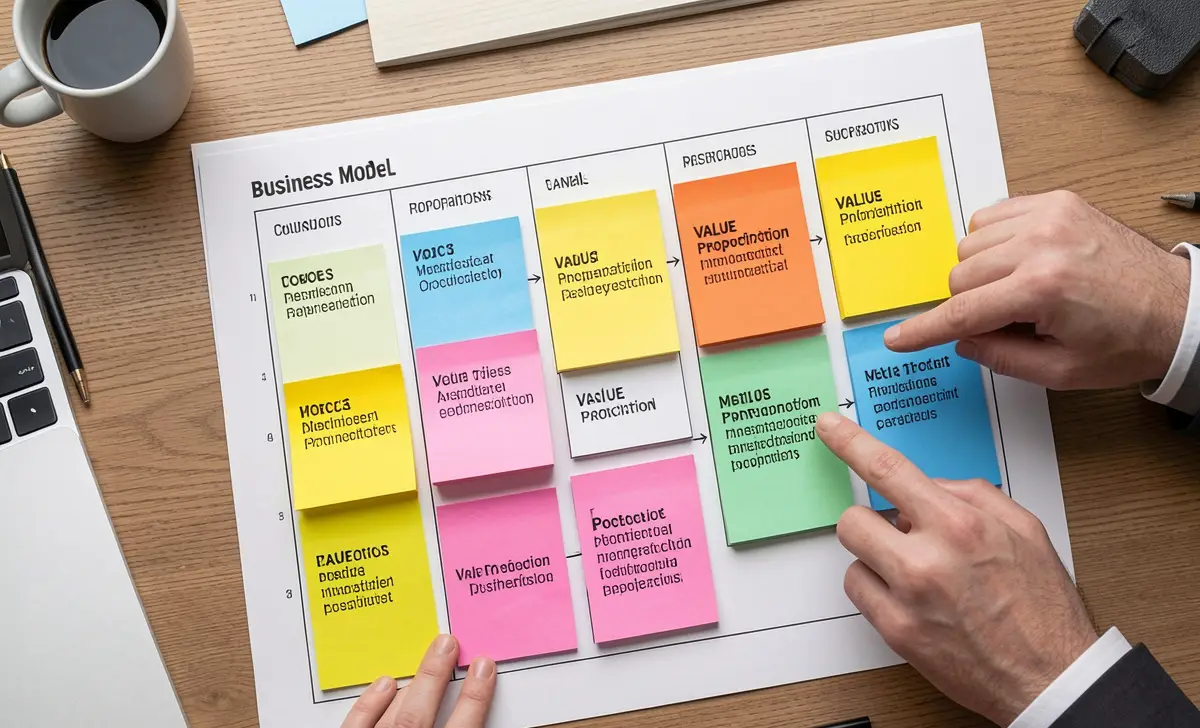
You’ve got a startup idea buzzing in your head. But when someone asks, “How does this actually make money?” your answer gets fuzzy. That gap between vision and viability? That’s exactly where business model canvas startups’ trust comes in. Before you dive deeper, make sure you’ve taken care of basics like registering your business name. No jargon, no 50-page business plan—just one page that forces clarity.
Here’s the thing: most founders skip this part. They jump straight to building. Then they wonder why customers aren’t lining up. This guide walks you through filling out your canvas without the overwhelm. And yes, we’ve included a free, editable template you can grab at the end.
What Is a Business Model Canvas? (And Why Startups Love It)
Think of the Business Model Canvas as your startup’s cheat sheet. It’s a one-page framework that maps out the nine core pieces of how your business creates, delivers, and captures value. Created by Strategyzer, it’s become the go-to for founders who need to think strategically without drowning in paperwork.
Why do startups gravitate toward it? Three reasons:
- It’s visual. You see connections instantly.
- It’s fast. You can draft a first version in 45 minutes.
- It’s flexible. Change one box, and you immediately see the ripple effects.
If you’re looking for a simple business model canvas guide for beginners, this is it. No MBA required.
The 9 Building Blocks Explained (With Startup Examples)
Let’s break down each section. I’ll pair every block with a real startup example so you can see how it works in practice.
Customer Segments: Who Are You Actually Serving?
Don’t say “everyone.” Be specific.
Example: A meal-prep startup might target “busy remote workers in Austin who value healthy lunches but hate cooking.”
Value Propositions: What Problem Do You Solve?
This isn’t your feature list. It’s the outcome your customer cares about.
Example: “Get a chef-quality lunch delivered in 10 minutes—so you can stay in flow without the 3 pm takeout guilt.”
Channels: How Do You Reach Them?
Where does your audience actually hang out? Instagram? LinkedIn? Local co-working spaces?
Example: A B2B SaaS tool might rely on LinkedIn ads + founder-led content on Twitter.
Customer Relationships: How Do You Keep Them?
Is this self-serve? Personal support? A community?
Example: A fitness app might use automated onboarding + a private Slack group for accountability.
Revenue Streams: How Do You Make Money?
Be honest here. Subscription? One-time fee? Commission?
Example: “Freemium model: free basic tracking, $9/month for advanced analytics.”
Key Activities: What Must You Do Really Well?
What’s the non-negotiable work that makes your value prop real?
Example: For a marketplace startup: “Vet and onboard high-quality service providers.”
Key Resources: What Do You Need to Pull This Off?
People, tech, IP, capital—what’s essential?
Example: “A lightweight mobile app + a small team of community moderators.”
Key Partnerships: Who Can Help You Scale Faster?
Who already has your audience? Who can fill your gaps?
Example: A sustainable fashion brand might partner with eco-influencers for authentic reach.
Cost Structure: What’s It Really Going to Cost?
List your biggest expenses. Be realistic.
Example: “App development ($15K), initial marketing ($3K/month), payment processing fees.”
See how these connect? Change your customer segment, and your channels probably shift too. That’s the power of seeing it all on one page.
How to Fill Out Your Business Model Canvas: A 5-Step Process
You don’t need to nail every box on the first try. Start messy. Refine as you learn. Here’s how we’d walk through it with a new founder:
Step 1: Start with Your Customer (Not Your Product)
Grab a sticky note. Write down: “My ideal customer is __ who struggles with __.”
If you can’t finish that sentence clearly, pause. Talk to three real people first. Your canvas is only as good as your assumptions.
Step 2: Map Your Value Before Your Costs
What’s the one thing your customer would miss if you disappeared tomorrow? Write that in Value Propositions. Keep it to one sentence. If it takes a paragraph, you’re still thinking in features, not outcomes.
Step 3: Pressure-Test Your Revenue Assumptions
Ask yourself: “Would someone pull out their credit card for this today?” If the answer isn’t a confident yes, your revenue model needs tweaking. Try pricing it against a competitor—or better yet, ask potential customers directly. Once you have revenue coming in, learning cash flow forecasting becomes essential for sustainability.
Step 4: Identify Your 3 Most Critical Risks
Which boxes feel shaky? Maybe you’re assuming a partnership that doesn’t exist yet. Or your key activity requires skills you don’t have. Flag those. They become your next week’s to-do list.
Step 5: Turn Your Canvas into a 90-Day Action Plan
Pick one box to validate first. Usually, that’s Customer Segments or Value Propositions. Design a tiny experiment: a landing page, a DM to 10 target users, a prototype demo. Learn. Adjust. Repeat. With so many tasks on your plate, knowing how to prioritize tasks becomes critical.
This process works whether you’re building a tech startup or figuring out how to fill out a business model canvas for a small business like a local bakery or freelance consultancy. The framework adapts.
Business Model Canvas vs. Lean Canvas: Which Should Your Startup Use?
You might have heard of Lean Canvas. It’s a variation created by Ash Maurya, tweaked for early-stage startups. So which one should you pick?
| Business Model Canvas | Lean Canvas |
|---|---|
| Best for: Established ideas, team alignment | Best for: Pre-revenue, problem-solution fit |
| Focuses on: Full business ecosystem | Focuses on: Problem, solution, metrics, advantage |
| 9 standard blocks | Replaces some blocks with “Problem” and “Unfair Advantage.” |
Quick rule of thumb:
- If you’re still figuring out what to build → Lean Canvas
- If you know your solution and need to map how it scales → Business Model Canvas
Still unsure? Try this: sketch your idea on both. Which one feels more actionable? That’s your starter.
Free Editable Template + Workshop Ideas for Teams
Ready to build yours? We’ve put together a clean, editable Google Docs template you can duplicate and use right now. No email gate, no upsell—just grab and go.
If you’re working with a co-founder or small team, try these business model canvas workshop ideas for teams:
- The 30-Minute Sprint: Set a timer. Each person fills out one box silently. Then discuss gaps.
- Role-Play the Customer: One person acts as your target user. Others pitch the value prop. Adjust based on their reactions.
- Risk Radar: After drafting, vote on the two riskiest assumptions. Assign one experiment per person to test them this week.
Pro tip: Print your canvas on poster paper. Stick it on a wall. Update it every Friday. Watching it evolve is weirdly motivating.
Common Mistakes First-Time BMC Users Make (And How to Avoid Them)
I’ve reviewed hundreds of these with founders. Same pitfalls come up again and again:
Being too vague: “Customers: everyone” won’t cut it. Get specific or you’ll build for no one.
Fix: Add demographics, behaviors, even a name (“Marketing Mary, 32, overwhelmed by tools”).
Skipping validation: Assuming your value prop is obvious. It’s not.
Fix: Show your canvas to three target users. Ask: “Does this solve a real problem for you?”
Treating it as a one-time task: Markets change. Your canvas should too.
Fix: Schedule a 20-minute monthly review. Update one box based on new learnings.
Overcomplicating revenue: Starting with five monetization streams.
Fix: Pick one. Master it. Add complexity later.
Next Steps: Turn Your Canvas into Traction
You’ve got your first draft. Nice. Now what?
- Share it with one trusted advisor or potential customer. Ask for blunt feedback.
- Pick one experiment to test your riskiest assumption this week.
- Revisit in 14 days. What changed? What surprised you?
If you’re building an online business or a solopreneur’s venture, remember: your canvas can be leaner. Focus on Value, Customer, Channels, and Revenue first. The rest can wait. Once your model is solid, you might need to reduce operational costs to stretch your runway further.
And if you want to go deeper on validating your assumptions, we’ve got a follow-up guide that walks you through running cheap, fast tests.
FAQs
How long should it take to complete my first Business Model Canvas?
Aim for 45–60 minutes for a rough draft. Don’t overthink it—you’ll refine as you learn.
Can I use this for a side hustle or solo project?
Absolutely. In fact, it’s perfect for solopreneurs. Just focus on the four core boxes first: Customer, Value, Channels, Revenue.
Do I need special software?
Nope. Pen and paper work great. If you want digital, our free Google Docs template or tools like Miro are solid options.
What if my idea changes halfway through?
That’s the point. The canvas is meant to evolve. Update it as you get new information—that’s how you avoid building the wrong thing.