
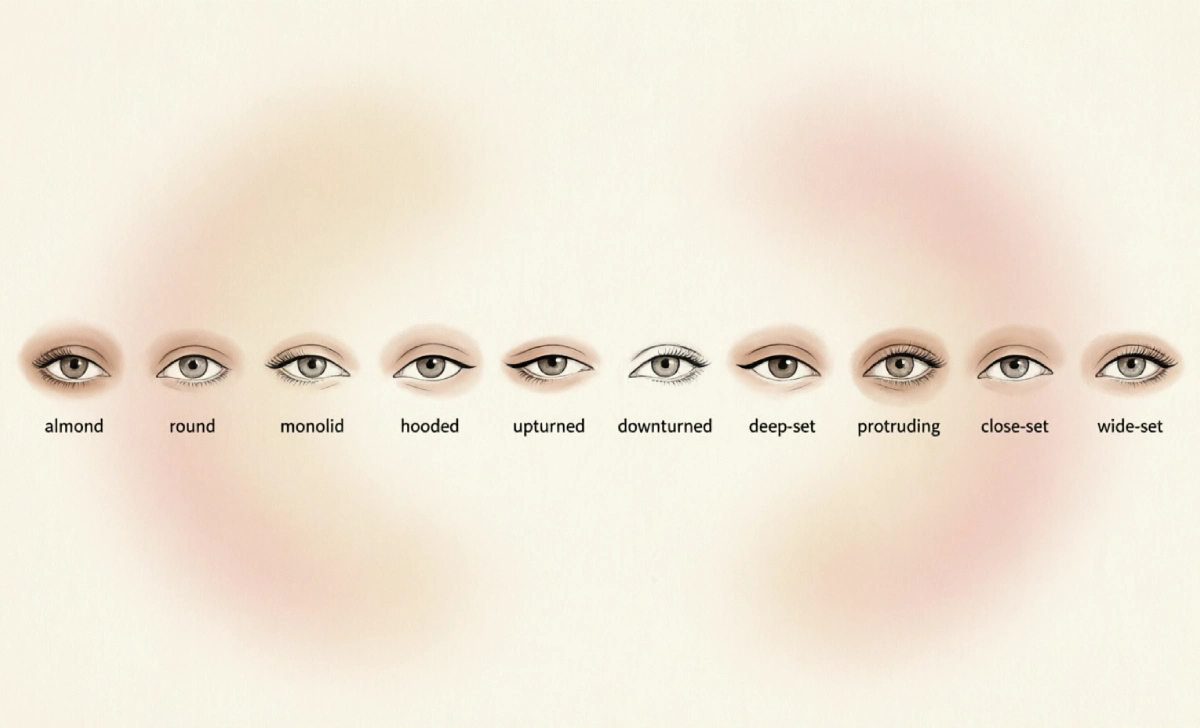
Ever followed a makeup tutorial exactly, only to wonder why it looked nothing like yours? The answer usually comes down to eye shape. Your eyelid fold, the angle of your outer corners, and the condition of your under-eye skin all decide where liner should flick and how shadow should blend.
Most people never learn their eye shape’s name, so they keep using techniques built for someone else’s face. This guide names the different eye shapes, helps you spot your own in a mirror, and gives you makeup tricks built for your actual structure. Let’s find your shape first.
How Can I Accurately Determine My Eye Shape?

Stand in front of a mirror in natural light and relax your face. You’re looking for three clues: crease, corner angle, and spacing.
Start with the crease. A visible fold above the lash line, with little or no skin draping over it, points toward almond, round, or upturned eyes. No visible fold, or one that vanishes when your eyes are open, usually means hooded or monolid. How you shape your eyebrows can also shift how open or hooded your eyes look, so keep brows in mind too.
Next, trace an imaginary line from the inner to the outer corner of one eye. An upward tilt signals upturned eyes; a downward dip signals downturned; a level line means neither.
Finally, check the space between your eyes. If an imaginary third eye fits comfortably in that gap, you’re wide-set; if it barely fits, you’re close-set. Put these three observations together and your dominant shape becomes clear.
What Are the Different Eye Shape Names and Their Key Characteristics?
Almond eyes are the benchmark: a visible crease, tapered outer corner, and a slight natural lift that suits almost any technique. Round eyes show more visible white below the iris, with a well-defined crease that gives an open, wide look.
Monolid eyes have a smooth, uninterrupted lid from lash line to brow bone, which makes them ideal for gradient shadow. Hooded eyes hide their crease under a fold of skin, giving a sultry look but complicating eyeliner; Taylor Swift is often cited as an example.
Upturned eyes lift naturally at the outer corners, creating a built-in cat-eye. Downturned eyes dip slightly there instead, giving a soft, kind expression.
Deep-set eyes sit further back in the socket, so the brow bone reads more prominent — Blake Lively has this shape, and brightening the lid helps. Protruding eyes project forward with more visible lid surface. Close-set eyes sit closer than one eye-width apart, while wide-set eyes leave more than that. None of these shapes needs fixing — each just responds to a different technique.
Almond, Hooded, and Monolid Eyes: Makeup Techniques That Truly Work
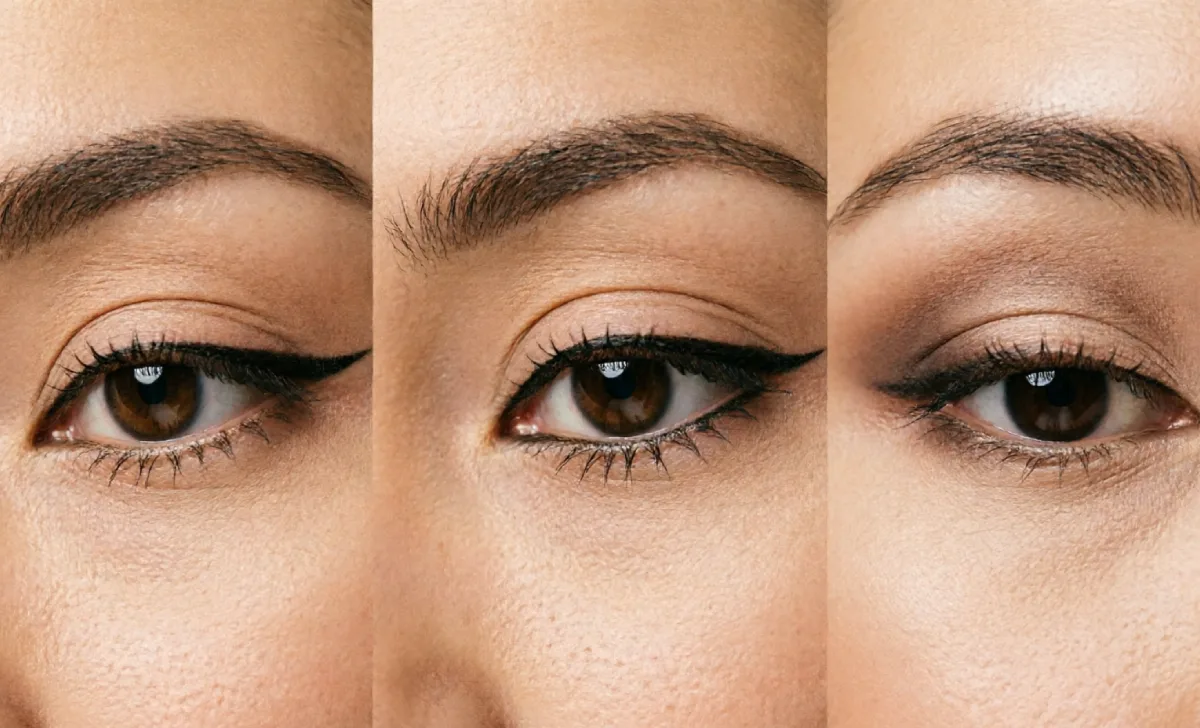
Almond eyes are the most forgiving shape. A classic winged liner along your lower lash line highlights their natural symmetry, and nearly any shadow placement works.
Hooded eyes need a workaround. Build a new crease slightly above your natural fold using matte shadow, since color placed directly in the fold disappears. Tightlining the upper waterline saves lid space, and shimmer belongs only at the center of the lid for a lifting effect. Maybelline’s long-wear gel liner holds up well here because it resists transfer.
Monolid eyes suit gradient placement best. Press your darkest shade at the lash line and blend it upward until it fades. A thin liquid liner works better than a thick one, and curled lashes with volumizing mascara open the eye without forcing a crease that isn’t there.
Round, Upturned, and Downturned Eyes: Shape-Specific Makeup Strategies
To elongate round eyes, extend shadow past the outer corner in a soft wing rather than circling the whole eye with liner — full circles tend to emphasize roundness instead of softening it.
Upturned eyes already have lift, so balance matters more than drama. A touch of shadow along the outer third of the lower lash line keeps the shape grounded while still allowing bold lid colors.
Downturned eyes respond well to a specific liner trick: keep the line thin at the inner corner, then flick it upward at roughly 45 degrees just before the eye ends. Pair this with a transition shade angled the same way for a seamless lift.
Deep-Set, Protruding, Close-Set, and Wide-Set Eyes: Corrective and Enhancing Makeup
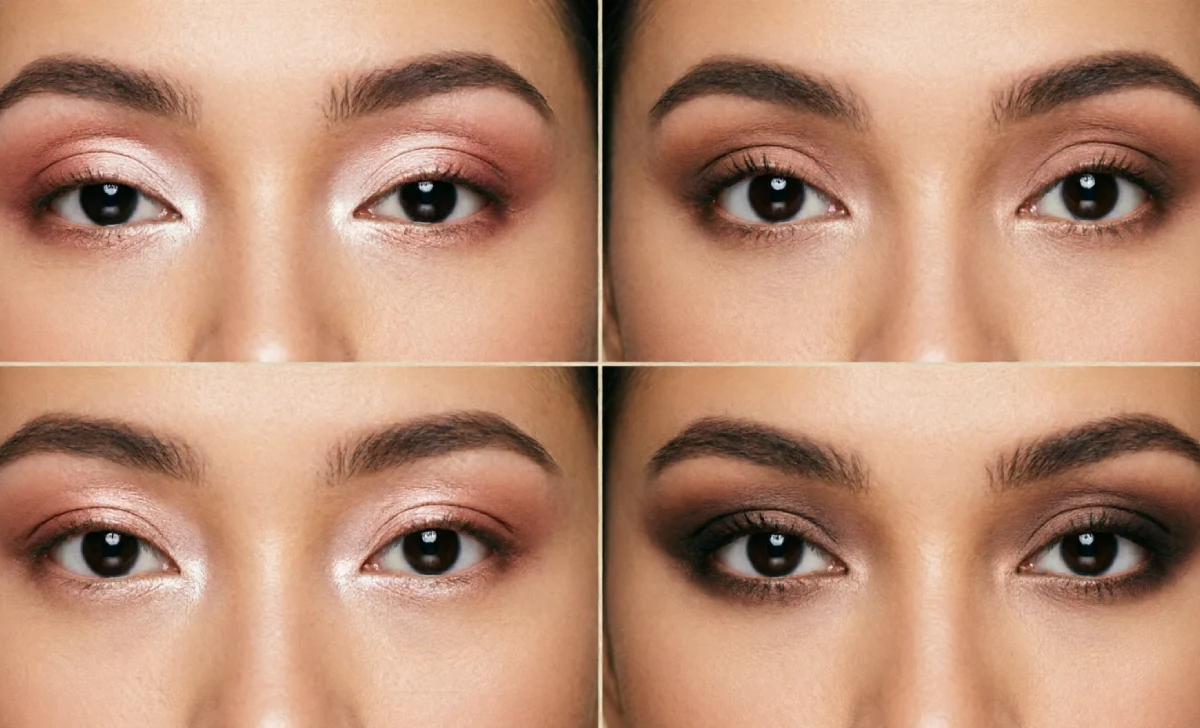
For deep-set eyes, sweep light shimmer across the mobile lid and keep crease color soft — heavy dark shadow only pushes the eye further back. A nude waterline liner keeps the whole look open.
Protruding eyes benefit from matte, medium-toned shadow across the lid to visually recede the surface, with highlighter reserved for the brow bone to draw the eye upward.
Close-set eyes widen with a light, reflective shade at the inner corner and depth kept to the outer half only; wing liner from the mid-point rather than the inner corner. Wide-set eyes need the opposite approach: extend your brows slightly inward, deepen shadow near the inner crease, and line the inner corners to close the gap visually.
What Are the Best Products for Every Eye Shape?
Tubing mascara is worth seeking out for hooded or deep-set eyes, since it wraps lashes in a polymer that won’t smudge onto skin. L’Oréal and MAC both make reliable versions.
Monolid and downturned eyes benefit from a fine-tip liquid liner for precise control, while protruding or oily lids need a primer to stop pigment from creasing or fading by midday.
Close-set eyes can use a shimmering brightening pen at the inner corner, and wide-set eyes pair well with a soft kohl pencil along the inner lash line to narrow the gap.
How Can I Adjust My Eye Makeup as I Age?
Eye shape shifts naturally with age. Reduced skin elasticity can soften a crease or add a slight droop, turning an almond eye more hooded over time — a normal change your makeup can adapt to.
Creamy shadow formulas glide better over texture than powders, and a hydrating primer prevents settling into fine lines. Matte shadow on the lid, paired with light shimmer just beneath the brow, restores a subtle lift.
Common Eye Shape Mistakes and How to Avoid Them
Heavy liner across the full upper lash line is the most common hooded-eye mistake; it eats lid space and shrinks the eye visually. Tightlining plus a thin outer flick fixes this without extra product.
Deep-set eyes suffer when dark shadow gets packed into the crease, since it pushes the eye further inward. Wide-set eyes look more spaced when the inner corner is over-highlighted. And round eyes lose their open quality when liner circles the entire eye instead of stopping short at the inner corner.
Frequently Asked Questions About Eye Shapes
Which eye shape is considered the most attractive?
No single shape wins across cultures or eras. Confidence and well-applied makeup outshine any specific shape.
Can your eye shape change as you grow older?
Yes. Skin laxity can deepen a hood or soften a crease over time, and makeup techniques can adjust right alongside it.
What is the difference between hooded eyes and monolid eyes?
Hooded eyes have a crease hidden under a skin fold; monolid eyes have no crease fold at all. Closing your eyes and checking for any visible line is the quickest way to tell them apart.
How can I make my eyes look more symmetrical with makeup?
Slight asymmetry is normal. A marginally thicker line and longer wing on the smaller-looking eye, plus a touch more shadow on its crease, evens things out.
Conclusion
You arrived unsure of your eye shape — now you can name it, spot it in a mirror, and apply techniques built specifically for it, right down to how you grow your lashes to finish the look.
No eye shape needs fixing. Every technique here simply works with what you already have, so pick up your liner and start practicing on the shape that’s yours.