
You eat well, sleep most nights, and squeeze in workouts. But something still feels off — a quiet emptiness you cannot quite name. That gap between doing the right things and feeling truly whole is exactly where the 7 dimensions of wellness come in.
True wellness is not just about your body. The National Wellness Institute has long taught that well-being covers your emotions, your mind, your relationships, your sense of purpose, and more. When you look at the full wellness wheel, everything becomes clearer. By the end of this guide, you will know what each dimension means, how they connect, and where to take your first small step.
What Exactly Are the 7 Dimensions of Wellness?
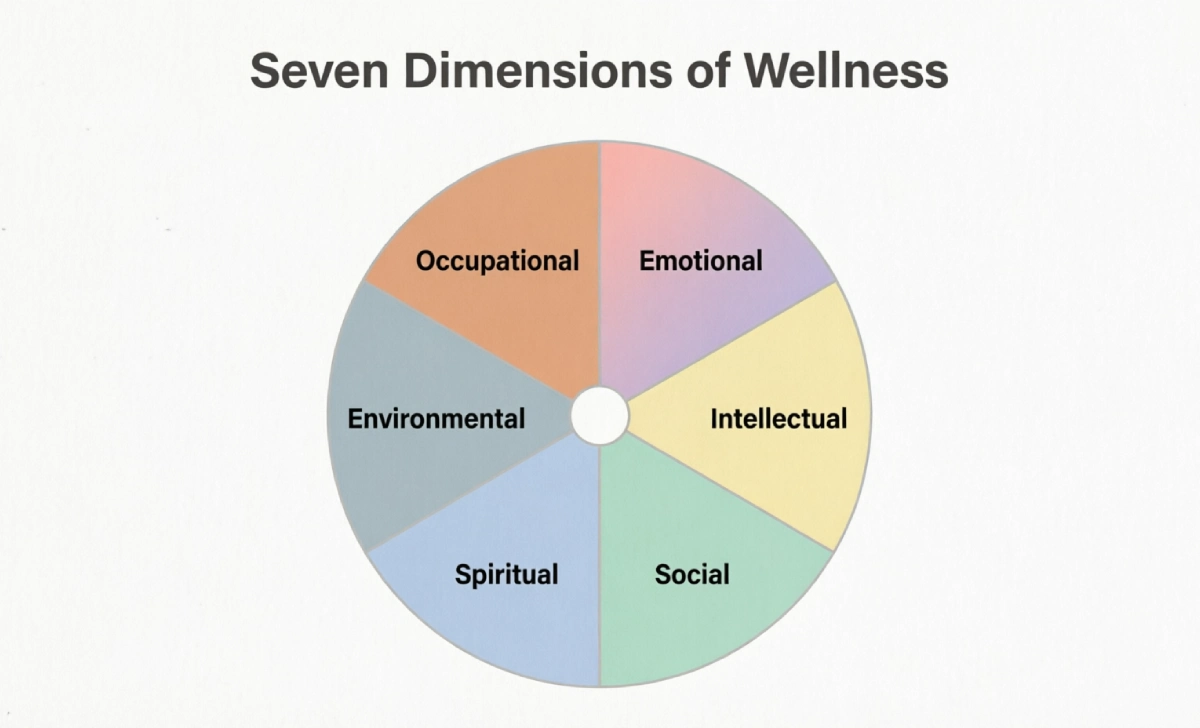
The 7 dimensions of wellness break well-being into seven connected areas of life. Think of them like sections of a wellness wheel — when every section is reasonably full, the wheel rolls smoothly. When one section is flat, the whole ride gets bumpy in ways you might not expect.
The seven dimensions are:
- Physical Wellness
- Emotional Wellness
- Intellectual Wellness
- Social Wellness
- Spiritual Wellness
- Environmental Wellness
- Occupational Wellness
Wellness, in this view, is an active process of making choices toward a more fulfilling life — not just avoiding illness.
1. Physical Wellness: Building Your Body’s Foundation

Physical wellness goes far beyond hitting the gym. It is about listening to your body and giving it consistent, everyday care — enough rest, proper hydration, nourishing food, and regular check-ups.
What most people miss is how physical neglect shows up quietly. You feel irritable more often, struggle to focus, or take longer to recover from a cold. The good news is that small changes add up fast. A ten-minute walk or going to bed twenty minutes earlier can start shifting things almost immediately.
2. How Can You Nurture Your Emotional Wellness Every Day?
Emotional wellness is not about being happy all the time. It is about feeling your emotions, understanding them, and healthily managing them. Many people push through stress for weeks, then suddenly snap at someone they love or feel completely numb.
Building this dimension starts with something simple: noticing how you actually feel. Journaling for a few minutes, talking to a trusted friend, or spending quiet time alone can strengthen your emotional core. When you consistently acknowledge your inner world instead of ignoring it, you build a steadiness that holds you up when life gets hard.
3. Intellectual Wellness: Keeping Your Mind Sharp and Curious

Intellectual wellness is not about being book-smart or academically accomplished. It is about staying curious and mentally active in whatever way feels natural to you. A stimulated mind asks questions, tries new things, and lets itself be a beginner again.
Neglecting this dimension makes life feel flat and repetitive. The fix does not require huge time. Listening to a podcast on an unfamiliar topic, trying a new recipe, or having a conversation with someone whose views differ from yours can wake up your mind in the best possible way.
4. What Does Social Wellness Look Like in a Connected World?
You can have hundreds of online connections and still feel deeply alone. Social wellness is not about being the most popular person — it is about having relationships that feel real, supportive, and nourishing. Quality always beats quantity here.
If you have been feeling isolated, social wellness is something you can rebuild step by step. Send a message to someone you have been thinking about. Accept an invitation you would normally decline. Even a brief, genuine exchange with a neighbor can remind you that you are part of something larger than yourself.
5. Is Spiritual Wellness Only About Religion?

The answer is a clear no. Spiritual wellness is not limited to organized religion. At its core, it is about having a sense of purpose, a set of values, and a feeling of inner peace that does not depend on outside circumstances.
You might find it through meditation, quiet reflection, walks in nature, or service to others. Without spiritual wellness, it is easy to feel adrift — chasing achievements that never fill the emptiness you hoped they would. Following simple healthy habits that bring calm and intention to your day can be a meaningful entry point into this dimension.
6. Environmental Wellness: The Space Around You Matters
You walk into a cluttered room after a long day and feel your shoulders tighten. You sit in a space filled with natural light, and your mood lifts immediately. Your surroundings shape how you feel more than you might realize.
Environmental wellness means the spaces around you support your health rather than drain it. You do not need to redesign your entire home. Clear one surface that has been stressing you out. Open a window. Add a plant or a warmer lamp. Small adjustments can create a calm that ripples into every other part of your life.
7. Why Occupational Wellness Matters Even If You Don’t Love Your Job
Not everyone wakes up excited to go to work — and that is okay to admit. Occupational wellness is not about landing your dream job tomorrow. It is about finding meaning, balance, and a sense of growth in whatever work you do, whether paid or unpaid.
When this dimension is neglected, you feel stuck, resentful, or permanently exhausted — and that strain spills into your relationships and health. Small shifts help. Set a firm logout time to protect your evenings. Have an honest conversation about your workload. Look for one small skill to learn that opens a new door.
How All 7 Dimensions Work Together to Shape Your Well-Being
None of the 7 dimensions of wellness operates alone. They form a web, and a change in one area sends ripples through the others. Imagine someone deeply unhappy at work. Over time, that dissatisfaction eats into their emotional wellness. Their social life suffers. Sleep gets disrupted. Energy for physical activity disappears — all from one neglected dimension.
The beauty is that this works in reverse, too. When you start moving your body regularly, your mood improves. That emotional lift makes you more patient with loved ones, which strengthens your social bonds. Every small positive step is never just about that one area — you are always nurturing a larger ecosystem within yourself.
How Can You Start Balancing the 7 Dimensions Today?
You do not need to fix everything at once. Simply notice which dimension feels the quietest right now and ask yourself: where do I feel most out of balance?
Then pick one tiny action. If your social wellness feels low, send one text. If your body has been neglected, even a simple DIY body scrub can be a meaningful act of self-care that reconnects you with your physical wellness. The size of the action matters far less than the message it sends to yourself — that your well-being is worth investing in.
Frequently Asked Questions About the 7 Dimensions of Wellness
Who developed the 7 dimensions of wellness model?
The concept evolved from work by the National Wellness Institute and Dr. Bill Hettler, who originally proposed six dimensions. Over time, other organizations expanded the model to seven dimensions, with variations seen in university wellness programs worldwide.
How is this different from SAMHSA’s 8 dimensions of wellness?
SAMHSA’s model adds a financial dimension and is used in recovery and behavioral health contexts. The 7-dimensions model focuses on general life balance, making it a helpful starting point for anyone exploring holistic wellness without a clinical framework.
Can you work on more than one dimension at the same time?
Absolutely. Many actions naturally support multiple dimensions at once. Going for a walk with a friend benefits your physical, social, and emotional wellness simultaneously. The dimensions are interconnected by design.
What is the most commonly neglected dimension?
Emotional and spiritual wellness tend to be the most neglected because they are less visible and easier to push aside. People prioritize urgent work or physical demands while postponing quieter inner work — not realizing how much those neglected areas shape overall life satisfaction.
Conclusion
Wellness is not a finish line you cross. It is a living practice of paying attention to all the parts of you that matter. The 7 dimensions of wellness give you a map, not a test. Pick one gentle step forward today, and let that be enough.