

You’ve spent hours writing a post. You’ve optimized the keywords, formatted the headers, and finally hit publish. A week later, you check Search Console and realize something’s off. You’re getting impressions, but barely any clicks. Sound familiar? If you’re dealing with a sudden drop in organic search traffic, that’s often the first warning sign your CTR needs attention.
That’s exactly why understanding your click-through rate matters. If you’re wondering what makes a good CTR organic search, you’re asking the right question. The truth is, there’s no single magic number that works for everyone. But I’ll show you exactly what to aim for, why your numbers might be lagging, and how to fix them without rewriting your entire blog. One thing to remember: not every metric deserves your attention—learn which SEO metrics to ignore so you focus on what actually moves the needle.
What Is Click-Through Rate (CTR) in SEO?
CTR is just the percentage of people who see your link in search results and actually click on it. It’s a simple ratio that tells you how appealing your search snippet is compared to everything else on the page.
How to Calculate CTR for SEO
The math is straightforward. You take your total clicks, divide them by your total impressions, and multiply by 100.
So if your article shows up 2,000 times in Google and gets 60 clicks, your CTR is 3%. Most tracking tools do this automatically now, but knowing the formula helps you spot weird data spikes before they panic you.
Here’s the thing: CTR isn’t just a vanity metric. Even if Google doesn’t use it as a direct ranking signal, a higher CTR means more real traffic, more engaged readers, and better chances of earning backlinks or shares. It’s the bridge between ranking and actually getting visitors.
What Is a Good CTR for Organic Search? Benchmarks by Position
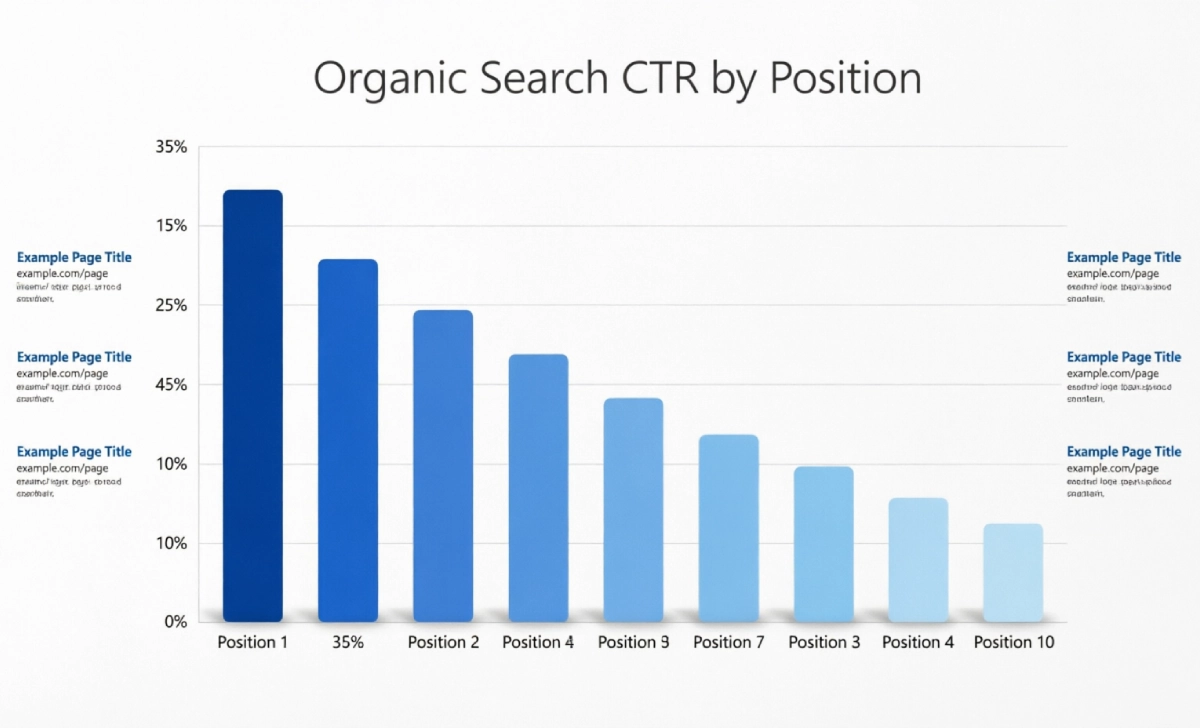
Let’s cut straight to the numbers. Realistic expectations change depending on where you sit in the results. Based on recent industry tracking, here’s what average organic CTR looks like right now:
| Position | Typical CTR Range |
|---|---|
| #1 | 25–35% |
| #2 | 12–18% |
| #3 | 8–12% |
| #4–5 | 4–7% |
| #6–10 | 2–4% |
These aren’t hard rules. They’re just baselines. Your actual target shifts based on search intent, niche, and what Google decides to show above your link. If you’re selling software, you’ll likely see lower CTRs than a lifestyle blog. If an AI Overview or shopping carousel sits above you, expect your clicks to drop even if you rank #1.
Instead of chasing a perfect percentage, ask yourself: Is my CTR matching what others in my position typically get? If you’re at #3 but pulling 4%, something in your snippet isn’t resonating.
Why Is My SEO CTR Low? 5 Common Causes & Fixes
You’ve probably noticed your competitors ranking below you, still pulling more clicks. It’s frustrating, but it’s usually fixable. Most low-CTR problems come down to these:
Your title is vague or passive
“SEO Tips for Beginners” tells me nothing. “7 SEO Mistakes That Quietly Kill Your Traffic” makes me want to click.
Your meta description reads like a summary, not a hook
If you’re just repeating the title or listing random keywords, readers scroll past. Give them a reason to click. What will they learn? What problem gets solved?
You’re targeting the wrong intent
If someone searches “buy running shoes” and your post is “how to clean old sneakers,” they won’t click. Google shows you, but readers ignore you because you’re solving the wrong problem.
Your result gets buried by SERP features
Featured snippets, “People Also Ask” boxes, and video carousels steal attention. If you can’t outrank them, optimize your snippet to stand out anyway.
Your page feels outdated
A title that says “Best Tools for 2022” screams stale. Add a current year or refresh the angle to signal relevance.
Truth is, you don’t need a full content overhaul to fix this. Start with your title and meta description. Test small changes, track the results, and iterate. Understanding the core blog post ranking factors helps you prioritize what to optimize first.
Does CTR Affect Google Rankings in 2026? The Truth
You’ve seen the headlines. Some say CTR is a massive ranking factor. Others quote Google saying it’s completely ignored. So which is it?
Google’s official stance is clear: they don’t use raw CTR as a direct ranking signal because it’s too easy to manipulate and too noisy to rely on. Makes sense.
But correlation still matters. Pages that get more clicks usually keep readers longer, reduce bounce rates, and earn more engagement signals. Google’s algorithms pick up on those behavioral patterns. So while CTR itself might not directly push you up the rankings, the user behavior it drives absolutely does.
When you’re optimizing for clicks, it helps to understand which signals actually move the needle. Not every metric deserves your attention—learn which SEO metrics to ignore so you focus on what actually moves the needle.
How Does CTR Affect SEO Rankings Over Time?
You might be thinking, if it’s not a direct factor, why bother? Because CTR acts as a feedback loop. When more people click, Google sees that your result satisfies the query. Over time, that consistency can nudge your average position upward.
It also protects you. High CTR pages tend to survive algorithm updates better because they’ve already proven they match user intent. If your CTR drops suddenly after an update, it’s usually a sign that your content no longer aligns with what searchers expect.
Tracking this metric gives you an early warning system. You’ll know when to tweak, when to rewrite, and when to leave well enough alone.
Quick Wins: 5 Tactics to Improve CTR Without Rewriting Content
You don’t always need a full content refresh to boost clicks. Sometimes, small adjustments move the needle faster than you’d expect.
1. Add brackets or parentheses to titles
“[2026 Updated]” or “(Step-by-Step Guide)” sets clear expectations. Readers know exactly what they’re clicking into.
2. Front-load your strongest words
Put the benefit first. “Fix Low CTR in 10 Minutes” beats “10 Minutes to Fix Low CTR” when people are scanning.
3. Test two different meta descriptions
Write one focused on the outcome, another focused on curiosity. Swap them every few weeks and check Search Console for shifts.
4. Use structured data for rich results
FAQ schema, how-to markup, or review stars can make your listing visually pop. More eye contact in the SERPs = more clicks.
5. Match your title to the exact query
If people search “why is my CTR dropping,” include that exact phrase early in your title. Relevance builds instant trust.
The 5-Minute CTR Diagnostic Framework
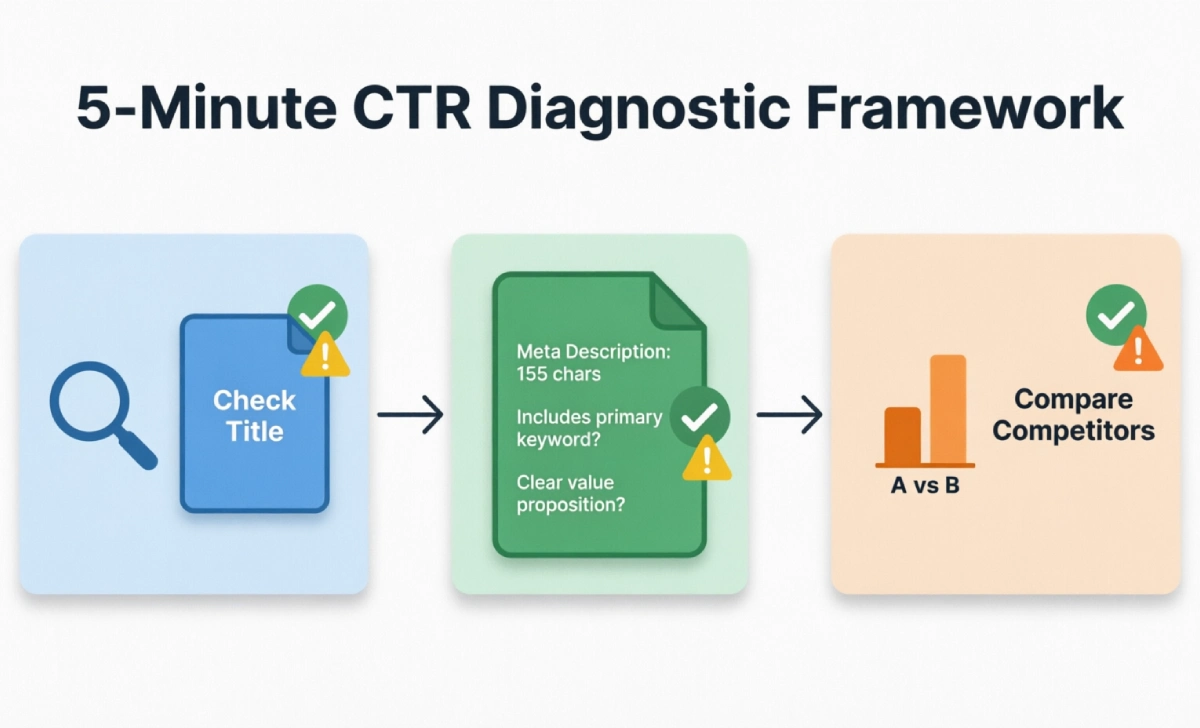
Most guides skip the part that actually matters: figuring out why your specific page isn’t getting clicks. Here’s a simple flow you can run through right now:
- Check your title. Does it promise a clear outcome or spark curiosity? If it’s vague, rewrite it using one of the tactics above.
- Read your meta description aloud. Does it answer “what’s in it for me?” If it sounds like a textbook summary, make it conversational and specific.
- Compare your page to the top 3 results. What are they doing differently? Better formatting? More recent data? Stronger hook? Match their clarity without copying their exact words.
Start with step one. Give it two weeks. If clicks don’t budge, move to step two. Still stuck? Your content angle might need a fresh spin. It’s not about perfection. It’s about testing, tracking, and adjusting.
FAQs
What’s a realistic CTR goal for a new blog?
Aim for the average of your current position first. If you’re ranking #6–10, a 2–4% CTR is completely normal. Focus on moving up one spot before stressing over percentages.
Should I rewrite old posts with low CTR?
Not always. Start with the title and meta description. If those tweaks don’t help after a month, then update the content itself—especially if the data or examples are outdated.
Does mobile CTR matter as much as desktop?
Yes. Most searches happen on phones now. If your title gets cut off or your page loads slowly on mobile, you’re losing clicks before anyone even reads your content.
How long before I see CTR improvements?
Give changes 2–4 weeks to register in Search Console. SEO moves slowly, but snippet tweaks usually show results faster than full content rewrites.
Conclusion
If your click-through rate feels stuck, pick one underperforming post. Tweak the title. Watch what happens. Real progress comes from small, consistent adjustments, not overnight overhauls. And if you need a roadmap to recover traffic after the update, start with these proven recovery steps.