

In this article
Few athletes in American sports history earned more and kept less than Evander Holyfield. The man who beat Mike Tyson — twice — collected an estimated $230 million in fight purses across a career that spanned three decades. Yet as of 2026, Evander Holyfield’s net worth is estimated at somewhere between $500,000 and $1 million. That gap between what he earned and what he has left tells one of the most striking financial stories in boxing history.
Evander Holyfield Net Worth
As of 2026, his net worth is estimated at roughly $500,000 to $1 million. That figure comes with a significant caveat: years of tax problems, multiple divorces, and support obligations for 11 children mean his liabilities have at times weighed heavily against his remaining assets, and no exact figure has ever been disclosed.
This is not a story of modest earnings. Holyfield’s peak purses placed him among the highest-paid athletes of the 1990s, and in 2012 The Independent described him as effectively broke despite career earnings of about £350 million. The decline was driven by extreme spending, a large family across several relationships, costly divorces, and business ventures that never replaced his boxing income.
His Fayetteville, Georgia mansion — a 54,000-square-foot, 109-room estate built for around $10 million — became the clearest symbol of that decline. It first faced foreclosure in 2008 and was sold at a foreclosure auction for $7.5 million in 2012; rapper Rick Ross later bought the property. Since then, Holyfield has not held any comparable real estate or business assets.
Main Income Sources
Holyfield’s income came from several directions across his career, though fight purses dominated everything else by a wide margin.
His primary earnings came from professional boxing during the heavyweight golden era of the 1990s, when pay-per-view revenue shares pushed the biggest purses into eight figures. During his active years, endorsements and sponsorships added supplemental income, though these faded quickly once his title days were over.
His post-boxing income is much smaller but has not disappeared. He finished fifth on the first season of Dancing with the Stars in 2005 and was the first housemate evicted from Celebrity Big Brother in the UK in 2014. His 2008 autobiography, Becoming Holyfield, produced a book deal, and in 2007 he launched the Real Deal Grill, a kitchen appliance line. As of 2019, he was reported to earn around $1.2 million a year, mostly from personal appearances — a respectable income, but nothing close to what he once made in a single night.
Today, appearance fees, name licensing, and his work as a boxing adviser to Chinese heavyweight Zhang Zhilei appear to be his most consistent revenue sources. There is no publicly confirmed business generating major recurring income.
Career Highlights
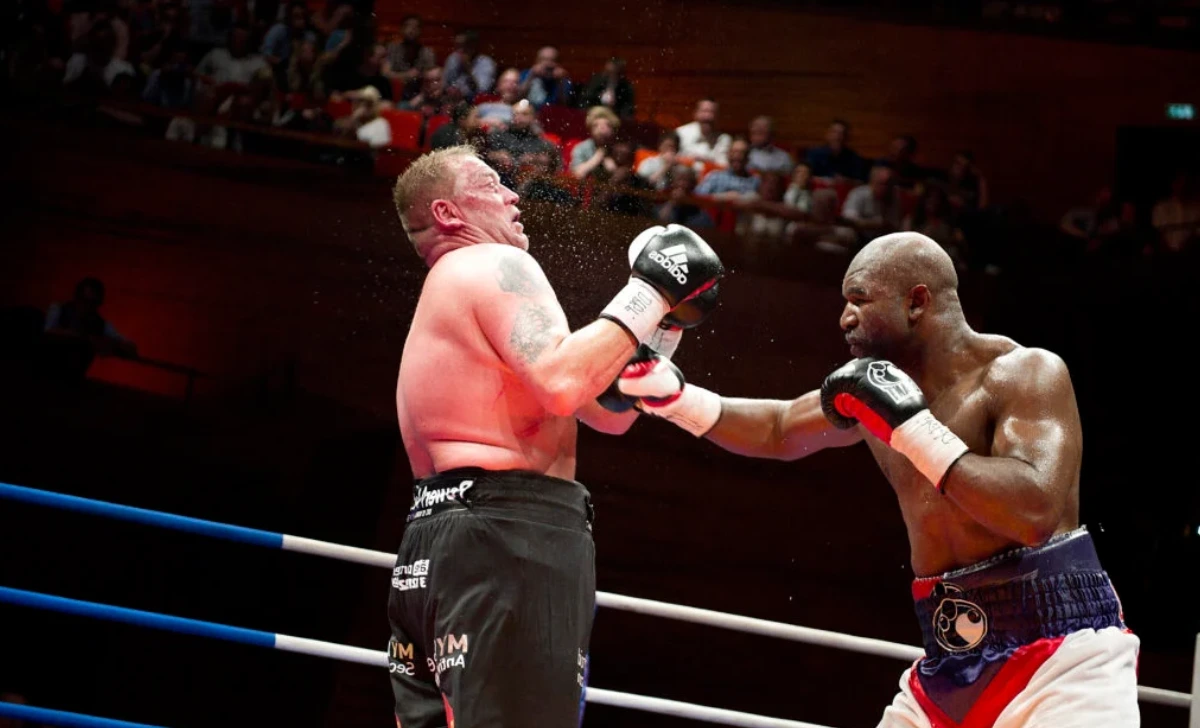
Holyfield turned professional after winning a bronze medal in the light heavyweight division at the 1984 Los Angeles Olympics, following a disputed semifinal disqualification. He won the WBA cruiserweight title in 1986, added the IBF belt in 1987, and became undisputed cruiserweight champion in 1988 by beating Carlos De León.
Moving up, he knocked out Buster Douglas in 1990 to become undisputed heavyweight champion, setting the stage for the most lucrative decade of his career. His 1991 defense against George Foreman paid him about $20 million. The Riddick Bowe trilogy from 1992 to 1995 generated multi-million-dollar purses across all three bouts.
The two Tyson fights defined his financial peak. For their first meeting in November 1996, Holyfield was the underdog and was paid about $11 million to Tyson’s roughly $30 million — then won by 11th-round TKO. That victory flipped the economics: for the June 1997 rematch, the infamous “Bite Fight” that ended with Tyson disqualified, Holyfield earned $35 million to Tyson’s $30 million. The 1999 unification bout against Lennox Lewis, which ended in a controversial draw, added a $20 million purse.
In 2000, by beating John Ruiz for the vacant WBA title, Holyfield became the first boxer to win a version of the heavyweight championship four separate times. For a look at how other athletes turned peak earning years into longer-term income, see Mike Alstott’s life after the NFL.
Major Success Factors
Holyfield’s ability to command massive purses was not accidental. His conditioning and durability were exceptional, allowing him to compete at the elite level from the mid-1980s into the 2000s — an unusually long window that kept him available for high-value rematches and unification fights.
The “Real Deal” brand worked because it reflected reality. Holyfield trained obsessively and projected a disciplined, faith-driven public image attractive to sponsors and broadcasters. When Tyson’s personal life generated constant negative headlines, Holyfield’s reputation made him the preferred alternative for brands and networks.
His willingness to fight the best opponents — repeatedly — also mattered financially. The Bowe trilogy, the Tyson fights, and the Foreman and Lewis bouts were all high-risk matchups that lesser champions avoided. Each generated maximum pay-per-view interest because the outcomes were genuinely uncertain, which translated directly into bigger gates and larger revenue shares.
Assets and Business Ventures

At his peak, Holyfield’s asset base was substantial. The Fayetteville estate, with 109 rooms across 54,000 square feet, was one of the largest private homes in America, complete with a bowling alley, movie theater, and Olympic-size pool. Luxury cars and jewelry rounded out the portfolio.
On the business side, he founded Real Deal Records and built a promotional company under his “Real Deal” brand, and his name appeared on the Real Deal Grill. None of these generated income at a scale that could substitute for boxing revenue.
His later years have been marked by smaller paydays. After a final run of fights in his 40s, he formally retired in 2014. In September 2021, at 58, he returned for an exhibition against former UFC champion Vitor Belfort, which ended in a first-round technical knockout loss and was widely seen as driven more by money than competition. His family remains tied to sport: his son Elijah, a former NFL running back, has joined WWE, and his son Evan is a professional boxer.
Financial Growth and Collapse
Holyfield’s financial trajectory moved steadily upward through the 1990s. Purses grew with each high-profile matchup, pay-per-view deals improved, and his mainstream appeal gave him commercial value that extended past his athletic prime. The foundation looked solid from the outside.
The collapse came from multiple directions at once. Three divorces drained significant assets, and supporting 11 children across several relationships became a persistent legal and financial burden, with courts ordering ongoing child support payments. Tax problems added to the pressure. The foreclosure of the Georgia mansion made his difficulties public, and the sale of cars, jewelry, and other assets followed.
Rather than a single bad decision, his story is one of spending that assumed the next big purse would always arrive — until his age made that impossible. By the time he stopped fighting, the earning engine that had produced tens of millions per fight was gone.
Conclusion
Evander Holyfield’s net worth in 2026 reflects what happens when extraordinary career earnings meet unchecked spending, multiple legal obligations, and little long-term financial planning. He earned an estimated $230 million in fight purses before taxes, promoter cuts, and expenses — and retained only a small fraction of it.
What remains is an estimated $500,000 to $1 million, supported by appearance income and his name’s lasting appeal. His boxing legacy as the only four-time heavyweight champion and an Olympic medalist is permanent; his finances are a cautionary tale. For another athlete’s post-career story, explore Jordan Cameron’s net worth.
Disclaimer: The net worth figures mentioned are based on publicly available information, industry reports, and reliable estimates. In some cases, additional insights or updates may be considered where available. Although we aim to keep the data as accurate and current as possible, these figures should still be viewed as estimates rather than exact financial records. We always appreciate corrections or updated information from reliable sources.